
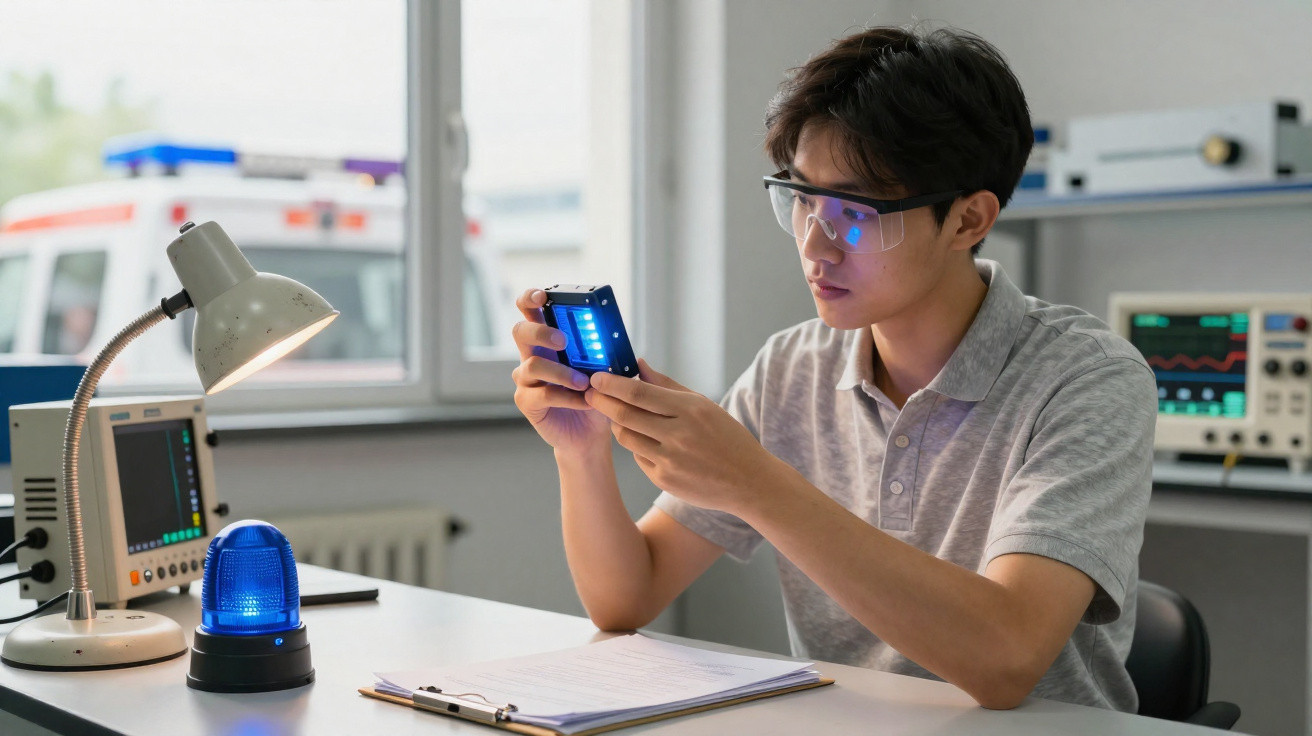
How long have blue lights been used as an optical emergency signal? When did the first rotating beacons, roof bars and front flashers reach the market? What requirements must blue lights meet today? And why did the new Road Traffic Licensing Regulations cause problems with vehicle registration? Here are the key facts.
Contents
- From headlamps to the Auer beacon
- Roof bars and front flashers
- Blue lights using LED technology
- Which approvals are required?
- Three categories of warning lights
- Electromagnetic compatibility
From headlamps to the Auer beacon
Blue light has been used as an optical emergency signal in Germany since the 1930s. Blue was chosen because enemy bomber pilots were expected to find this colour less easy to detect. At first, designers used forward-facing headlamps fitted with blue lenses.
Around 1955, Auer launched the first rotating beacon. Economic recovery in post-war Germany had increased road traffic, making it necessary to improve the visibility of emergency vehicles. The now legendary Auer beacon therefore produced a flickering flash that could be seen from every direction.
This 360-degree light output was made possible by a lens system. Other manufacturers later developed the rotating-reflector principle, in which a concave mirror revolves around a fixed bulb beneath a blue light dome.
Roof bars and front flashers
The first roof-bar systems were already introduced in the United States during the 1970s. In Germany, Hella was among the first companies to present a modular blue-light bar in 1984: the RTK 4-SL (rotating beacon and siren combination with urban/rural switching for the acoustic signal). It entered series production in 1986.
From the 1990s onwards, manufacturers increasingly equipped their beacons with double-flash technology, also known as stroboscopic technology. Compared with conventional light sources, the xenon lamps used for this purpose provide better light output, use little energy and have a longer service life.
As directional flashing lamps, they became widely used as front flashers installed in vehicle grilles. These had first appeared on the market during the 1980s.
Blue lights using LED technology
Over the past 10 years, LED technology (light-emitting diode) has become increasingly established in the blue-light sector. It delivers an even better energy balance, greater durability and more compact beacon designs.
LEDs became more powerful year after year. As manufacturing capacity expanded, the range of products grew steadily and prices fell accordingly.
Emergency vehicles now commonly use LEDs not only for blue lights, but also for warning and work lights, as well as lighting for the surrounding area and equipment compartments. A continuing trend is to integrate LED modules into the vehicle bodywork.
Which approvals are required?
To use blue beacons on emergency vehicles today, they must have lighting type approval. Before international regulations were introduced, paragraph 22a of the Road Traffic Licensing Regulations (StVZO), Technical Instruction (TA) No. 13a and the explanatory notes to TA 13a were the relevant provisions for national approval.
Since 3 July 1994, Regulation No. 65 (ECE-R 65), “Uniform provisions concerning the approval of special warning lamps for motor vehicles”, issued by the United Nations Economic Commission for Europe (ECE), has been recognised in Germany and incorporated into national law.
Among other matters, it specifies luminous intensity, light distribution, light colour and flash frequency. A distinction is made between lamps with a single luminous-intensity level (Class 1) and those with two levels (switchable day/night luminous intensity = Class 2). ECE-R 65 also defines the operating-temperature range and water resistance.
Three categories of warning lights
The regulation generally divides flashing warning lights into three categories:
- T = rotating or fixed flashing lamps with a reference axis running vertically through the centre of the light source (rotating beacons, 360 degrees). They may be configured as individual lamps or as a complete or half roof bar containing two or more warning-light systems.
- HT = rotating or fixed flashing lamps with a horizontal axis parallel to the vehicle's longitudinal centre plane. HT systems need only emit light 135 degrees to the left and right of the vehicle's longitudinal centre plane respectively (270 degrees rather than 360 degrees).
- X = directional flashing lamps with a horizontal reference axis parallel to the vehicle's longitudinal centre plane, which emit light over a limited angular range. This category includes front flashers.
ECE-R 65 identifies the light colour using letters:
- A = Amber
- R = Red
- B = Blue
The UN regulation also makes a further distinction according to luminous-intensity level:
- Class 1 = lamps with only one luminous-intensity level (night-time luminous intensity).
- Class 2 = lamps with two luminous-intensity levels (switchable day/night luminous intensity).
Electromagnetic compatibility
A further requirement for the approval of blue beacons is proof of electromagnetic compatibility (EMC), for example under EC Directive 72/245/EEC as amended by Directive 95/54/EC of 31 October 1995 or Directive 2004/104/EC of 14 October 2004. EMC type approval may alternatively be obtained under ECE-R 10, Revision 2, “Uniform provisions concerning the approval of vehicles with regard to electromagnetic compatibility”.
Some manufacturers also offer, as an option, approval under the rules of the International Civil Aviation Organization (ICAO). Where direction indicators, position lamps, rear lamps and stop lamps are integrated into the bar, they must comply with ECE-R 6 and ECE-R 7 respectively.





Comments
No comments yet. Be the first to comment!
Leave a Comment