
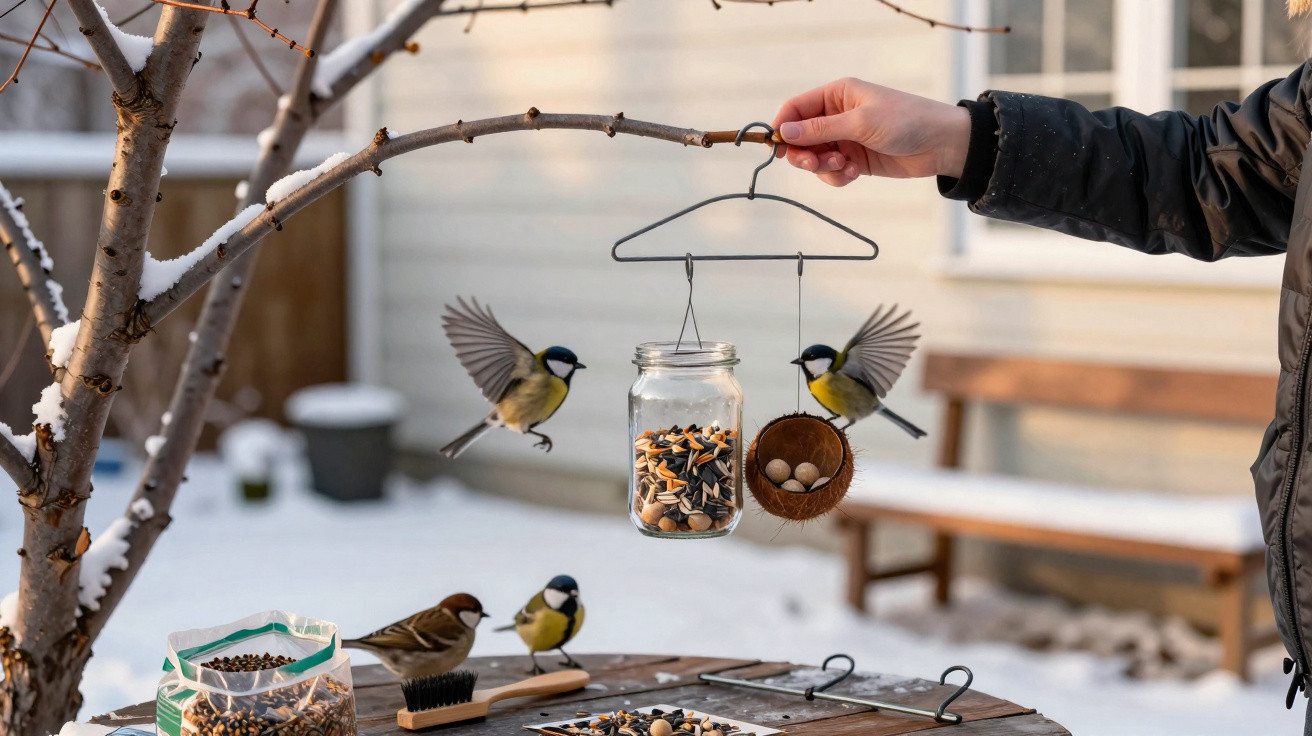
As soon as the first frost settles on flowerbeds and balcony planters, many people ask themselves: how can I help birds without immediately buying expensive specialist equipment? A simple craft idea from amateur ornithology shows how a metal clothes hanger from the wardrobe can become a safe feeding station – with just a few adjustments and virtually no cost.
Why birds need urgent support in winter
Winter drastically reduces the natural food supply. Insects disappear, berry bushes have been stripped, and daylight hours are short. Small species such as tits, sparrows and robins in particular need plenty of energy to maintain their body temperature.
- Frost and snow cover seeds and leftover insects.
- Long nights mean many hours without food.
- Weakened animals become easy prey for cats and other predators.
Well-positioned feeding points can make a real difference. It is not only the food that matters, but also where and how the feeder is secured. This is precisely where an unassuming metal clothes hanger comes in.
The clothes hanger trick: turning wardrobe waste into a lifesaver
Metal clothes hangers often end up in the bin or gather dust at the back of a wardrobe. Yet they are ideal as flexible supports for seed feeders, fat balls or homemade feeding stations.
“An old metal hanger can be turned into a sturdy feeding hook in just a few minutes – flexible, inexpensive and surprisingly robust.”
The basic principle is simple: straighten and reshape the hanger, then use it as an extended arm between the feeding point and its support. This makes it possible to fix feeders securely to branches, railings or pergolas – far enough away from cats, rats and inquisitive dogs.
How to turn a clothes hanger into a bird feeder hanger
You only need basic tools that are found in almost every home:
- 1 metal clothes hanger (one without a plastic coating is ideal)
- 1 pair of pliers (combination or flat-nose pliers)
- work gloves, if needed
Follow these straightforward steps:
- Carefully straighten the hanger roughly by hand.
- Use the pliers to shape a sturdy hook at one end – this will later hold the feeding station.
- Bend another hook at the opposite end, which can be placed over a branch, balcony railing or pergola.
- Lengthen or shorten the middle section as required so that the feeder hangs freely.
- Press the ends firmly closed with the pliers to stop anything from slipping off.
If desired, secure the completed hook further with some string or wire. The hanger can bear more weight than it first appears to – even larger seed feeders can usually be hung from it without any difficulty.
Benefits of the hanger method compared with ready-made holders
Many DIY shops and garden centres sell purpose-made holders. They work, but often cost more than necessary. The do-it-yourself clothes hanger solution has several advantages.
| Aspect | Hanger holder | Bought holder |
|---|---|---|
| Price | Almost free, recycled | Several pounds each |
| Flexibility | Can be bent and adjusted as needed | Fixed shape, little scope for adjustment |
| Environmental footprint | Reuses materials already available | New production, packaging and transport |
| Safety for birds | Can create a large distance from the ground and predators | Often positioned closer to railings or walls |
The hanger solution is especially practical in urban settings with balconies, small gardens or courtyards. The hook can be moved or adjusted in seconds, then stored away again in spring.
Where to hang the feeding station – and where not to
Even the best bird feeder is of little use if it is placed in an unsuitable spot. Many mistakes are made with good intentions: hanging it too low, too close to shrubs or near the roof of a house.
“A medium height is ideal: easy for birds to reach, but difficult for cats and martens to access.”
Useful rules of thumb:
- Hang it at least 1.5 to 2 metres above the ground.
- Leave enough distance from walls that cats could jump from.
- Do not place it directly in dense shrubs; it should hang slightly out in the open.
- Ensure birds have a good view so they can spot enemies early.
The clothes hanger makes it easier to achieve exactly these distances. It extends the reach of a branch or railing, placing food where birds are safest.
Suitable food for winter bird feeding
Not every food suits every species, and some supermarket products do more harm than good. Salty or seasoned leftovers from lunch should never be put out for birds.
Reliable winter options include:
- unsalted sunflower seeds
- ready-made wild bird seed mixes without ragwort seeds
- fat balls without plastic nets (preferably offered in feeders)
- oats, lightly mixed with vegetable fat
- nuts, unsalted and unseasoned, roughly chopped
Fat mixtures stay firm for a long time on cold days and provide plenty of energy. They can even be placed in old cups or small jars, which can then be hung from the clothes hanger – another clever recycling idea.
Do not overlook hygiene: clean feeding stations save lives
Where many birds feed in a small area, the risk of disease rises. Feeders should therefore be cleaned regularly, especially during damp weather.
A practical approach:
- Remove leftover food and empty trays.
- Rinse with hot water and, if necessary, use a little mild washing-up liquid.
- Allow everything to dry thoroughly before adding fresh food.
- Dispose of mouldy or stuck-together food remains immediately.
The hanger’s major advantage is that feeding containers can be removed, cleaned and rehung in moments. This reduces the risk of diseases spreading.
Recycling, conservation and compassion: why the idea is so popular
Many people are looking for ways to make everyday life more sustainable without having to transform their whole lifestyle. Turning an old clothes hanger into a bird feeder holder fits this approach perfectly.
“Anyone who feeds birds this way is not only helping individual birds, but also supporting biodiversity in their local area over the long term.”
Birds that make it through winter successfully can raise more young in spring. This strengthens local populations – a point specialists repeatedly emphasise. Particularly in densely populated areas, many species depend on people providing nesting places, water and food.
For families with children, this can easily become a small winter project: bend the hanger together, mix the food and choose the best position in the garden or on the balcony. Along the way, children learn how nature conservation and resource protection can work in everyday life.
What to consider regarding metal and safety
Despite all its benefits, it is worth taking a brief look at possible risks. Exposed, sharp wire ends have no place at a feeding station. They could injure birds or damage clothing.
- Bend over all ends neatly or cover them with tape.
- Check the hook regularly for rust, breaks and bent sections.
- Remove feeders in very strong winds in good time so that nothing falls down.
If the hanger is badly rusted or already brittle, it belongs in metal recycling rather than the garden. Choose a stronger example for feeding birds.
Anyone who likes the idea can repurpose other everyday objects next: empty tin cans as weather protection, old cups as food containers or leftover timber as perches. The metal clothes hanger remains the flexible link that brings everything to the right place – right into a safe winter haven for blackbirds, sparrows and more.


Comments
No comments yet. Be the first to comment!
Leave a Comment