

The scene opens with a wardrobe left half-open, its hangers crooked and stacks of clothes balanced through sheer stubbornness.
You pull out one T-shirt and send three others tumbling down, mutter a quiet swear word, then shove the door shut harder than necessary. The day was already chaotic, yet this minor cotton disaster feels like the final straw. It seems as though nothing is where it belongs - neither around you nor inside you. In your mind, the clutter becomes as overwhelming as the drawer full of socks. It is only a wardrobe, you tell yourself. Yet it does not feel like only anything. There is a peculiar comfort in the thought of emptying it completely, folding everything, getting rid of what weighs you down, and putting each item back in silence. As though every neatly folded shirt could turn down the noise inside. As though organising the wardrobe were, secretly, a way of organising yourself.
When wardrobe chaos becomes a measure of inner chaos
Anyone who speaks regularly with psychologists and therapists tends to hear the same point: the home often reflects what is happening in the mind. A crammed wardrobe, full of creased clothes and things you barely remember owning, reveals more than a lack of time. It points to things building up. To postponements. To decisions continually put off. When you finally set aside an afternoon to tackle those shelves, something shifts that is not merely the stack of T-shirts. Organising a wardrobe is one of the few modern tasks where the result can be seen straight away. The before and after is tangible, right in front of your tired eyes.
That visual certainty can soothe a brain worn down by vague problems. Work, bills, relationships, career prospects… almost none of these comes with an “after” as clear as a reorganised wardrobe. Here, you are in charge of how things are arranged. You choose what stays and what goes, what moves up and what moves down. There are no meetings, no one else’s approval and no deadline in an email. It is simply you, the shelves and one small part of the world that you can control. For a few hours, the wardrobe becomes a testing ground where life appears to follow your decisions.
In research into wellbeing at home, many people describe precisely this feeling of being able to “breathe more easily” after tidying just one area. It does not have to be the entire house. A wardrobe, shelf or drawer can provide a sense of a real, visible win. A UCLA study involving American families found that stress levels tend to be higher in homes with too many objects on display. Clutter is not merely unattractive: it is visually exhausting, undermines concentration and drains energy. When you organise your wardrobe, you cut down on stimulation, make clothes easier to choose and remove a small daily irritation. It is one less battle in your routine. That may sound minor, but the brain registers it as relief.
The private ritual of emptying, choosing and putting back
There is an interesting detail here: the feeling of emotional control does not come solely from the finished result, but from every small action along the way. Emptying the wardrobe creates controlled chaos on the bed or floor. For a few minutes, the room may look worse. This time, however, the chaos is directed by you. You determine the order of sorting, the pace, whether music plays or whether you work in silence. It is a script you write as you go. Each time you fold a T-shirt, straighten a pile or set aside a coat for donation, you are teaching your brain to make firm choices. Keep. Go. Need. Do not need. One decision at a time.
This almost meditative, repetitive rhythm can have a direct effect on an anxious mind. Your hands are occupied, your attention stays on one task and visual rewards arrive quickly. For many people, it is the closest everyday life gets to a mindfulness practice. There is no mysticism involved, only practical repetition. The scent of clean laundry, the feel of fabric, the sound of a drawer sliding shut without catching. These are small sensory signs that say: here, at least here, everything is under control. Even if it is only for the next few weeks.
Behavioural researchers have described structured household tasks as “anchors of predictability”. At a time when the feed changes constantly, prices rise and the news feels heavy, there is a certain comfort in knowing the towels are folded in the same way on the same shelf. A well-organised wardrobe makes later decisions simpler, reduces mental fatigue and creates a tiny territory of calm in a noisy world. Reorganising wardrobes can therefore become a small act of emotional resistance: if I cannot control the rest, then at least in here, things follow my logic.
How to make tidying a tool for emotional care
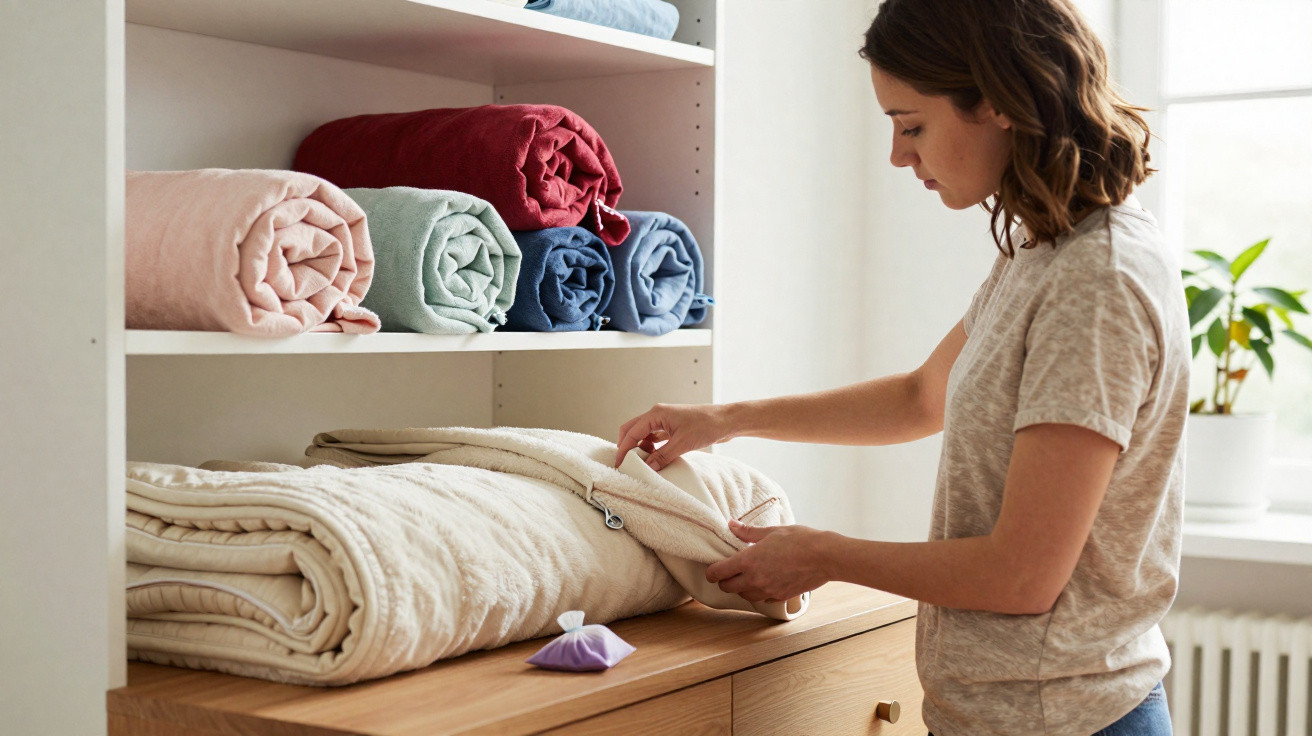
A straightforward method can entirely change the feeling from “another chore” to “a gift you give yourself”. Begin with a very small section: just the T-shirt shelf, only the trouser hangers, or simply the underwear drawer. The brain recoils from huge tasks; smaller, specific goals are less intimidating. Empty that particular space completely. Put everything on the bed and take a breath. Then make three groups: wear often, wear rarely, no longer wear. That is all. Do not think about fashion, weight or “maybe one day”. Think about what makes sense for your life today.
Next, settle on a clear system for what remains: by colour, garment type or how often it is worn. There is no universally correct method, only one that works for you. The key is to create a pattern you can repeat. Turn all hangers the same way, keep piles at a similar height, and use boxes or baskets for smaller items. Visual order sends a quiet message to the brain: “this is organised; you do not need to worry about it right now”. Let us be honest: no one manages this every day. That is fine. A little consistency is enough; perfection is not required.
Many people undermine themselves by trying to turn tidying into a one-day marathon. That epic Saturday plan: “I’m going to organise the entire house.” The outcome is often frustration, exhaustion and half the clutter merely moved somewhere else. A kinder suggestion is to view the wardrobe as an ongoing project rather than a punishment. If you are tired, do one section and stop. If you are irritated, use tidying as an outlet rather than a penalty. Try not to compare yourself with photographs of perfect wardrobes on Instagram. They do not show piles of washing, odd socks or unfiltered reality.
A common trap is turning organisation into self-reproach: “how did I let it get this bad?”, “what a messy person I am”. This inner dialogue destroys any sense of control and triggers guilt and shame. Try replacing it with something gentler, almost journalistic: “right, this is what my wardrobe looks like today; what can I do with the time I have?”. Even one organised drawer is a small success. It is the kind of detail that improves your mood on a Monday, when you find the clothes you wanted in five seconds rather than after fifteen minutes of chaos.
“When a physical space starts making sense again, the mind has a little more room to deal with what cannot be resolved so quickly,” says a clinical psychologist interviewed for this report. “Organising does not cure everything, but it offers pauses.”
- Start small: Choose one section of the wardrobe, not the whole wardrobe. This reduces anxiety and makes finishing more likely.
- Set a time limit: Use a timer for 20 to 30 minutes. Tidying with a defined end point does not become endless torture.
- Use boxes or baskets: Put items to donate, repair or throw away into visible containers. This makes decisions easier.
- Create an “easy zone”: Set aside a space for the clothes you use most in everyday life. It reduces stress during rushed mornings.
- Return once a month: A brief monthly check stops everything from returning to chaos. Even five minutes makes a difference.
An organised wardrobe will not solve your life, but it can change your day
When you close the door of a freshly organised wardrobe, there is a microsecond of silence. It is almost impossible to notice, but it is there. A welcome emptiness. Seeing aligned piles, spaced hangers and labelled boxes produces the feeling that “OK, something is under control”. It does not solve money troubles, erase conflict or put the world right. But it offers firmer ground from which to face the rest of the day. It is like drinking a glass of water in the middle of chaos: it does not put out the fire, but it leaves you less dizzy.
Reorganising wardrobes also has a symbolic element that few people openly acknowledge: there are farewells inside them. It can be difficult to admit that a dress from an earlier phase of life no longer makes sense, or that trousers which no longer fit do not need to stare at you every day. Throwing things away, donating them or passing them on creates both physical and mental space. It says, “this no longer represents me”. With every item you choose, you quietly redraw who you are today. Identity fits, in part, on shelves.
Perhaps that is why so many people feel the urge to sort through wardrobes during periods of change: the end of a relationship, a new job, children growing up and leaving home. Organising becomes a quiet rite of passage. It is a way to mark, in concrete terms, that something has changed. Handling clothes, boxes and drawers means handling your own story. It is no coincidence: when the world inside your head shifts, the world inside your wardrobe often shifts too. Perhaps that is the hidden invitation in those creaking doors. Open, face it, choose, close. Then, suddenly, breathe a little more easily.
| Key point | Detail | Value for the reader |
|---|---|---|
| Organising provides visible control | The wardrobe’s before and after is immediate and concrete | Helps reduce feelings of chaos and helplessness |
| The process works as a ritual | Emptying, sorting and replacing items practises clear decisions | Reduces anxiety and creates a feeling of agency |
| Starting small is more sustainable | Focus on sections of the wardrobe and maintain quick reviews | Makes organisation achievable, without frustration or guilt |
FAQ:
- Question 1: Does organising a wardrobe really help with anxiety, or does it only feel that way? For many people, it offers genuine help. The task provides focus, produces a concrete sense of control and reduces visual stimulation that can make the mind feel more unsettled.
- Question 2: How often should I reorganise my wardrobe? There is no fixed rule. A sensible average is a larger reorganisation with each seasonal change, plus brief monthly checks lasting 5 to 10 minutes.
- Question 3: What if I do not have time for a complete tidy? Choose micro-tasks: just the sock drawer, only the belts or simply the T-shirts. Small blocks of effort added up over several weeks have the same effect.
- Question 4: Why do I feel guilty when I see my messy wardrobe? Many people link disorganisation with personal failure, which is not true. A busy life, lack of support and tiredness matter more than a supposed “lack of care”.
- Question 5: Is it worth hiring a professional organiser? If it fits your budget, they can be very helpful in creating systems you can maintain. Yet even without professional support, small changes can make a difference.


Comments
No comments yet. Be the first to comment!
Leave a Comment