
You open the envelope or check the app, look at the total and suddenly experience the chill in your draughty hallway in a very particular new way. That cold stream beneath the front door is no longer merely “a bit annoying”; it is money escaping from your home.
In an older property, these small betrayals begin to stand out everywhere. There is the shiver as you pass the bay window, the curtain that moves of its own accord on a windy evening, and the room that remains five degrees colder than the others, however far you turn up the thermostat.
It can seem unfair, even oddly personal. You value the home’s character: its high ceilings, timber doors and sash windows. Yet that charm comes at a cost in kilowatts and irritation.
Then a modest trick reveals just how much heated air is getting away.
Why older homes lose money through unseen gaps
If you live in an older home, you will probably know exactly where the cold seems to “live”: the living-room corner beside the window, the stretch of floor near the back door, or the upstairs landing where the wind finds an entrance whenever there is a storm.
What many people fail to appreciate is the cumulative effect of all those small draughts. A narrow gap beneath one door may appear insignificant, but throughout an entire house those gaps can add up to the equivalent of leaving a window open on the tilt, steadily draining away heat all day.
Picture your home as a balloon with a few small leaks. Your boiler or heat pump keeps supplying warm air, but unless the openings around doors and windows are addressed, that warmth simply escapes. The heating system has to work harder, comfort disappears and bills gradually rise.
All of a sudden, a straightforward roll of foam tape becomes rather appealing.
UK energy assessors regularly encounter the same scenario. A couple in a 1930s semi say their house “never feels warm”. They have already replaced the boiler, bled the radiators and bought heavier curtains, yet none of it has solved the issue.
When the assessor arrives with a thermal imaging camera, the result can be stark: blue trails around every window frame, a vivid cold outline around the front door, and heat escaping beneath the floorboards by the back door like water from a split pipe.
They spend under £80 on seals, brushes and several tubes of flexible sealant. The work takes a quiet, somewhat tedious DIY weekend. Their next bill is not halved, but it falls by enough to be noticeable. Better still, they no longer need to wear jumpers while watching telly.
The same story plays out in countless older homes. It is neither glamorous nor Instagrammable: simply fewer draughts, lower bills and a house that begins to feel old in the best sense.
The reasoning is uncomplicated. Heating a home is essentially a balance between the warmth you produce and the warmth that escapes. Older homes often have single glazing or early double glazing, slightly distorted frames, brickwork that has shifted and timber that has moved over many decades.
Those appealing imperfections form tiny openings: around hinges, below sills and between a door and its frame. Air is both lazy and opportunistic, always travelling from warm spaces towards cold ones. Each crack offers it an easy route.
Sealing those leaks does more than prevent “cold air coming in”. It also slows the routes through which warm air gets out. Your boiler or heat pump can therefore run in shorter bursts to achieve the same temperature, and you can feel warmer with the thermostat set slightly lower. The energy saving is not magic; it is physics combined with foam and common sense.
Practical ways to find and seal draughts
The most valuable action is one that almost nobody does: take an unhurried walk around the house on a windy day and pay close attention. You need no equipment or gadgets, only your skin. Stand by every door and window, close your eyes and check for moving air around your hands, ankles and face.
Next, be more methodical. Hold a lit incense stick or a narrow strip of tissue close to the edges of frames and thresholds. If the smoke or paper moves, you have located a leak. Use masking tape to mark each spot.
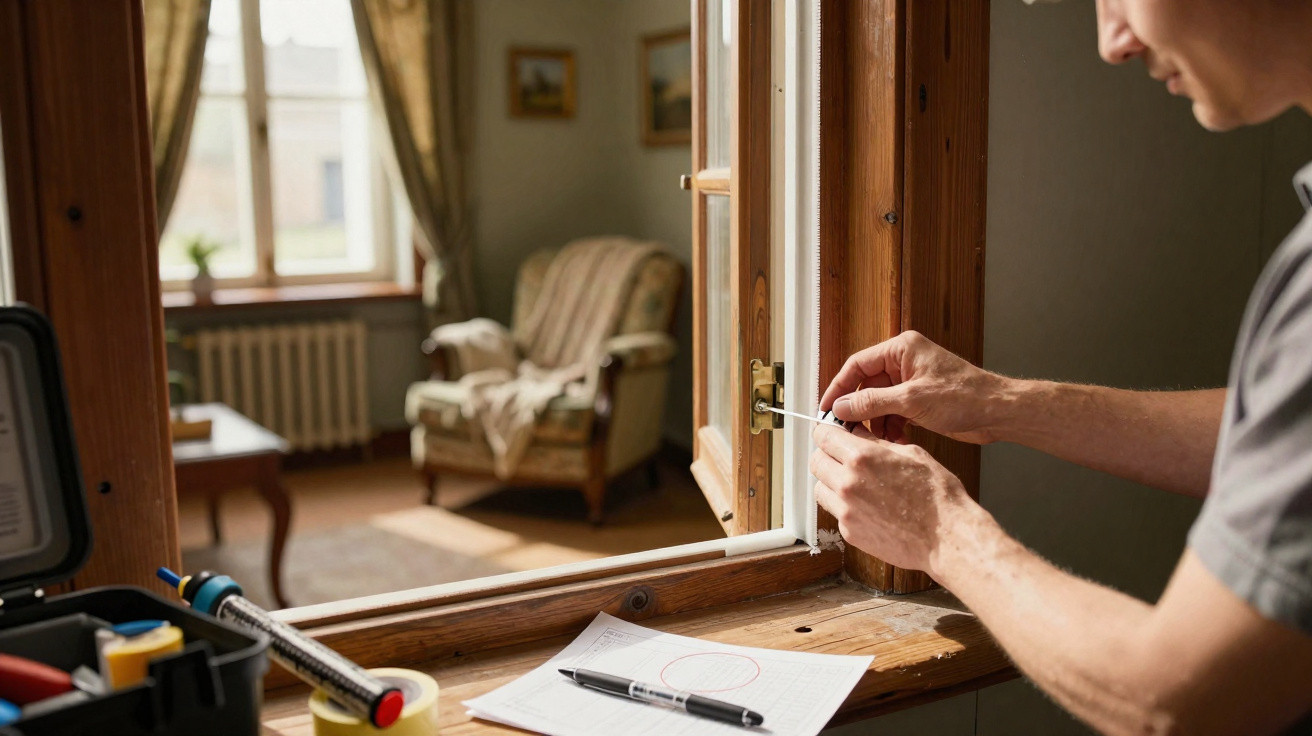
Return later with the right kit: self-adhesive foam or rubber strips for door and window frames, a brush strip or rubber threshold seal for door bottoms, and flexible sealant for openings around sills and frames. It can feel fiddly initially, but by the second window you may find yourself surprisingly capable.
This type of project does carry one risk: overdoing it, or sealing the wrong areas. Some older homes need a degree of background ventilation to manage damp and condensation. If you block every gap indiscriminately, you could exchange a cold draught for mould behind the wardrobe.
Work with the building rather than against it. Leave trickle vents open where your windows have them, and never permanently seal air bricks or vents serving gas appliances. Direct your efforts towards clear comfort problems: whistling keyholes, gaps surrounding loose letterboxes and that dramatic strip of daylight beneath the back door.
There is no need to tackle everything at once. Draught-proof one room, live with the result for a week and assess how it feels. Your body is a decent scientist when you give it time to notice changes.
Professionals refer to “building tight, ventilating right”, an approach that suits characterful older homes perfectly. The aim is to decide where air enters and exits, rather than allowing the wind to make that decision.
“The cheapest unit of energy is the one you never have to use,” says Mark, a domestic energy assessor from Leeds. “People think payback means years. A £15 door brush can feel worth it in a single stormy night.”
To keep the task manageable, prioritise quick wins before taking on larger projects. Begin with:
- Self-adhesive foam or rubber seals on the worst windows and doors
- A good brush or rubber seal on the front and back door
- A simple letterbox cover and a close-fitting keyhole cover
Let’s be honest: nobody truly does this every day. You are unlikely to turn hunting for draughts into a weekly routine. Still, one proper weekend with a roll of tape, a door brush and a tube of sealant can transform the feel of your whole winter.
Living in an older home that is less draughty and less expensive
The biggest surprise for most people is not the bill but the sensation. Once the worst gaps have been sealed, the house can seem quieter. That faint, persistent chill at the back of your neck while reading or working from home disappears.
The change is especially noticeable when you come in on a cold, wet evening. Previously, the hallway may have felt like an in-between space separating the street from the living room. Now you feel the warmth sooner, and you no longer automatically reach for a second pair of socks.
At a deeper level, draught-proofing can alter your relationship with the building. Older homes sometimes feel like stubborn characters determined to operate on their own terms. Taking the time to identify where heat is leaking and carefully improve those weak points can make it feel as though you are working with the house, rather than battling it.
We have all looked at a winter energy bill and felt a little powerless. Sealing gaps is not glamorous, but it is among the few actions that delivers a direct and visible result. You will remember that strip of foam around the frame and the brush strip fixed to the threshold the next time the wind is howling and your curtains remain still.
It also does not have to be flawless. A slightly uneven piece of tape can still stop a draught, while a door brush with one loose screw can still reduce the wind. The objective is not to turn an old home into a laboratory-standard airtight box. It is to waste less heat, be more comfortable and make your space suit the life you really live there.
| Key point | Detail | Benefit for the reader |
|---|---|---|
| Identifying air leaks | Use your hands, smoke or tissue to find draughts around windows and doors | Enables you to target the areas genuinely wasting energy |
| Selecting suitable materials | Foam or rubber strips, door brushes and flexible seals suited to each type of leak | Prevents unnecessary purchases and maximises the impact on your bill |
| Ventilating intelligently | Reduce troublesome leaks while retaining the air supply needed for a healthy home | Keeps the house healthy while cutting heat loss |
FAQ:
- How much could I genuinely save by sealing draughts? In a typical older UK home, focused draught-proofing can reduce heating use by roughly 5–15%, depending on how leaky the property was initially.
- What should I seal, and what should I leave untouched? Seal gaps around windows, external doors, loft hatches and skirting boards; keep trickle vents, air bricks and anything serving fires, stoves or gas appliances open.
- Is it worthwhile if I rent my home? Removable, low-impact measures such as self-adhesive strips, draught excluder sausages and clip-on letterbox covers can have a major effect without upsetting your landlord.
- Can I undertake this myself, or do I need a professional? Most basic draught-proofing is straightforward DIY; if you are uncertain about ventilation or own a complicated older building, a home energy survey can offer direction.
- Will sealing everything lead to damp or mould? Ill-considered sealing can do so, which is why designed ventilation points should remain open and you should focus on obvious leaks that make rooms uncomfortable.






Comments
No comments yet. Be the first to comment!
Leave a Comment