
The winter evening looked perfect on paper: a crisp bite in the air outside, and indoors the fireplace that only needed a little more wood. The logs in the shed seemed ideal - greyed on the surface, bark slightly split, and when I picked them up they didn’t feel cold and clammy but dry. “These are ready,” I thought, grabbed the best armful and stacked it by the stove. Five minutes later: smoke instead of flame, a dull hiss as if the wood were objecting. The chimney draw was fine, the air intake too. And yet the fire sulked, burning half-heartedly.
That’s when it clicked: this apparently perfect firewood was hiding something you can’t see with the naked eye.
When “dry” isn’t actually dry
Anyone who heats with wood a lot knows the little self-deception: you look at the outside, give it a quick knock, hear a reasonably bright sound and tell yourself it’ll do. From the outside it looks bone-dry, the cut face is pale, the cracks suggest long seasoning - and still the stove smokes like an old steam engine.
This is where the rarely admitted problem starts: firewood can look dry for months and still be soaking wet inside.
A neighbour told me how, two winters ago, he bought 10 stacked cubic metres of supposedly “kiln-dried” beech. Flawless logs, all the same length, neatly split, stacked tidily on a pallet. He was proud of his “stockpile for years”. But by January a grey haze would drift through the garden whenever he lit the stove. The flames stayed low, the wood hissed, and the glass in the stove door quickly glued itself up with a black coating.
Later, a check with a wood moisture meter brought the reality: readings between 25 and 30 percent. For firewood, that’s a complete failure.
What’s going on follows a simple logic: wood doesn’t lose moisture at the same rate everywhere. The bark can be dry and the ends can look cracked while the core is still packed like a sponge. Thick logs and dense hardwoods in particular hold on to water for surprisingly long. Airflow, sunlight, the way the stack is built - all of it affects whether the internal moisture can escape or stays trapped.
And it’s exactly that invisible remainder that turns supposedly well-prepared winter wood into a smelly, inefficient and even harmful fuel.
The hidden moisture mistake: where the wood secretly stores water
The biggest blunder usually isn’t the stove - it’s what happened months earlier in the stack: pieces that are too large, stacks built too tightly, and not enough air where it matters. Many people cut the wood once, split it roughly, and assume, “That’ll dry out.” It does to a degree, but never evenly.
Especially in the core, genuine moisture pockets can form. The outside turns grey and cracked, the end grain feels dry - while inside there’s still 5–8 percent too much water that you can’t see or feel, only burn off later.
A classic scenario: wood is felled fresh in April, split roughly in May, then placed “in the open air” against the house wall for summer. The front side dries in the sun, the back sits in still air. The outer 2–3 centimetres become very dry, while the rest lingers at 23–28 percent residual moisture. In the first winter you might only notice slightly poorer lighting behaviour. In the second winter, as you reach further into the stack, the difference becomes brutally obvious: same species of wood, completely different burn.
A chimney sweep once told me about a house where the back row in the shed was almost green - and had been slowly rotting away like that for years.
From a physics point of view, it’s straightforward: water moves through wood along the grain and leaves via the surface, where air and temperature can “carry it away”. If logs are left too large or packed tight, zones form where there’s no real air exchange. The outside dries and can almost crust over, while the moisture content inside stays stubbornly too high. You think you’re storing it dry, but you’re actually preserving the residual moisture in the core.
That’s how you end up in the worst middle ground: no longer fresh, not properly dry - perfect conditions for mould, and later for disappointing evenings by the fire.
How to recognise truly dry firewood - without fooling yourself
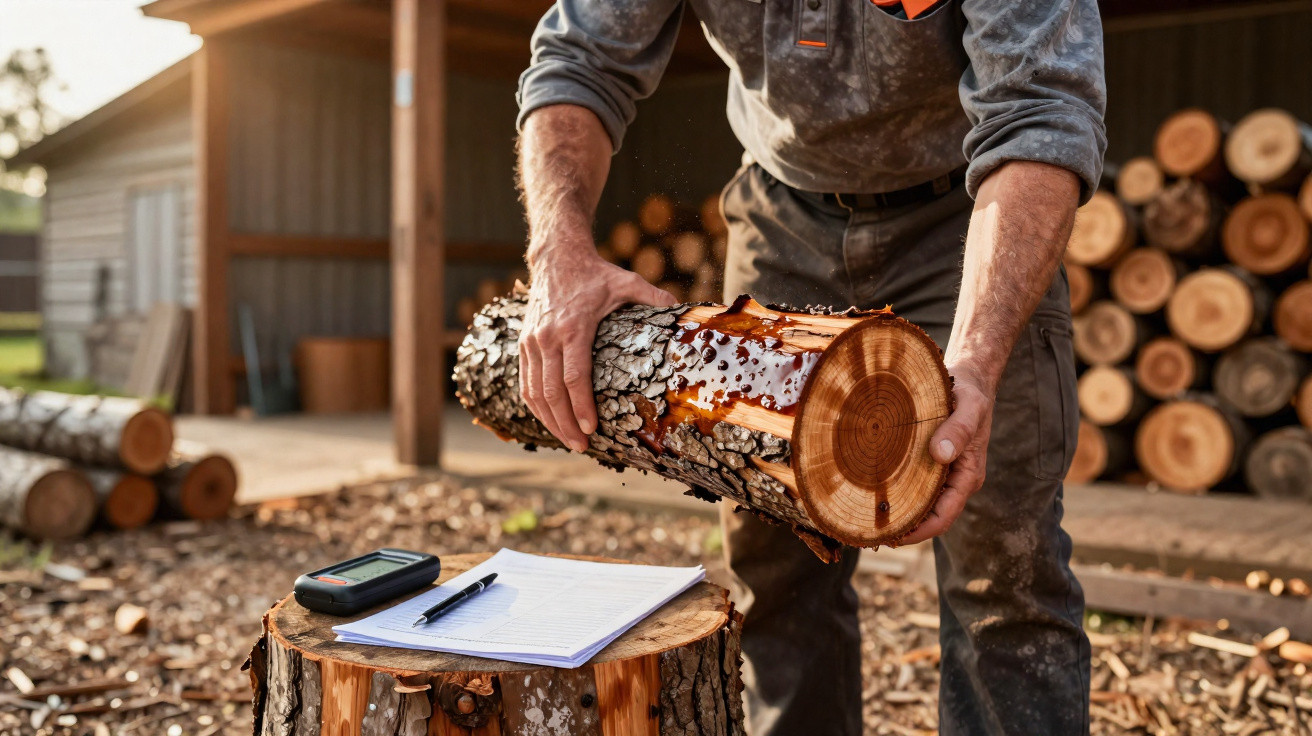
The simplest and most reliable tool is a small device many people put off buying for years: a wood moisture meter with pin probes. It’s not a luxury - more like a blood pressure monitor for your wood pile. Don’t measure only on the end grain; split a log and take the reading from the freshly exposed core. That’s when the illusion disappears.
Target value: under 20 percent residual moisture, ideally between 15 and 18. Anything above that belongs back on the stack, not in the stove. Once you’ve measured it, the difference between “feels dry” and “is dry” is startling.
A common mistake is trusting looks and sound too much. The bright “clack” when two pieces are knocked together can mislead if the surface is dry and hard while the core is still holding moisture. The fingertip test - briefly touching the cut face to see if it feels cool or damp - also has limits. On a cold autumn day even good wood will feel cool.
What genuinely helps is a small change in routine: it’s better to re-check a few logs too early than to discover in January that half your supply is smouldering away as a wet biomass.
“The most expensive wood isn’t the wood you buy - it’s the wood you burn when it’s wet,” an older heating engineer once told me. “You’re paying for energy that only turns into water vapour and clogs up your flue.”
- At least once per season, check a cross-section: split a log and measure the core, not just the outside.
- Let the stack ‘breathe’ on purpose: don’t lay a tarp directly on the wood; keep a gap and ensure the base area is open.
- Split oversized pieces again, ruthlessly: two medium logs are better than one impressive chunk that stays damp for ever.
- Mark damp zones in the shed: visually separate rows that are still too wet and burn them later.
- Let’s be honest: nobody checks wood moisture every day - a fixed measuring date in autumn is often enough to save the winter.
What this moisture mistake does to your wallet, your air and your day-to-day life
Once you pay attention, it becomes obvious: this hidden moisture mistake isn’t a niche concern for firewood purists - it has a real impact on daily life. Wet or semi-dry wood doesn’t just burn poorly; it eats through your supply without delivering proper heat. Over an evening you can end up feeding two or three extra logs into the stove just to get the same comfort indoors. You stare at a tired-looking fire and hear the soft hiss of water you never wanted to burn in the first place.
At the same time, particulate emissions rise, the glass soots up faster, neighbours get the smoke on the air - and the chimney sweep finds in the flue what your wood store never managed to get rid of.
| Key point | Detail | Benefit for the reader |
|---|---|---|
| A “dry” appearance isn’t enough | Cracks, a grey surface and a hard sound can mislead if the core is still above 20% moisture. | Readers understand why their seemingly good wood causes problems and where the real cause lies. |
| Measure instead of guessing | A simple wood moisture meter and measuring the split core exposes the hidden moisture mistake. | A practical tool to check your own supply objectively and avoid heating problems. |
| Proper storage makes the difference | Air circulation, stacking method and log size determine whether wood dries evenly or stays wet in the core. | Clear ways to improve existing wood storage and prevent future mistakes. |
FAQ:
- How long does firewood really need to dry? Softwood usually needs 1–1.5 years; hardwood such as beech or oak is more like 2–3 years, depending on log size, storage location and weather.
- Can I dry wet wood in a cellar? Only to a very limited extent: without good ventilation, moisture builds up, the wood dries poorly and mould becomes an issue.
- At what reading is wood considered “dry”? For stove use, under 20% residual moisture is the rule of thumb; 15–18% measured in the core is ideal.
- Is sunshine enough to dry wood? Sun helps, but without moving air the moisture remains in the core. What matters is the combination of wind, clearance from the ground and protection from rain.
- Does it harm the stove if I repeatedly burn wood that’s too damp? Yes. Over time it can lead to increased tar deposits, damage to the chimney and more cleaning - not to mention unnecessary heating costs.






Comments
No comments yet. Be the first to comment!
Leave a Comment