
It begins with the best of intentions. On a Saturday, you clear the dining table, neatly fold every throw on the sofa and arrange your spices in orderly little rows. The house feels calmer, so does your mind, and you promise yourself that this time it will stay that way. A week later, post has found its way back to the table, the laundry basket is heaving, and an unexplained heap has appeared on the chair that was meant to remain empty “just this once.”
You glance around and feel that familiar sense of failure. Does this mean you are untidy, lazy or simply not “one of those organized people”? Or could the system itself be making it almost impossible to succeed?
One straightforward rule often determines whether your home remains organized or gradually returns to chaos.
The simple rule that quietly changes everything
The rule is simple: every single object needs an easy, obvious home. Not an imaginary home or a Pinterest-perfect one, but a place your tired, distracted, stressed, phone-scrolling self can use without stopping to think. An item without a designated place drifts. It ends up on the nearest surface, becomes part of a miscellaneous pile and soon attracts more things.
Our brains naturally look for the quickest route. When putting something away involves more than two steps, the mind tends to choose, “I’ll do it later.” Then “later” turns into the junk drawer, the chair-pile or the suitcase that is never completely unpacked. Organization fails not because you lack discipline, but because the journey from “in my hand” to “back in its home” is too complicated.
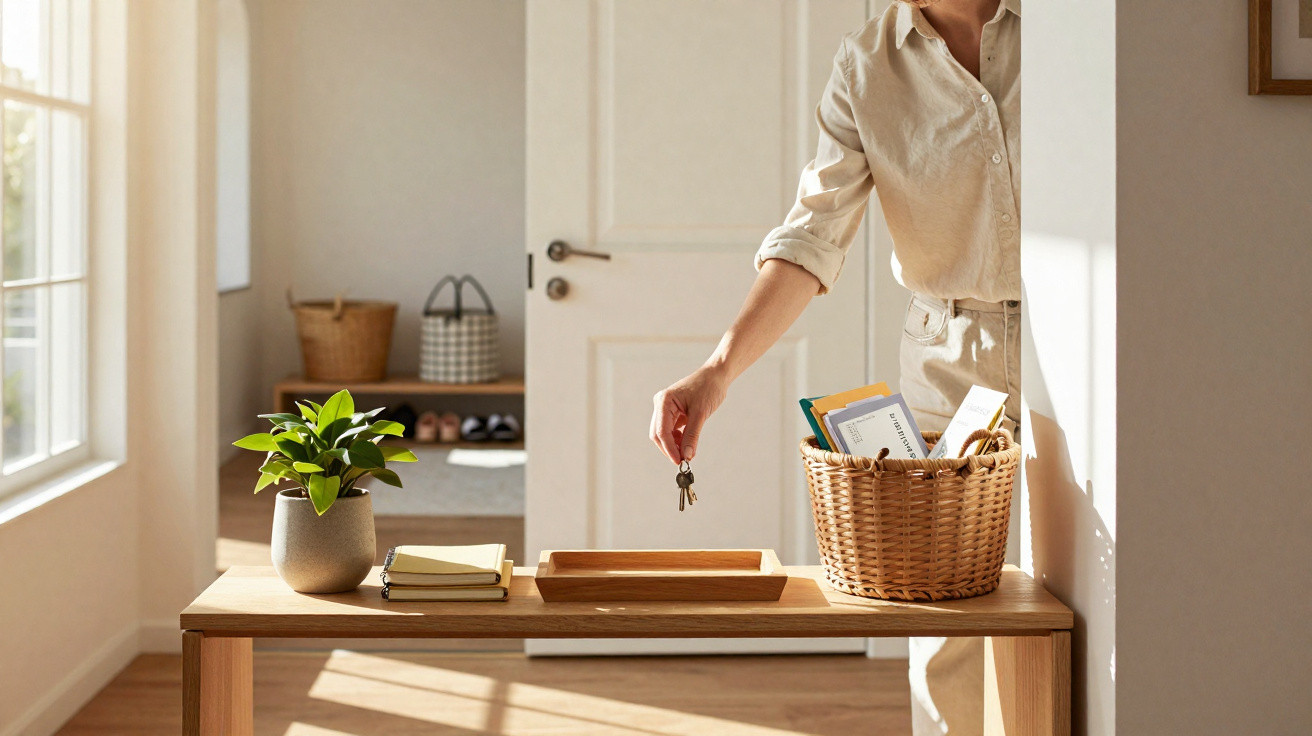
Consider your keys. Those who rarely misplace them usually follow this principle without even noticing. They use a bowl by the door, a hook or a small tray on the console table. It is the same place every time: no searching and no decisions. That is an easy, obvious home.
Compare that with the objects that wander around your house: scissors, phone chargers, tape and water bottles. They appear on the kitchen worktop, coffee table, in the bedroom or in the car. Whenever you need one, you are sent on a small scavenger hunt. You sigh, perhaps swear, and may even buy another “just to have a backup.” Much clutter is simply homeless objects multiplying.
Giving each item a genuine home is not merely about organizing possessions; it is about reshaping your habits. This rule succeeds because it eliminates tiny decisions. Instead of asking, “Where should I put this?”, you simply know, “This goes here.” Once that decision has been made, your brain can relax.
Of course, nobody follows the system perfectly every day. Life, children, late nights and early alarms all get in the way. But when everything has a home, mess stays superficial. It remains on the surface and can be put back within minutes, like leaves being swept into bags already waiting for them. The system gives you grace because it is designed for real life rather than an ideal version of it.
How to create an easy, obvious home for everyday items
Begin with one trouble spot instead of attempting the entire house. Choose the area that frustrates you most: the pile in the hallway, the bathroom worktop or the desk that keeps overflowing. Pay attention to what genuinely collects there, rather than what you think ought to be there. That is your useful information.
Next, give every repeat offender a home as close as possible to where you use it or naturally set it down. Post? Put a basket near the door. Headphones? Keep a small dish by the sofa. Dog lead? Fit a hook at lead height rather than at “aesthetic” height. If putting something away means walking into another room, it will probably never make it home.
People often undermine themselves by choosing systems that are overly attractive or unnecessarily complex. A tall box with a lid may look neat in a photograph, but the lid becomes an obstacle in everyday use, so post simply gets placed on top. A filing cabinet in another room may seem “organized”, but it is three steps and a door away. Your brain makes a quiet calculation and concludes that it is not worth the effort.
You have found the right home when returning an item is nearly as effortless as leaving it on the table. Choose lid-free baskets, open shelving, shallow drawers and transparent containers. The easier the action, the more instinctive it becomes. That is how organization begins to look after itself, including during your most difficult weeks.
There is a helpful change in mindset, too: rather than trying to “declutter your life”, address one everyday annoyance at a time. Think of the hairbrush that constantly disappears, the reusable bags forgotten on every supermarket trip or the charger carried from room to room. Each needs a home that fits the reality of how it is used.
“Organizing isn’t about perfection. It’s about reducing friction between you and the life you’re actually living,” says a professional organizer I once interviewed, who admitted her own kitchen junk drawer is very real, just tamed.
- Give frequently used items prime positions instead of hiding them at the back of a cupboard.
- Use open, visible storage for items you reach for every day.
- Keep things where you use or drop them, rather than where they “should” belong.
- Try the system for a week, then alter it if you continue to avoid using it.
- Treat containers as limits: once one is full, that category has reached capacity.
The quiet power of small, honest systems
As you start using this rule, a subtle change takes place. Rather than blaming yourself for untidiness, you begin to notice the structure of your habits. Shoes by the door are not a moral failing; they indicate that their current home is too distant, too low or too awkward to use. Make-up spread across the bathroom sink is your brain saying, “I need this in reach, not in a zippered pouch.”
Your expectations may become gentler and more precise at once. Gentler, because you recognise that your home does not need to resemble a magazine spread. More precise, because you start viewing clutter as a design issue instead of a character flaw. Add a hook here, a tray there or a box beside the bed, and your evening routine can suddenly feel much smoother.
At this point, the rule becomes about more than possessions; it becomes an act of self-respect. Giving everything a home says that your time and energy matter, and that your mornings should not begin with a frantic hunt for keys. You are putting small supports in place for your future self: the version of you who is late, exhausted or in a bad mood.
Some people may feel inspired to transform the entire house over one weekend. You can do that, but there is no need. Tackling one surface, drawer or backpack at a time also works. Every object you assign a home removes one small frustration from daily life. It is the kind of improvement that does not make a dramatic statement on the first day, but quietly helps each morning when you find what you need in two seconds.
You may also find that you buy less. Once each new object requires a home, shopping prompts a different question: “Where will this live?” It is no longer a vague promise that you will find space somehow, but a specific and practical consideration. No home, no purchase. That alone can prevent a surprising amount of clutter from entering the house.
Perhaps that is the understated magic of this rule. It does not promise a flawless home; it offers a more forgiving one. It creates a space shaped around the way you and the people you love really move, put things down, forget, rush and rest. It is a home you can disrupt on a Tuesday evening and restore in ten minutes on Wednesday morning, with the lights low and the kettle boiling.
| Key point | Detail | Value for the reader |
|---|---|---|
| Every object needs an easy, obvious home | Keep items where you naturally use or drop them, rather than where they “should” go | Reduces friction and helps organization maintain itself over time |
| Keep storage simple and open | Choose trays, baskets, hooks and shallow drawers without lids or complicated steps | Makes putting items away almost effortless, even when you are tired or busy |
| Fix one irritation at a time | Begin with hotspots and regularly misplaced items, then expand gradually | Produces sustainable change without overwhelm and creates quick wins |
FAQ:
Question 1 What if my home is small and I feel like there’s no space to give everything a home?
Begin by reducing duplicates in clutter-heavy categories, such as mugs, bags, skincare and cables. Then choose compact vertical storage, including hooks on doors, magnetic strips, wall shelves and over-the-door organizers. The aim is not to create more space, but to provide clearer, more deliberate homes for fewer belongings.Question 2 How do I get my partner or kids to respect these “homes”?
Make the system extremely simple and easy to see: use labels, pictures for children and open bins near the door. Describe the benefit in terms that matter to them (“You’ll always find your favorite toy” or “No more morning key panic”) and let them help choose locations, so the system feels shared rather than imposed.Question 3 What if I keep ignoring the homes I set up?
Treat that as helpful information, not failure. The home may be too far away, too hidden or too fiddly. Move it nearer to where the item naturally ends up, remove lids or use a larger container. Your behaviour tells the truth, so adapt the system to match it.Question 4 Do decorative items also need specific homes?
Yes, although their “home” will often be a deliberate location: this shelf, that sideboard or this wall. When décor has a clear place, you spot more easily when surfaces begin gathering random extras and can reset them more quickly.Question 5 How long does it take before this feels natural?
Most people notice a difference within a week in one focused area, such as the hallway or desk. After repeating “this goes here” dozens of times, the action becomes muscle memory. Within a month or two, the rule no longer feels like a rule and simply becomes the way your home works.




Comments
No comments yet. Be the first to comment!
Leave a Comment