
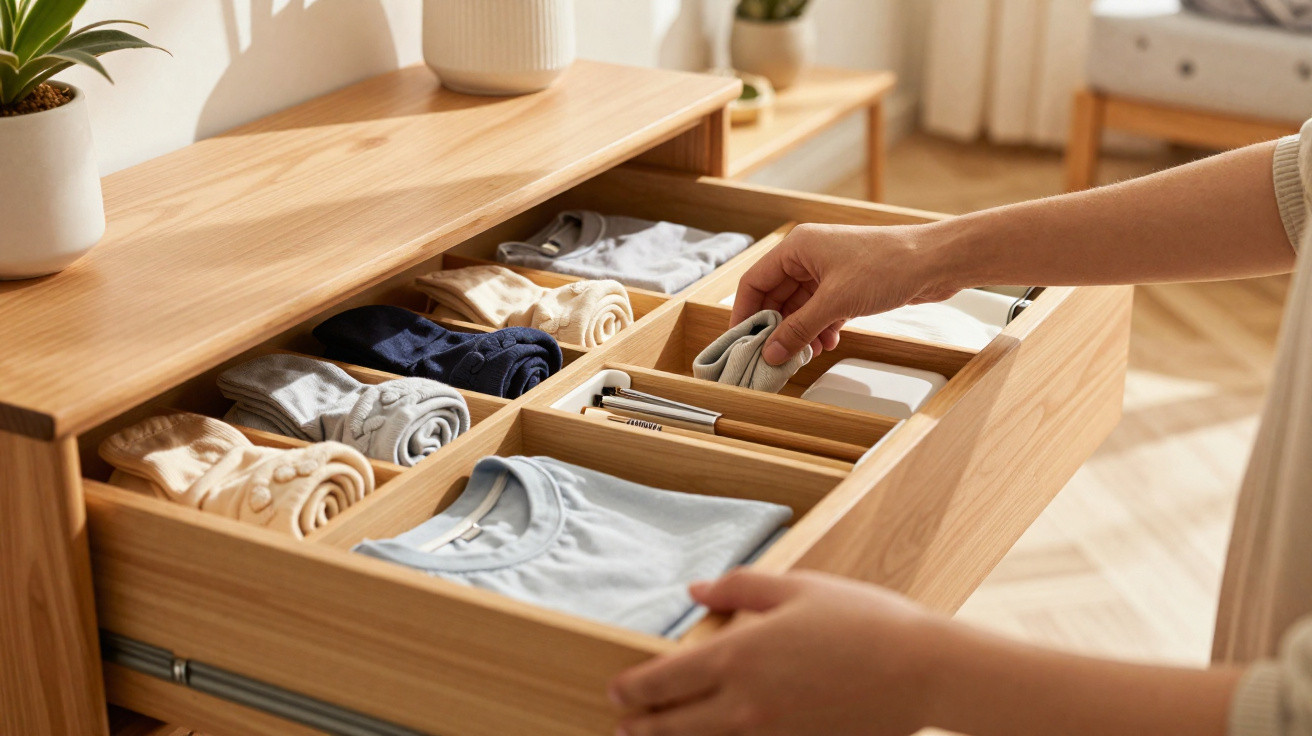
You open a drawer to pick up a pen and, all at once, it looks like the scene of a minor household disaster. Receipts are curling at the edges, loose batteries are rolling about, and there are three tape measures-except for the one you bought last week. You move a few things around, then close the drawer slightly too forcefully, knowing full well it will look identical tomorrow.
There is a small sense of embarrassment in it as well. The rest of the house may appear completely under control, but one tug on a handle reveals the reality. It is not that we never tidy; we simply lack a system that can withstand everyday life.
Oddly enough, there is a genuinely simple way to end the disorder.
Why drawers always descend into chaos
Look inside nearly any untidy drawer and the same issue appears: it is essentially one large, empty container. There is no framework or separation, only a space where items can slide, roll and become tangled together. That is the real issue.
We promise ourselves that we will “put things back where they belong”, yet nothing inside the drawer truly has an assigned home. Keys end up beside scissors, socks consume lone earbuds, and wooden spoons disappear beneath elastic bands. Whenever another item is dropped in, the unseen boundary between “organised” and “heap” becomes narrower.
Eventually, you avoid opening that drawer unless there is no alternative.
Consider the kitchen junk drawer. You know exactly which one. It may begin with a packet of batteries and a roll of tape, before acquiring an unidentified key, a spare charging cable and a birthday candle you cannot bear to throw away.
Three months on, you are rooting through business cards, dried-up pens, twist ties and takeaway menus for restaurants that closed in 2019. You are running late, your phone is on 3%, and the charger you “definitely put somewhere safe” is concealed beneath an expired warranty.
You do not deliberately make a mess. It accumulates through countless small moments of “I’ll just put this here for now”.
The principle is straightforward: open space allows belongings to spread, while divided space keeps them in place. Drawers without compartments resemble roads without lanes-everything drifts about and collides.
Our minds favour shortcuts, particularly when we are tired. An unstructured drawer requires a fresh decision each time: “Where does this go?” A drawer with a layout answers immediately: “Tech bits here, small tools there, pens in that corner.”
The drawers that stay neat most easily are those that subtly direct your hand whenever you open them.
The simplest drawer organisation method: create small “parking spots”
The straightforward idea that changes everything is to view each drawer as a collection of small parking spots rather than one large storage hole. Divide its interior into distinct areas with anything available-boxes, trays or even old food containers with their labels removed.
Pinterest-worthy styling is not the aim. The goal is “open, grab, close, done”. Keep long items at the back or down one side. Gather tiny loose objects into close-fitting sections. Place daily-use belongings in the front row, practically greeting you as you pull the drawer open.
The mess vanishes not because you have suddenly become tidier, but because the drawer no longer permits things to roam.
Begin with the single drawer that frustrates you most. Take everything out and place it on a table, then properly assess what is there. Sort belongings into “families”: writing supplies together, technology bits together, tools together and miscellaneous paperwork together.
Next, collect whatever small containers are to hand: shoebox lids, candle jars, old plastic takeaway tubs or trimmed cereal boxes. Arrange them inside the drawer like a puzzle until “mini boxes” cover most of the base. Give every group of items its own parking spot.
Close the drawer, then open it again, and your mind gives a small sigh of relief.
It succeeds because a vague aim becomes a physical rule. When a battery rolls into the pen section, it looks out of place, so you instinctively return it to where it belongs. There is no need to consciously decide; your eyes handle it.
It also creates a built-in boundary. Once the “chargers and cables” area is full, that is the limit. Something must be removed or stored elsewhere. The drawer begins to say “enough” for you.
Honestly, no one follows this perfectly every day. Yet once the structure exists, even a lazy quick tidy becomes remarkably quick. You are simply straightening lanes instead of reconstructing a city.
Small habits that preserve your new drawer order
After your drawer has defined sections, all that remains is a small routine: the three-second reset. Whenever you close it, take one brief look. If anything has strayed beyond its “parking spot”, push it back into place.
That is all. It is not a complete tidy-up or a Sunday task-just a minor adjustment while your hand is already there. Across a week, that three-second action saves ten minutes of later annoyance. Across a month, it prevents the dreaded session of dumping everything out and beginning again.
Its almost dull simplicity is precisely why it works in real homes occupied by genuinely busy people.
The mistake most of us make is trying too intensely, too perfectly and too quickly. We buy costly organisers, label every compartment and spend hours making everything flawless. Then life intervenes, a hectic week arrives, and the “perfect” system fails after one rushed morning.
Instead, begin with something imperfect and adaptable. Repurpose containers. Alter the arrangement after a few days if it does not feel practical. Do not give seldom-used items valuable front-row space simply because they look attractive there.
Show some kindness to your future self. Your drawer is not required to impress anyone; it only has to function at 7:32 a.m., when you are half awake and already running late.
“The breakthrough wasn’t organizing my drawers once,” says Emma, 34, who tamed four chaotic kitchen drawers in an afternoon. “It was realizing I could be lazy and they’d still stay mostly under control. The drawer does half the job for me now.”
- Create distinct zones – Use any small containers to separate the drawer, ensuring each “family” of objects has a dedicated place.
- Keep daily essentials at the front – Items you reach for every day should occupy the first row and remain easy to access.
- Set limits on capacity – When a compartment is full, take it as a cue to bin, donate or relocate something.
- Do the three-second reset – Before shutting the drawer, guide any wandering items back to their section.
- Review it once each season – A brief seasonal clear-out prevents random clutter from gradually returning.
From hidden drawer chaos to quiet confidence
There is an unexpected sense of power in knowing that a closed drawer is not hiding a mess ready to catch you out. It is a small detail, almost invisible externally, but it changes how you function at home. You open it, find what you need and close it. No hunting around and no muttering to yourself.
One organised drawer often has a knock-on effect. Once you sort out the worst one, your cutlery drawer can seem rather sorry by comparison. Your bathroom drawer may suddenly feel too jumbled. You begin to see each drawer not as a black hole, but as a group of parking spots waiting to be mapped out.
This change is not about turning into someone else. It is about giving your existing self a space that suits the way you actually live: rushed mornings, unpredictable evenings and the occasional “I’ll just deal with it later”. The drawer takes on your laziness while still keeping its form.
Perhaps the next time you open that troublesome drawer, you will stop briefly and picture how it might look with a few boxes and five minutes of sorting. Then one day, without giving it too much thought, you will empty it and begin.
And that soft little click as a well-organised drawer closes? It tends to stay with you.
| Key point | Detail | Value for the reader |
|---|---|---|
| Split the drawer into zones | Use boxes, trays or recycled containers to make small “parking spots” | Makes it clear where each item belongs, reducing time spent searching |
| Begin with one stressful drawer | Empty it fully, sort objects by type, then give every group a section | Delivers a fast first success that encourages you to tackle further drawers |
| Use the three-second reset | Before closing the drawer, move anything misplaced back into its zone | Keeps drawers neat over time with virtually no effort |
FAQ:
- Should I buy dedicated drawer organisers? You can, although it is not essential. Begin with items you already own: small boxes, lids, jars and food containers. Once the system has worked for a few weeks, decide whether you would like to upgrade.
- What if my drawer is very shallow? Choose low-profile options such as cut-down cardboard boxes, slim trays or even folded cardboard dividers. Prioritise separating categories horizontally instead of stacking items.
- How should I handle “miscellaneous” items? Give yourself one small “misc” area, but keep it limited. Once it overflows, take that as a sign to give those items a proper category or get rid of them.
- How frequently should I reorganise my drawers? Most people need only a light refresh every few months. If you regularly do the three-second reset, a quick five-minute check each season is generally enough.
- What if other people in my household ignore the system? Make it highly obvious and effortless: use clear zones, visible containers and keep the most-used items at the front. Show them where things belong once, then allow the drawer to “teach” them over time.



Comments
No comments yet. Be the first to comment!
Leave a Comment