
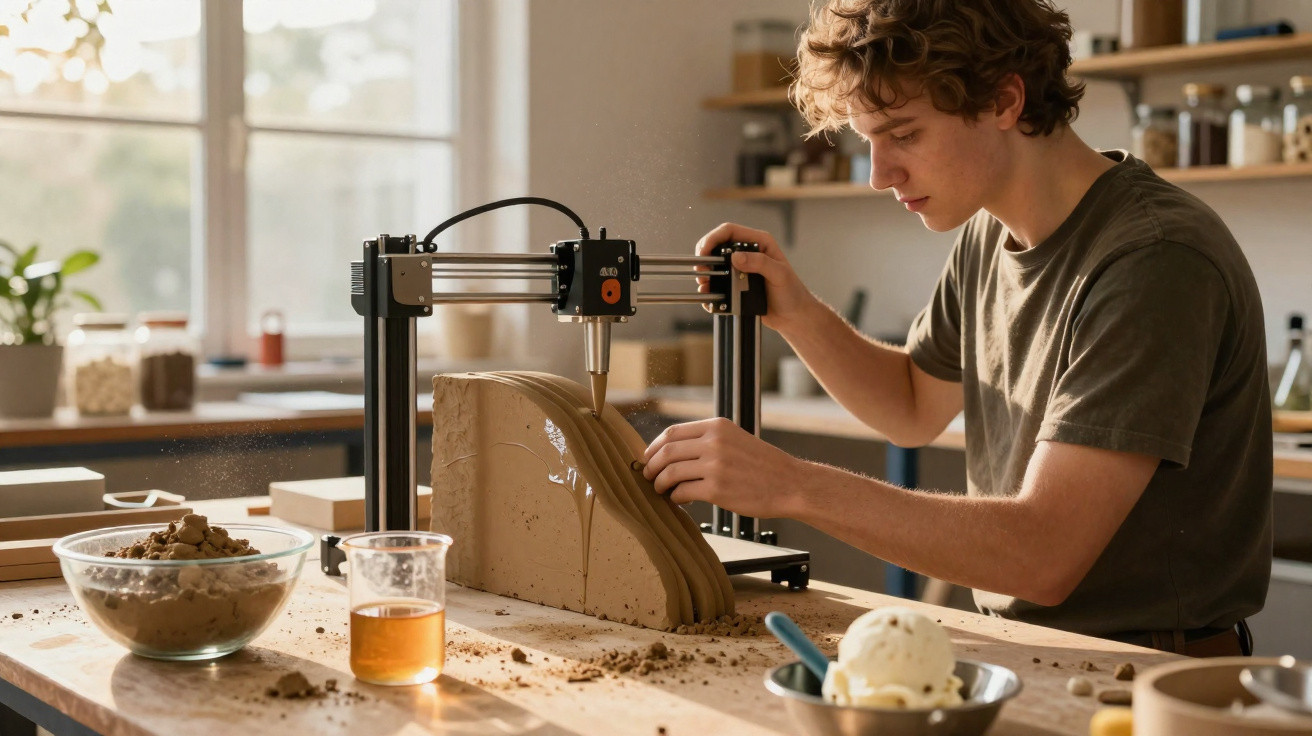
A biopolymer best known for giving ice cream its smooth, creamy feel could soon have a surprising second job: helping construction teams turn soil into printable walls.
Researchers led by the University of Colorado Boulder (UC Boulder) discovered that sodium alginate - a widely used food thickener - makes mixes of clay and sand much easier to form with a 3D printer.
The results hint at a lower-impact route for building, where what would normally be excavated waste can be remade into usable construction material. Instead of being hauled off to landfill, locally dug earth could be printed into walls.
Nature already knows the recipe
Across the natural world, builders routinely make strong structures from loose ground. Termites assemble towering mounds from soil, wasps craft intricate nests, and honeycomb worms create reef-like barriers along the shoreline.
These creatures don’t rely on cement. Instead, they use biopolymers - large biological molecules that act like a natural glue, often found in saliva - to lock soil and clay into solid shapes.
“From termite mounds to adobe buildings, humans and animals have been building with earth since the dawn of time,” said Wil Srubar, professor in the Department of Civil, Environmental and Architectural Engineering.
“But there hasn’t been a lot of science to how earthen builders design the materials. So, we wanted to use scientific knowledge and tools to understand it.”
A food additive enters construction
Srubar’s group, working with collaborators at Columbia University in New York, set out to identify a biopolymer that could both bind earth into wall material and still perform well inside a printer.
They took inspiration from nature’s approach and then put candidate binders through laboratory testing.
The challenge sounded straightforward but proved demanding: the mixture had to be stiff enough to keep its form once deposited, yet fluid enough to pass through a narrow nozzle without clogging.
Five binders faced the test
In total, the researchers evaluated five biopolymers. Three were derived from legumes: guar gum, locust bean gum, and cassia gum - thickeners commonly used to keep oil and water mixed in products like salad dressing.
Another option, sodium alginate, comes from seaweed and is widely added to ice cream, where it helps stabilise the mixture and produce a creamier texture. Xanthan gum, also used as a food binder, is produced by fermenting sugar.
Once blended with the clay and sand used for wall-building, each biopolymer produced its own distinct behaviour in the mixture.
Charge beats glue for printing
Locust bean gum created a strong hold by binding soil particles into a tighter, more robust network. However, that same strength made the material resistant to movement, so it was difficult to force through the printer.
Sodium alginate worked in the reverse way. Rather than acting purely like a glue, it altered the electrical charges on the clay particles, causing them to repel one another like magnets with matching poles.
That subtle change mattered. The particles remained evenly suspended in a consistent mixture, while the material still moved smoothly out through the nozzle.
Sand was never just filler
Engineers have often treated sand as a simple, inactive bulk ingredient. This study suggests sand plays a more active role, influencing how the entire earthen mix performs.
Because of its surface charge, sand affects how biopolymers attach and how particles rearrange within the material. In other words, sand becomes a key design variable rather than a minor component.
A tiny dose changes everything
After identifying sodium alginate as the most promising option, the team focused on dosage. In natural earth taken from a granite quarry near Golden, Colorado, they mixed in only 0.12 per cent sodium alginate.
That small addition produced a blend that was both printable and strong. Compared with plain earth, it withstood up to 25 per cent more pressure and could be printed 33 per cent faster.
The formulation also reduced drying shrinkage by about three quarters. Lower shrinkage translates into fewer cracks as a printed wall dries and sets.
Ice cream biopolymer helps tilted walls
To demonstrate the material’s capabilities, the researchers printed a wall roughly eight millimetres thick that angled outward at steep pitches. Even when tilted to 60 degrees, the structure remained upright.
That angle exceeds the lean of the Leaning Tower of Pisa. While the current research focuses on printability, Srubar noted that the same method could be used to evaluate other biopolymers aimed at improving strength and durability.
Earth keeps a home comfortable
“There are some good indoor environmental benefits of having earth in a building,” said Samuel Armistead, a research associate in the Department of Civil, Environmental and Architectural Engineering.
“It can regulate indoor moisture and uptake air pollutants. It can also serve as a thermal insulator, keeping things cool in the summer and warm in the winter.”
These traits mean earthen walls can do more than provide structural support; they can help maintain comfortable indoor conditions as weather shifts through the year.
Construction waste finds a purpose
Excavation for foundations, basements, and parking structures often produces vast quantities of leftover soil. In many cases, that material is transported away and disposed of in landfill.
“Our study suggests that there are ways to reuse waste earth material onsite, and that could largely reduce the environmental footprint of construction,” Armistead said.
Ice cream science could help build walls
Clay and sand are widely available in the places where people build, offering the opportunity to use materials already on site.
“Clay and sand are among the most abundant building materials on Earth,” Srubar said. “The science and engineering we’re developing can be applied almost anywhere in the world.”
The same approach could eventually inform other forms of earth construction, including rammed earth walls and compressed earth blocks. Builders may soon be able to print more sustainable homes using the ground beneath them.




Comments
No comments yet. Be the first to comment!
Leave a Comment