
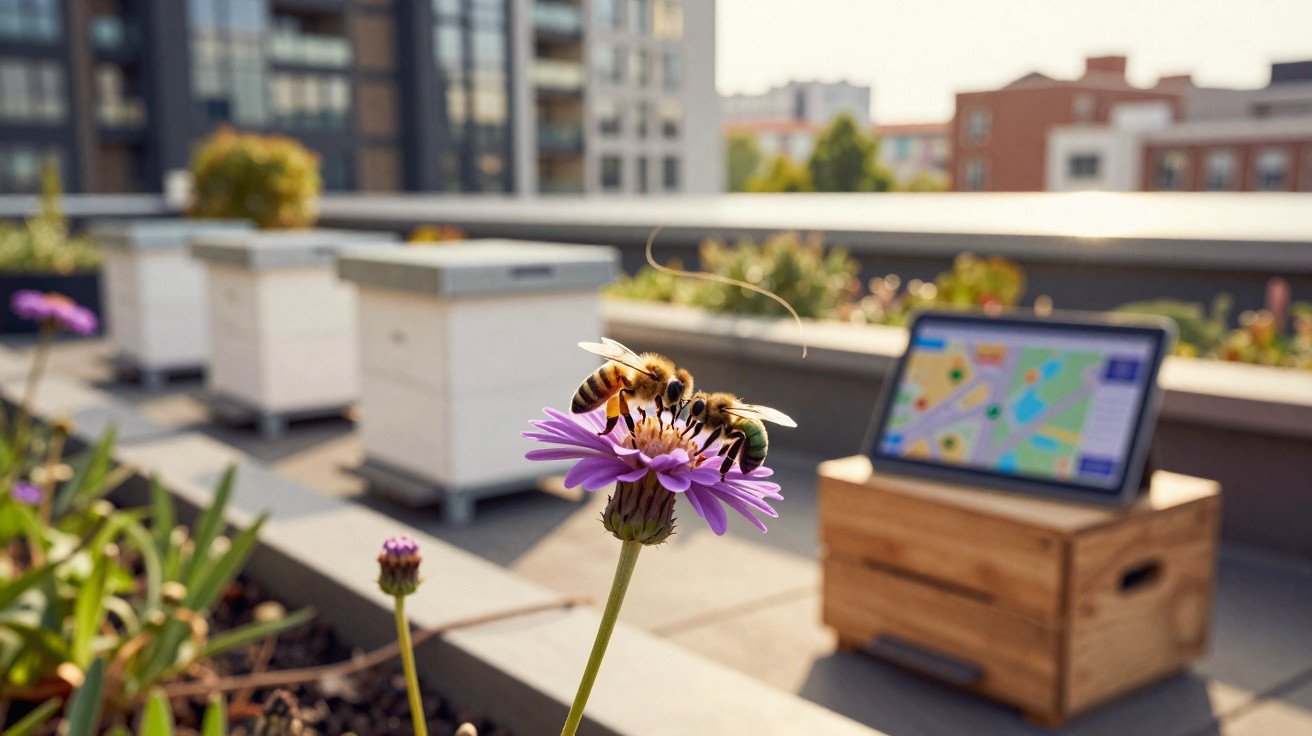
City beekeeping can put wild bees under pressure when honeybee colonies increase more quickly than flowers, space and routine health checks can keep up, a new study suggests.
The work reframes urban hives from a straightforward gesture of care into a planning challenge with genuine ecological costs.
Records reveal the strain
City records of apiaries show mounting pressure in places where managed honeybee colonies have expanded at speed.
By linking those records with risks faced by wild bees, Monika Egerer at the Technical University of Munich (TUM) showed why every additional hive raises demand within the same already-busy urban landscape.
Berlin illustrates the scale of growth: registered hives climbed from fewer than 2,500 in 2005 to more than 7,500 in 2022.
Figures on their own do not prove harm, but they do clarify why city beekeeping now requires regulation as well as goodwill.
Wild bees recover slowly
Even when honeybees and wild bees forage on the same flowers, they do not use the city in identical ways.
“In contrast to honeybees, wild bees often specialize in certain plants and habitats,” said Egerer.
Because most wild bees are solitary, the loss of a single sick or underfed female can wipe out the next generation from that nest.
This slow rebound raises the stakes of shortages: one poor season can mean fewer adults available to repopulate sites the following year.
Flowers set the limit
Urban areas can host many pollinators when gardens and parks provide reliable, continuous flowering.
For bees, floral resources-the nectar and pollen they rely on for food-determine whether a city is rich in forage or effectively stripped.
Carrying capacity, meaning how many bees a given area can support, shifts with the seasons, drought conditions, planting decisions and the amount of sealed ground such as pavements.
If hives are added without assessing that limit, shared green space can become a first-come, first-served feeding ground.
Heat raises demand
Competition can intensify with rooftop hives, because exposed boxes often run warmer than hives sited near vegetation and shade.
When colonies face heat stress, worker bees must spend extra energy cooling the hive, increasing the colony’s demand for nectar and water.
Thermal studies also indicate that honey harvesting and alterations to the honeycomb can disrupt internal hive temperatures, obliging bees to use energy to re-establish stability.
As a result, poor placement may harm honeybees first and then amplify pressure on nearby wild bees competing for the same flowers.
Crowding changes survival outcomes
One study in Montreal reported that wild bee species declined as honeybee abundance increased across urban green spaces following a major expansion in hive numbers.
The researchers compared bee communities recorded in 2020 with earlier surveys and also assessed pollen availability at the same sites across the city.
Small wild bees appeared particularly at risk, as their shorter foraging range leaves them with fewer alternative flower patches.
While this pattern cannot demonstrate that each hive directly caused each reduction, it aligns with the food-competition concern highlighted by the new concept.
Disease can travel
Shared forage is not the only risk when managed honeybees operate alongside wild bees.
Disease spillover-infections moving between species-can occur when insects visit the same blooms or nest nearby.
Field findings have associated honeybee viruses with infections in bumblebees, indicating how a managed colony can act as a reservoir for disease.
Where many colonies are concentrated-high hive density-health checks become more pressing for beekeepers and conservation staff alike.
Rules need cooperation
To balance benefits and harms, the TUM researchers created a framework for managed bees and wild bees, the Urban Bee Concept, built around six core measures.
The measures include planting more nutritious flowers, reducing hive density, improving disease control, providing training, and restricting hives in overly hot or polluted locations.
“It is crucial to work jointly here, with researchers, conservationists, governance and beekeepers,” said Joan Casanelles Abella, a postdoctoral researcher at TUM.
Common rules are important because city beekeepers range from hobbyists running a single hive to businesses operating large numbers of colonies.
Mapping tools guide better choices
Effective policy depends on understanding where hives, heat, floral resources and sensitive wild bee habitat overlap.
Mapping tools can identify overheated rooftops, areas with limited green cover, and neighbourhoods where existing colonies already compete heavily for food.
Since carrying capacity varies throughout the year, cities require repeated assessments rather than relying on one fixed number of permitted hives.
More detailed maps can also help safeguard zones set aside for wild bee conservation, while enabling careful beekeeping in appropriate places.
Improving habits and codes of conduct
Training can reduce impacts when beekeepers learn to recognise disease, position hives safely, and plant flowers that feed a wide range of bees.
Beekeeping associations can reinforce these practices through courses and codes of conduct, turning individual decisions into shared standards.
Corporate and turnkey beekeeping companies-businesses that install or maintain hives for clients-may require closer oversight.
Without registration and communication, city authorities cannot know where colonies are located or whether local floral resources can support them.
City beekeeping can still promote education, local food culture and appreciation for insects when hive numbers match flowers and health care.
Protecting wild bees now calls for fewer assumptions and stronger evidence, because good intentions do not create nectar or prevent viruses.






Comments
No comments yet. Be the first to comment!
Leave a Comment