
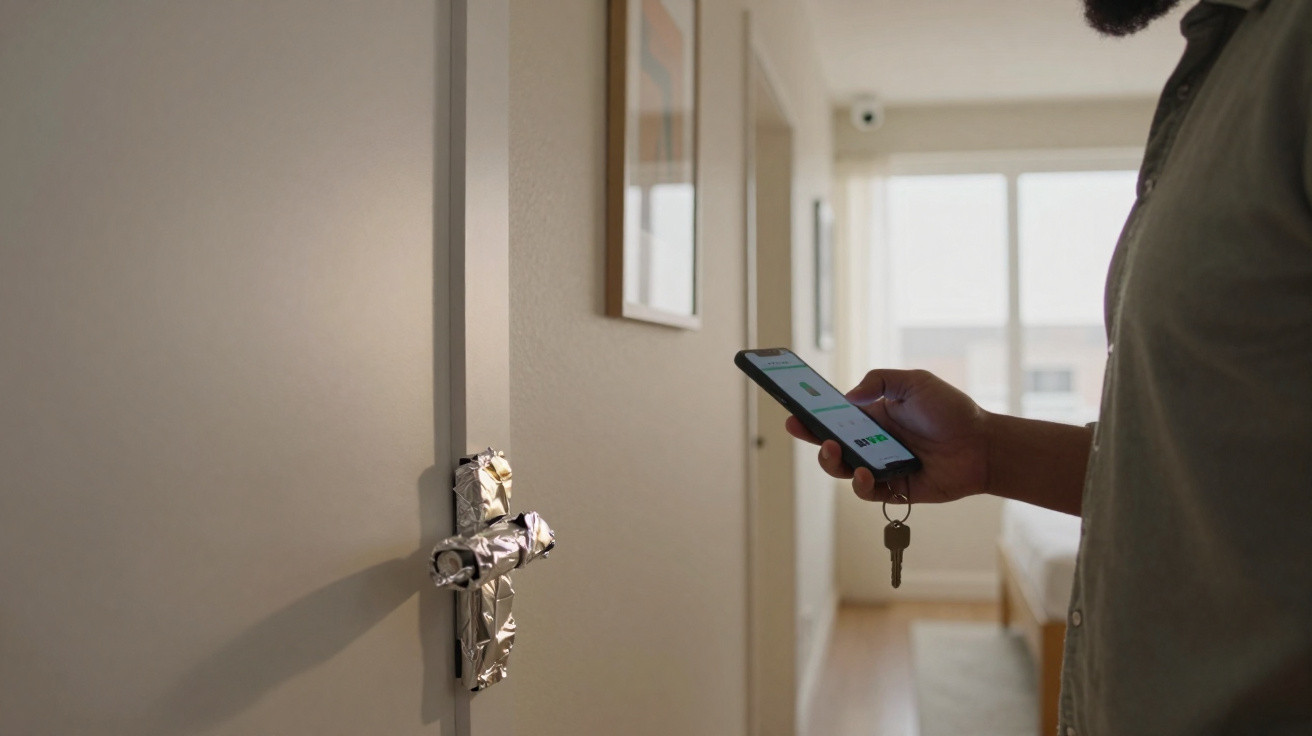
For several weeks now, an unlikely detail has been appearing on streets in the United States, the United Kingdom and Australia: aluminium foil. It is stuck, wrapped or taped around front-door handles. The act is subtle and, at first glance, almost absurd. Yet it has sparked neighbourhood rows, viral TikTok clips and serious arguments about the line between paranoia and caution. Neighbours trade worried WhatsApp messages, property managers lose patience, and local Facebook groups turn into miniature courts of public opinion. People who put up the foil say it is about security. Those who notice it see anxiety, an atmosphere of fear, or even conspiracy-minded folklore. Suddenly, an ordinary door handle reflects our shared fears. Almost nobody, however, dares knock and simply ask why.
Why are people wrapping door handles in foil – and what does it even do?
The same sight is appearing across many newer housing estates: matching façades, perfectly cut lawns, blinking Ring cameras … then a silver door handle tightly covered in crumpled aluminium foil. By day, it flashes in the sunshine like a poor piece of science-fiction DIY. At night, it catches every beam of light, almost like a silent warning. For some neighbours, it feels like a red flag. “Who does that? Has something happened at that house?” On quiet streets where every unusual detail stands out, this small piece of metal becomes a signal that is hard to overlook. It unsettles people as much as it fascinates them.
The trend took off on social media from 2022, with videos of women saying they were “protecting their family” by wrapping handles at night. It draws on several urban myths: that foil stops someone applying tape, oil or chemicals to the handle, or that it works as a makeshift alarm if the handle is moved. One TikTok creator from Texas, for instance, said that after seeing a suspicious pick-up truck circling her street, she began covering her handle “to know if someone had tried to get in”. The following morning, she said, the foil had shifted slightly. She took that as evidence of an attempted break-in. Her neighbours mainly saw one more reason to become anxious.
In practical terms, foil does not stop a lock being defeated, a bank card being slipped into a gap, or a genuine attempt to force the door. It is not armour; at best, it is a flimsy indicator. Home-security experts largely regard it as an emotional response: a low-cost way to regain a small feeling of control in a climate filled with alarming crime stories. It is a little like leaving a light on all the time, even when you know it is not genuine protection. The issue is that this visible signal sends fear outwards. It implies that an immediate threat is present on the street. Once it becomes a trend, it can blur the real message of prevention in favour of an aesthetic of fear.
What safety experts actually recommend instead of foil on your door
Experts following the phenomenon are fairly unequivocal: if the real aim is to secure a home, aluminium foil sits at the very bottom of the list. The essentials are a sturdy door, a good-quality deadbolt and effective outdoor lighting. Police also advise a straightforward habit: check entry points each evening, much as you would make sure a car is locked. There is no need to record the routine or turn it into a challenge. Simply make a calm round, handle by handle and window by window. Yes, it is repetitive, but it works far better than a hastily taped piece of foil.
Another useful approach is to make better use of technology already in place, rather than create conspicuous symbols of fear. Many households with smart doorbells do not properly use their available features: detection zones are set too broadly, notifications are switched off, and footage history is never reviewed. Let us be honest: hardly anyone does this every day. Even so, careful camera settings, targeted alerts for movement near the door and a shared alert arrangement with a trusted neighbour have far more real impact than a wrapped handle. They also do not send the same anxious message to the rest of the street.
Psychologists who work with feelings of insecurity emphasise an important distinction: it is possible to be cautious without displaying anxiety on the front of the house.
“The boundary between healthy vigilance and anxious behaviour is often the way we involve other people in our fear,” explains a therapist specialising in anxiety disorders. “When a protective action becomes a visible spectacle, it feeds collective concern.”
In this situation, a few simple principles can help strike the right balance:
- Choose discreet, effective security measures, such as locks, lights and sensors, rather than dramatic signs visible from the street.
- Speak to neighbours before copying a TikTok trend, particularly if it affects the atmosphere in a block of flats or housing estate.
- Ask honestly whether a particular action genuinely reduces risk, or merely soothes an internal worry without producing a practical effect.
Living next to foil-wrapped handles: awkward conversations and quiet worries
For neighbours, the real “bad news” is not the foil itself but the sense of threat it leaves hanging in the air. Some residents say they find themselves walking faster in the evening simply because two homes on their street have adopted this silver DIY measure. Others wonder whether there has been an attempted burglary that nobody told them about, or whether a predator is genuinely nearby, as rumours sometimes claim. The worst part is the silence: nobody wants to seem intrusive, and nobody quite dares knock on the door and ask directly, “Are you all right?” Concern then spreads quietly through pavement conversations and residents’ group chats.
In some neighbourhoods, the story even becomes a small symbolic war. One resident removes the foil from a shared block entrance handle because it looks unsightly. Another puts it back, convinced they are protecting everyone. A crumpled sheet of foil becomes an argument over individual rights and collective security. Meanwhile, residents who never asked to be involved have to explain to their children why “the house opposite has wrapped its door like a sandwich”. This minor scene captures something broader: a time when fear travels faster than facts, often because people do not have the confidence to discuss it openly.
| Key point | Details | Why it matters to readers |
|---|---|---|
| What foil on a door handle actually does | In most cases, it functions chiefly as a visible “tamper seal” and a personal ritual. It will not prevent forced entry or sophisticated break-ins, although it may reveal that somebody has casually touched the handle. | It helps you judge whether following this trend offers genuine protection or simply a sense of control without a meaningful safety benefit. |
| Better low-cost security upgrades | Reinforced strike plates, longer screws in hinges, a quality deadbolt and a motion-activated porch light are all relatively inexpensive but substantially increase the effort needed to break in. | It provides practical alternatives that strengthen real security without making your front door a public symbol of fear. |
| How to talk to a neighbour who does it | Lead with concern rather than judgement: ask whether they have had a scare, share what you have heard locally, and suggest practical options such as a shared camera or neighbourhood chat. | It lowers unspoken anxiety on your street and keeps the discussion based on facts rather than rumours and social-media myths. |
FAQ
Is wrapping a door handle in foil a genuine police safety recommendation?
In most areas, police and official crime-prevention advisers do not include this among their recommended measures. Their guidance generally focuses on sturdy doors, quality locks, lighting, alarms and simple nightly checks rather than symbolic actions.Can foil on a handle prevent chemicals or harmful substances being used?
In theory, a layer of foil could prevent direct contact with a contaminated handle, but in practice it is an unreliable barrier. If somebody is genuinely malicious, they can simply target another entry point or remove the foil.Why do some people feel safer with this ritual even if it is not very effective?
It is quick, visible and inexpensive. For anxious homeowners, the act of “doing something” can settle the mind, even if its actual effect on risk is very limited.Should I be concerned if my neighbour suddenly starts doing this?
It may mean they have heard a worrying story, had a minor scare or simply followed a social-media trend. The most constructive response is to speak to them calmly rather than let imagination fill in the gaps.What is a healthier way to manage fears about home security?
Combine practical steps with honest conversations: improve basic protections, check local crime statistics rather than rumours, and share your concerns with trusted neighbours or a professional instead of keeping everything to yourself.


Comments
No comments yet. Be the first to comment!
Leave a Comment