
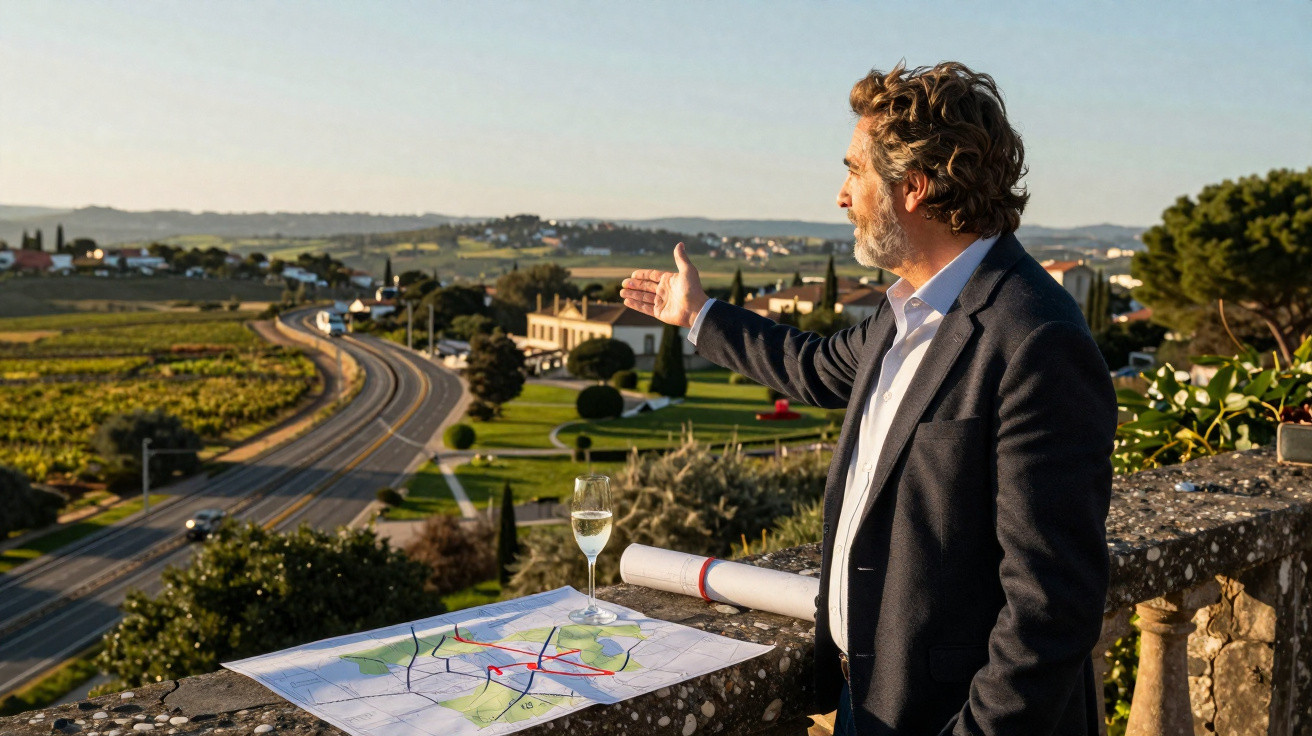
Jorge Sampaio, the Mayor of Anadia, says the project is part of the negotiations between the Government and Brisa. In tourism, the council will take on the management of Curia Park so the company can focus on refurbishing the thermal spa.
In Bairrada, it had long felt inevitable that Jorge Sampaio, 54, a graduate in Civil Engineering, would one day lead Anadia Town Council. The local authority’s former deputy mayor won the October election for the PSD - the party in government - and is relying on that alignment to finally secure a direct connection to the A1, a long-standing ambition for residents and businesses across the municipality.
The new A1 access - demanded by people in Anadia, who, because of IC2 traffic, are far from the Mealhada and Aveiro Sul junctions - will it move forward now that the Government is from your party, or not this time either?
We have been talking to successive governments about this for years. This government has already recognised how necessary this junction is. We sit between two junctions that are the furthest apart on the whole A1: more than 20 kilometres separate them.
On top of that, IC2 and EN325 traffic is heavily congested, which means the 13–14 kilometres between us and the Mealhada and Aveiro junctions can take more than half an hour to drive. That is why we have spent years pressing for this access - for local people and for companies.
What stage is the process at?
The government is renegotiating the concession with Brisa, and the information we have is that the creation of this junction is included in that negotiation. The junction would be close to the Amoreira da Gândara industrial area, with a direct link to IC2 near the Velodrome, and another direct link to Oliveira do Bairro, in the Vila Verde industrial area. This is when the A1 access junction in Anadia will finally move ahead.
When?
It is very unlikely that the work will be completed during this term of office, up to 2029.
On housing, is there a long waiting list for council homes or affordable-rent homes?
We do have a sizeable list of requests - around a hundred. But we are going to make a major dent in it. We have already handed over homes in Ancas, and by August we will complete the project in Sangalhos, with 21 homes.
We are also in talks with the State to buy the former Tax Office premises in Anadia and convert that building into housing. But we have another issue...
What is it?
People who are not in acute need, but want to move to Anadia, simply cannot - supply is very limited and what exists is extremely expensive.
What we are doing - to prod contractors and demonstrate that it is possible to build and sell at normal market prices - is to promote the construction of around 20 flats next to the urban park. We have contracted a company to carry out the build, but it will be the council selling the homes at market prices.
Does the council also want to convert old factories into housing?
We have some areas that the municipal masterplan (PDM) classifies as economic zones intended for industry, but they are abandoned and attract no proposals. We want to repurpose them for housing.
This is not about building housing inside active industrial zones. One example is the former Sachs factory, which is collapsing - a disgrace in the centre of Anadia. If no one is taking it on for industrial use, why shouldn’t that site be used for housing instead? And there are another half-dozen similar sites spread across the municipality. To make that possible, we are changing the PDM.
To talk about tourism is to talk about Curia and the thermal spa. Isn’t it an underused gem?
It is, but the Park and the thermal spa are privately owned, as is the hotel in that same cluster, which belongs to Sociedade Águas da Curia. We are negotiating with the company to split responsibilities.
For a long period - we are analysing 10 or 20 years - the council would take responsibility for maintaining and improving the Park, opening it up for public use. In return, the company would commit to using the money it saves on the Park to refurbish the thermal spa and the hotel. We expect to reach an understanding by September.
You have argued that Anadia Hospital, which is owned and run by the Misericórdia, should be integrated into the Local Health Unit (ULS) of the Aveiro Region. Why?
Anadia Hospital already works with the National Health Service through service contracts. But we believe it could offer more services.
It could act as a support anchor for Aveiro Hospital because it has excellent logistical conditions for surgery, consultations and inpatient care - capacity that is not being used, while Aveiro is short of space. I hope the new ULS management does not waste Anadia Hospital. I know the Misericórdia is open to what I am proposing.
The council promised legal support to people and businesses in Anadia who feel harmed by the high-speed rail line. Where does that stand?
The council will support our residents - whether private individuals or companies, and there will be more than a hundred - in negotiations with the State over the expropriation of land and of homes that will be demolished.
Those negotiations have not started yet, but they will affect a huge area of vineyards - in São Lourenço do Bairro, for example - one of the most important and beautiful wine-growing landscapes, which will be crossed by a viaduct for the high-speed line.
Will the Sparkling Wine Research Centre go ahead or not?
Sparkling wine is extremely important to us economically and culturally. We have two projects, both arising from dialogue with the Wine Commission.
The first is the Sparkling Wine Research Centre. The second is an incubator for sparkling-wine producers. Many small producers in our region do not have a production line for bottling and labelling. Our idea is to create a site, run with an almost cooperative-style management model, providing that equipment and technical support for those small producers.
Is the Velodrome in Sangalhos delivering what you hoped for when it opened in 2009?
It has exceeded every expectation. Each year it welcomes 8000 to 10000 high-performance athletes from 60 countries.
If we measure it by medals won by athletes who trained there - in cycling, gymnastics, judo, and so on - then in the most recent Olympic Games we "had" three Portuguese medals. But overall, at those Olympics, athletes who trained in Sangalhos won 17 medals.
Income does not cover costs: we run an annual deficit of €200,000. Even so, the impact on the local economy is far greater. Around 60% of our hotel trade comes from sports tourism. And what is an Olympic medal worth? In cycling, we won two - without the Velodrome, we would not have had them.
Should regionalisation go ahead?
My view is that we should be looking at a reorganisation of the country. It makes no sense for responsibilities in many areas to remain scattered across multiple bodies.
Take tourism as an example. In the Centro Region alone, we have Turismo do Centro with responsibilities, but overseas promotion sits with the Centro Tourism Agency. Then there are the CCDR (Regional Coordination and Development Commissions), the municipalities and the CIM (Intermunicipal Communities). That is five entities with tourism responsibilities, investing in tourism, and often duplicating efforts - promoting the same things, in different language, using resources that ultimately come from the same place.
What we need is to put the house in order. Concentrating services within the CCDR is the right direction.
In what direction should the local finance law move?
It needs to be revised. The transfer of powers to councils has amounted to shifting responsibilities from the State to local authorities, without giving them the management capacity or resources.
The next agreement must come with more funding and new management powers.



Comments
No comments yet. Be the first to comment!
Leave a Comment