
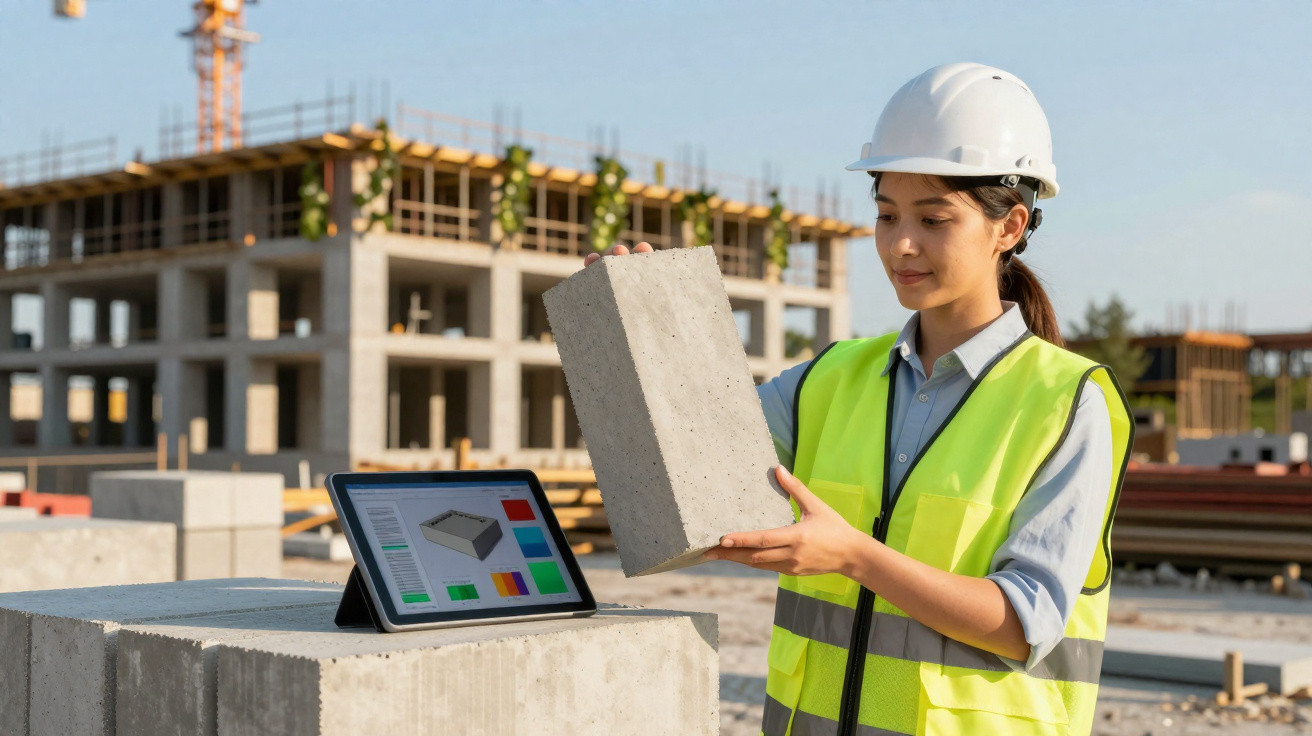
Researchers have shown that a newly developed concrete binder can convert captured carbon dioxide into stable mineral compounds, while still delivering the strength needed for structural applications.
This result reframes concrete from a leading emitter into a construction material capable of permanently locking carbon into the built environment.
Concrete tested at scale
In Karlsruhe, a city in south-west Germany close to the French border, load-bearing blocks and beams are now undergoing trials that put this carbon-storing behaviour under genuine structural demands.
Through close study of these full-size elements, Professor Frank Dehn at the Karlsruhe Institute of Technology (KIT) is tracking how the new binder captures carbon while also carrying weight and withstanding stress.
So far, testing indicates that the carbon, once bound into minerals, remains stable inside the concrete as it sets and performs under progressively higher loads.
These early findings suggest a realistic structural material, while also prompting the practical question of how much conventional cement can be substituted without undermining long-term performance.
Cement’s carbon footprint
The bulk of concrete’s climate impact comes from clinker, the kiln-fired component that enables cement to bind sand and aggregate.
Part of the emissions stem from the very high temperatures required, and more are released when limestone is processed in kilns that drive off carbon dioxide to produce Portland cement.
That chemical breakdown of limestone is a major reason cement clinker is linked to roughly eight per cent of global carbon dioxide emissions.
A binder that reduces clinker content without sacrificing strength addresses emissions at their principal source.
Supplies are shrinking
For years, builders reduced cement-related emissions by using supplementary cementitious materials-added powders that replace a portion of clinker.
Fly ash from coal-fired power stations and slag from blast furnaces proved effective, largely because those industries produced them at huge scale.
However, as coal power is phased out and steelmaking processes evolve, those supplies are dwindling, leaving low-carbon concrete with fewer established options.
What was once an add-on has become a core constraint, which is why alternative mineral feedstocks are now drawing greater interest.
How carbon is stored
C-SINC, the European project developing the new formulation, relies on magnesium silicates-magnesium-rich minerals that react with carbon dioxide.
Using an accelerated mineralisation process in which gas is transformed into solid minerals, these magnesium-rich particles bind carbon into magnesium carbonate.
Some of the carbon can be sourced from industrial exhaust streams, meaning the concrete is not only lower in emissions but can also store captured gas.
This carbon-binding chemistry sits at the centre of the approach and also sets the practical limit on how much clinker can realistically be replaced.
Why storage lasts
When carbon becomes incorporated into a carbonate mineral, it is far less likely to escape than carbon stored as compressed gas underground.
“The CO2 isn’t just stored, it’s chemically bound in a mineral. It remains firmly bonded, so it can’t escape over very long periods,” said Dehn.
A previous study found that processing olivine, a widely available magnesium-rich rock, can produce both a silica-rich cement substitute and a carbon-bearing magnesium carbonate.
That permanence is crucial, because a climate solution that releases carbon again decades later would deliver far less benefit than the researchers are aiming for.
Computers narrow mixes
Developing a workable concrete mix typically involves lengthy cycles of trial and error, so C-SINC is using algorithms to reduce the number of candidate formulations.
A major tool is machine learning-data-trained pattern-recognition software-which can identify promising recipes before teams cast trial batches.
After that, simulations estimate how the binder is likely to behave as the concrete cures, develops cracks, and carries loads over time.
While computational screening cannot replace physical validation, it can prevent months being spent on formulations that prove too weak.
Stress tests matter
Concrete intended for buildings must do more than set: it needs to bear loads, withstand weathering, and protect steel reinforcement.
“We’re doing that on a small scale, and in real large-scale structural elements as well,” Dehn said.
That caution is particularly important with unfamiliar binders, because small shifts in chemistry can change cracking behaviour, moisture transport, and the risk of corrosion.
A formulation that stores carbon but fails prematurely would not be practical at the scale the construction sector requires.
Europe backs scaling
Europe has committed nearly four million euros to C-SINC over four years, signalling that the concept is intended to go beyond laboratory chemistry.
The consortium brings together universities and a precast concrete manufacturer, combining research capability with industrial experience to move towards real construction use.
That partnership offers a quicker route into factory production, standards development, and full-scale building products.
Speed is critical, because climate-friendly concrete will not materially cut emissions unless producers can manufacture it cost-effectively and at volume.
Limits still matter
Even magnesia-based cements-binders built around magnesium compounds-still face open questions on durability and scale-up.
Some magnesium formulations have lower alkalinity, meaning they are less chemically basic, so reinforcement protection and weathering performance require thorough assessment.
Researchers must also demonstrate that the material can fit into existing supply chains, building codes, and mixing practices without driving costs too high.
Concerns around durability, cost, and compliance do not invalidate the approach, but they help explain why today’s large-scale testing is so urgent.
Future of carbon concrete
Concrete will not become a carbon sink overnight, but the ongoing trials indicate there is now a credible chemical pathway.
If full-scale testing continues to confirm strength and durability, future buildings could permanently store a share of the pollution once emitted to produce them.





Comments
No comments yet. Be the first to comment!
Leave a Comment