
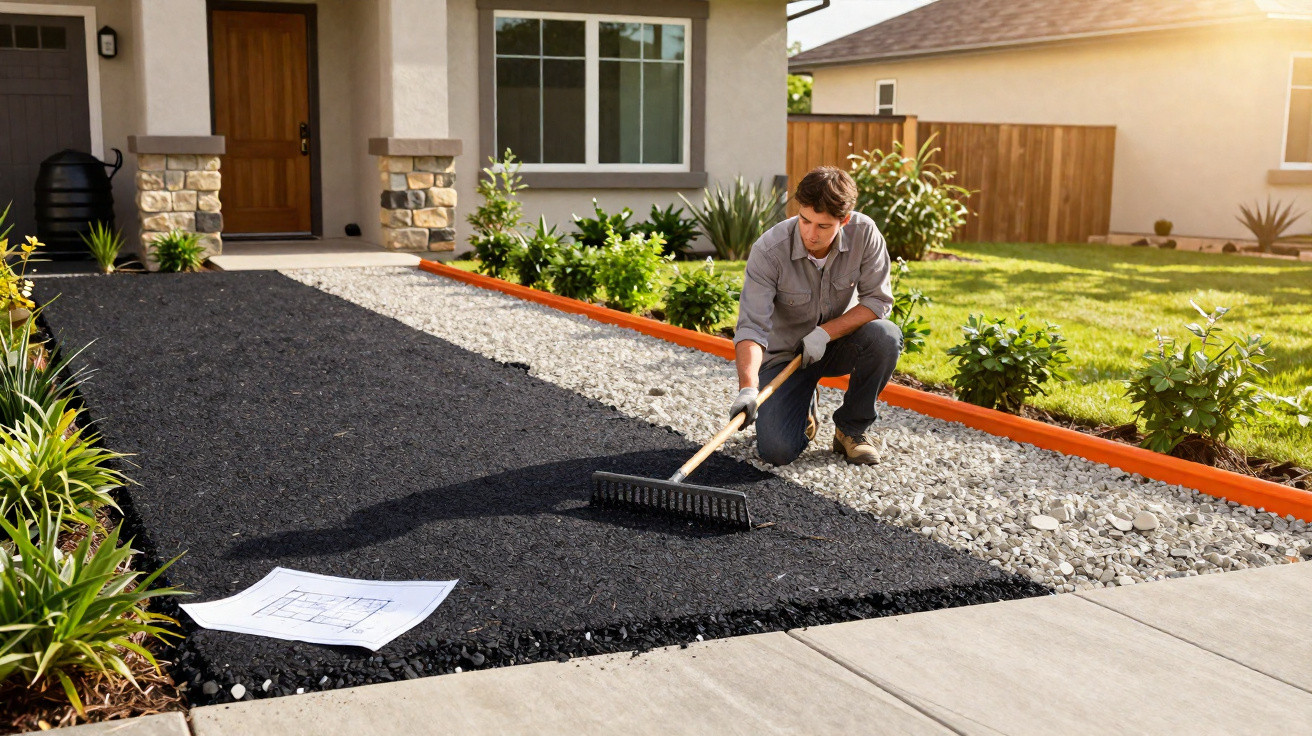
Cracked surfaces, puddles that sit for days, and grey heat islands in summer: that is the day-to-day reality in countless driveways. With concrete prices climbing and councils placing ever tighter limits on sealed surfaces, one question is becoming harder to ignore: how can you build a driveway that works for everyday life, is kinder to both your budget and the environment, and still stays solid under a car?
Why the continuous concrete slab has become a problem
For many homeowners, concrete still feels like the safe choice: pour it once and forget about it for decades-or so the assumption goes. Increasingly, though, that promise doesn’t hold up.
First, the emissions are significant. Cement-the binder that makes concrete work-has an energy-intensive production process that drives CO₂ output sharply upwards. Specialist sources estimate that cement manufacturing accounts for almost a tenth of global emissions.
Second, a fully continuous, completely impermeable slab no longer aligns with the direction many cities and councils are taking. Rules aimed at reducing land sealing and improving rainwater infiltration are pushing authorities to allow fewer “hard” driveways and parking areas. Every square metre that can’t absorb water adds pressure to sewers and treatment works-and makes flooding during heavy downpours more likely.
Then there’s the price. In Germany, a properly built concrete driveway often costs between €85 and €160 per square metre, including the sub-base. If deep cracking develops later, it becomes awkward quickly: patch repairs are immediately visible, and extensive remedial work can easily run back into four- or even five-figure sums.
"Concrete slabs look ‘definitive’-but in reality they make you inflexible, expensive and hostile to rainwater."
Recycled asphalt: a robust driveway with a smaller bill
An option long established in road construction-and increasingly used on private property-is recycled asphalt. Professionals often call it processed planings: old roads are milled off, broken down, re-bound and laid again. What was waste becomes a fresh wearing course.
How recycled asphalt is made and what it delivers
When a road is removed, the top layer is milled away and broken into pieces. Those fragments go through a processing plant, where they are sorted, blended and combined with fresh binder. The resulting mix is then laid again as a surface for paths, yards or driveways.
This loop reduces demand for raw materials such as aggregate and bitumen, cuts transport distances and lowers energy use compared with building entirely from new materials. In real-world terms, asphalt driveways-whether they include recycled content or not-typically last around 15 to 30 years. Because asphalt flexes more than a rigid concrete slab in heat and frost, it is generally less prone to deep, full-width cracking.
What recycled asphalt costs
The numbers are where it gets particularly interesting. While a high-quality concrete driveway can quickly reach triple-digit prices per square metre, asphalt driveways with recycled content are usually well below that. As a broad guide, €26 to €72 per square metre is realistic for a professionally installed area, including the sub-base. Standard asphalt often sits somewhere in the middle of this band.
If environmental impact is a priority, there are also versions designed to manage rainwater better or to rely on alternative binders:
- Drainage asphalt: a porous structure that lets water soak away faster, typically around €50 per square metre.
- Plant-based binder asphalt: replaces part of the petroleum content, costs about 20% more than the standard option, but improves the CO₂ balance.
For households with a heavily used driveway and regular car traffic, recycled asphalt often lands as the compromise: strong, markedly cheaper than concrete, and made with a share of reused material.
Crushed concrete: low-cost, permeable and surprisingly practical
If keeping costs down is the top priority, crushed concrete can be even more attractive. Old slabs and components are broken up, cleaned and crushed into different grades. The finished product commonly contains sand, aggregate and traces of mortar-a blend that, once compacted, locks together into a surprisingly stable load-bearing layer.
Permeable ground instead of a rigid slab
Used on a driveway, crushed concrete forms a semi-bound surface. It sits much firmer than loose gravel, yet stays open enough for rainwater to drain into the ground. Standing water is reduced, drainage systems are under less strain, and the ground beneath the surface doesn’t dry out completely.
Cost-wise, many people get a genuine surprise: in many areas, recycled concrete can be up to 50% cheaper than comparable bulk materials such as decorative gravel or natural stone. On long access tracks running several dozen metres, that gap can add up to several thousand euros.
Pros and cons in everyday use
Maintenance is generally manageable. Leaves and small branches can be swept or blown away; occasional dips can be topped up and compacted with a plate compactor or a hand tamper. Done now and then, this keeps the surface load-bearing and reasonably even.
At the same time, it shares some characteristics with gravel:
- Tyre tracks can deepen over time.
- If you drive in too quickly, dust can be kicked up, dirtying wheels, sills and the entrance area.
- Fine chippings can get carried into the house.
"Crushed concrete isn’t for perfectionists-but it’s a bargain for long, soakaway-friendly driveways."
Homeowners who want to control weeds on a driveway without chemicals often reach for household mixes. A commonly used combination is water, vinegar, coarse salt and a little washing-up liquid. Specialist sites, however, warn against heavy-handed use: salt acts like a steriliser in soil, damages soil life, and should only be used on surfaces that are already impermeable or that have their own drainage system.
Which surface suits which house?
Choosing between recycled asphalt, crushed concrete and a remaining option of conventional concrete depends heavily on how the driveway is used, the ground conditions and the budget. A simple comparison helps with orientation:
| Option | Typical use | Water absorption | Cost level |
|---|---|---|---|
| Concrete slab | presentational drive, crisp edges | virtually impermeable | high |
| Recycled asphalt | frequently driven driveway, parking bays | moderate, better with drainage variants | medium |
| Crushed concrete | long driveways, rural plots | very permeable | low |
Appearance plays a part too. Asphalt looks technical and dark; crushed concrete reads as rougher and more rustic. If you like greenery, you can pair the surface with grass pavers or planted edging strips-and accept a deliberately slightly “imperfect” look.
Tips for planning, sub-base and drainage
Whatever surface you choose in the end, the foundation is what determines how long it lasts and how well it works day to day. A durable build-up usually follows the same basic steps:
- excavate to sufficient depth, taking frost depth into account
- install a load-bearing, well-compacted crushed-stone sub-base
- plan a fall of roughly 2% away from the house
- direct water into beds, swales or a soakaway trench
On very clay-heavy ground, it can be worth considering additional drain pipes or gravel trenches. These help prevent waterlogging beneath the surface. If you’re building in an area with strict rules against land sealing, it’s sensible to check requirements in advance with the local planning office or a landscaper. Some councils even support permeable surfacing-for example, by reducing surface-water charges.
How eco surfacing can still feel comfortable
Many homeowners worry that an “eco” driveway automatically means more mess and less comfort. In practice, a workable middle ground is often possible with a few design choices. One approach is to lay a firm, easy-to-clean strip directly in front of the front door and garage, while the remaining area uses a permeable surface. That keeps the entrance tidy without sealing the entire plot.
If you have children-or you regularly use bikes and scooters-smooth wheel tracks matter. With crushed concrete, a stabilising grid made from plastic or concrete cells can hold the aggregate in place. With recycled asphalt, a properly compacted top course delivers a more comfortable surface for both walking and driving.
What the technical terms really mean-and what owners should check
Terms such as “permeable” or “eco surface” sound clear, but in practice they can describe very different products. Some materials only allow water through joints; others are porous throughout. For approvals, that distinction can be crucial. If you want to be certain, ask the supplier to confirm in writing what infiltration performance the surface actually achieves.
Over the long term, recycled and permeable surfaces can pay off twice: they reduce the risk of frost damage caused by standing water, and they may cut fees where councils charge less for unsealed areas. At the same time, the garden stays healthier because more rainfall ends up where it should-soaking into the ground rather than disappearing down a gully.


Comments
No comments yet. Be the first to comment!
Leave a Comment