

Thinking politically about the problems we face, individually and collectively, is a civic duty. Reflecting on the territory we live in - and reshape every day - should sit naturally within that effort. In Portugal, political debate about territory has become poorer, with particular sharpness in this century. This is not because there are no real issues, but because there is no structured political thinking about them.
A way of thinking that once drew strength from multidisciplinary reading and a wide range of academic research has ended up weakened by the case-by-case, atomised and legalistic outlook that has taken hold across the State’s technical-administrative machinery and bureaucracy.
Territory is not a neutral backdrop against which politics happens. Every policy carries choices, priorities and interests that ultimately take physical form in territory. Overlooking this does not merely lead to technical mistakes; it is, above all, a lack of political intelligence. A country that does not think about its territory will struggle to think about its future.
Thinking politically about territory in Portugal
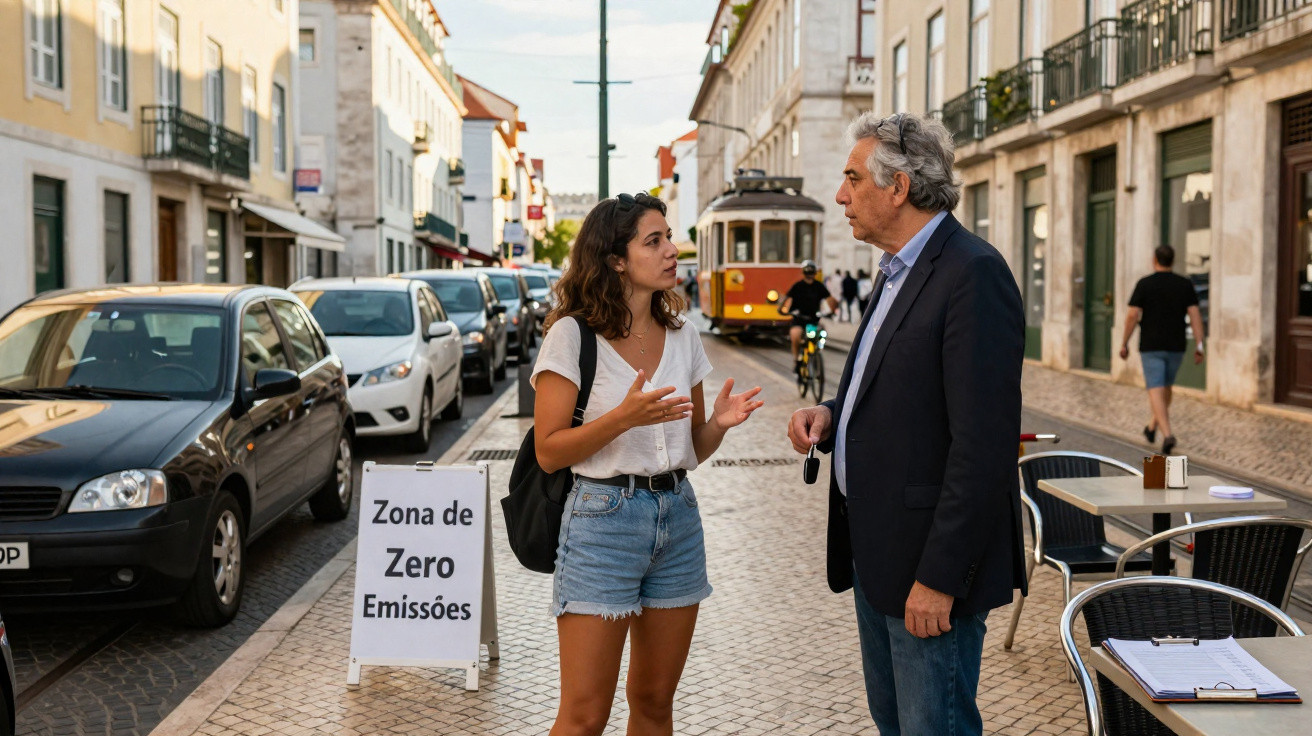
Territorial policy rarely reaches public debate as a strategic question. Instead, it appears in fragments, reduced to isolated views and one-off problems - housing, wildfires, floods, the abandonment of inland areas - treated as though they were unrelated. They are not. They are different manifestations of the same collective incapacity: failing to understand territory as a complex system and to use it as a field for sustainable development, integrating environmental, economic and social dimensions.
How bureaucracy displaced strategy in territorial governance
Over time, territorial governance has been captured by a bureaucratic practice in which procedure has outweighed strategic vision, and the technical-administrative opinion has come to count for more than political decision-making. In parallel, urban planning has also been gradually hollowed out as an instrument that should be integral to territorial policy.
This hollowing-out is not explained only by excessive bureaucracy, but by factors that have accumulated over time: the shift in scale of urban phenomena, now extending far beyond the traditional city; the growing complexity of territorial problems; the fragmentation of disciplinary approaches; the difficulty of weighing up - and deciding between - contradictory values; and the replacement of an integrated view of territory with generalist spatial planning and a technical-administrative management approach that is rarely effective.
The end result is a system that does not plan, does not take risks and does not respond - one in which politicians have stopped governing territory and have instead begun to manage it defensively.
This blockage is neither inevitable nor abstract. It is created by people, often blurred into the hierarchies of our institutions. Laws are written by people, opinions are issued by people, and decisions - or the lack of them - arise from concrete institutional, cultural and historical contexts. Over recent decades, a vicious cycle has taken shape: when faced with genuine difficulties, the response is more legislation, more procedures and greater complexity. In practice, the system has become less efficient and less able to tackle and resolve problems.
The consequences are visible. Territories are increasingly dysfunctional, degraded and vulnerable to environmental disasters, unable to cope with extreme events. There is a structural demographic problem, with large areas of the country in continuous population decline. The State finds it ever harder to weigh up, debate and decide on models of spatial planning and territorial occupation, land use, and where infrastructure should be located. Strategic instruments do exist, but they remain vague and incapable of guiding concrete action. Planning instruments also exist, but they have become heavy and inoperable, captured by the bureaucratic phenomenon.
Insisting, in this context, on rigidity, institutional fragmentation and the illusion of bureaucratic control is a political mistake. It is essential to find ways to unlock institutions and to shift from a mindset of binding opinions to one of contributory opinions. Governing territory requires flexibility, agility and decision-making capacity. But it also demands knowledge. Nobody makes good decisions about what they do not understand.
Knowledge, integrated expertise and sustainable territorial development
Making decisions about territory means studying it, understanding it and working on it continuously. It means politics moving closer to those who think about it and transform it every day - architect-urbanists, geographers, architects, engineers, sociologists, environmental specialists - not to replace political decision-making, but to make it informed, responsible and transformative. This integrated knowledge enables clear objectives, strategies suited to different scales, and the ability to intervene at the right moments and in the right places.
Territories are built and reshaped through social, economic and environmental dynamics that must be understood. The role of policies with territorial impact is to correct and guide those dynamics, anticipate problems and build a vision of the future. There is no planning and no governance without a shared vision of the desired and feasible future.
Governing territory is not merely an exercise of power. It is political decision-making grounded in study, dialogue and a broad, coordinated view of the future. Political decisions, however abstract or global they may seem, end up having impacts on territory. Ignoring that is to abandon governing. Studying it - and debating it seriously - is the first step towards doing so again.
Will we continue to treat territory as a mere administrative problem, or recognise it as a strategic asset for the country’s sustainable development?




Comments
No comments yet. Be the first to comment!
Leave a Comment