
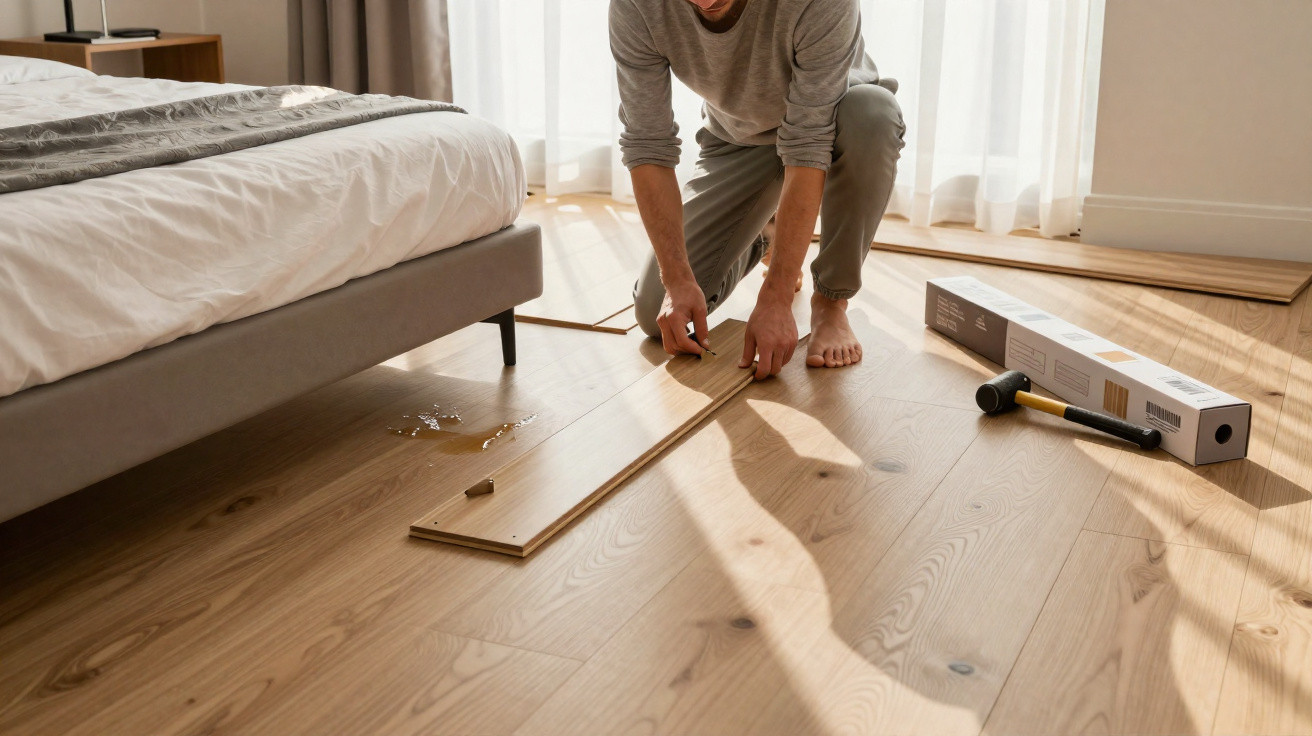
SPC vinyl flooring has been appearing more and more in bedrooms because it brings together a timber-like look, a floating installation method and a rigid core that does not rely on wood fibres. That matters most when there is spilled water, damp cleaning or minor leaks: while standard laminate can swell if moisture gets in through the joints, SPC planks are sold in versions marketed as fully water-resistant.
What is SPC flooring and why has it become an alternative to laminate?
SPC is a type of rigid-core vinyl flooring. It uses a denser, more stable centre than flexible vinyl and is topped with layers that provide the pattern, surface finish and wear protection. Manufacturers describe SPC as a solid polymer-core product intended for both residential and commercial spaces.
In a bedroom, this build makes it possible to use planks that look like wood without the HDF core found in many laminates. In practice, you get good dimensional stability, impact resistance and, in many ranges, an underlay already attached at the factory.
- Rigid, high-density core
- Planks available in a range of wood-style patterns
- Water-resistant models
- Options with integrated acoustic underlay
- Floating installation in many product lines
Why does it cope better if water gets into the bedroom?
The key difference is the core. Traditional laminates typically use HDF (a wood-fibre board), and when moisture works its way through the seams over time it can cause the edges to swell. Water-resistant SPC does not use that same fibreboard core, so spills do not trigger the same wood-expansion behaviour.
That said, not every laminate is automatically weak around water: there are ranges with protected HDF and locking systems rated to withstand water for 24, 72 hours or longer, depending on what the manufacturer specifies.
Is SPC flooring really quieter in the bedroom?
It depends on the construction you choose. Simply being SPC does not guarantee less noise, because a rigid, dense core can carry the sound of footsteps. The benefit tends to come from models that include an acoustic underlay underneath, or from installing over a compatible acoustic solution. Some SPC lines are sold with attached underlay specifically to cut noise and improve underfoot comfort.
For that reason, anyone replacing laminate mainly for a quieter room should check the technical datasheet rather than relying on the SPC label alone. Plank thickness, the type of underlay, subfloor flatness and the installation method all affect how much sound you notice in the bedroom.
- Choose models with an attached acoustic underlay
- Check whether the manufacturer allows an additional underlay
- Avoid installing over an uneven subfloor
- Compare acoustic performance data between products before buying
- Factor in sound transmission to the room below as well
How does click installation make refurbishment easier?
Many rigid floors use locking joints that allow planks to be laid over the subfloor without gluing each piece down. Manufacturers refer to this as a floating, adhesive-free installation and may allow it over certain existing floors, provided the base is dry, clean, flat and within the tolerances set for that product. This can remove steps from a refurbishment, although cutting, perimeter expansion gaps and proper subfloor preparation are still required.
- Check the level and flatness before you start
- Keep the expansion gaps stated by the manufacturer
- Do not cover up leaks or damp problems beneath the new planks
- Confirm whether the existing floor is suitable for this installation
- Follow the manual for the specific locking system you have bought
The subfloor still makes all the difference
A water-resistant plank does not turn the whole system into a barrier against leaks. Water can still get in at the edges, reach skirting boards and walls, or sit under the covering if there is a larger leak. On top of that, rigid SPC needs a sufficiently flat base; some denser cores are less forgiving of imperfections and can make subfloor irregularities more obvious.
For a bedroom that sees frequent cleaning, occasional dampness or the risk of spills, SPC vinyl offers a clear advantage over many wood-core laminates: the plank does not depend on HDF to hold its structure. Even so, the final choice should weigh up water resistance, the locking system, underlay, thickness and installation requirements, because those details are what decide whether the floor remains stable, comfortable and quiet after the refurbishment.


Comments
No comments yet. Be the first to comment!
Leave a Comment