
You often hear it before you spot it: that faint, horrible screech as something hard scrapes across your lovely hardwood floor. It might be a chair leg, a fallen key or the dog racing round a corner as though it is competing in the Indy 500. Then it appears: a light, glaring mark cutting through the rich grain of the wood, like a paper cut across your pride in the living room. You crouch down, trace the groove with a fingertip and get that familiar pang of regret that comes with owning something you genuinely value.
You search online for costly repair kits, check your bank balance and then recall an odd piece of advice you came across before: “Rub a walnut on it.” Really? A walnut?
So there you are, standing above the scratch with a nut in your hand, trying to decide whether it is an internet myth or a small piece of everyday magic.
How a simple walnut can “heal” a scratched hardwood floor
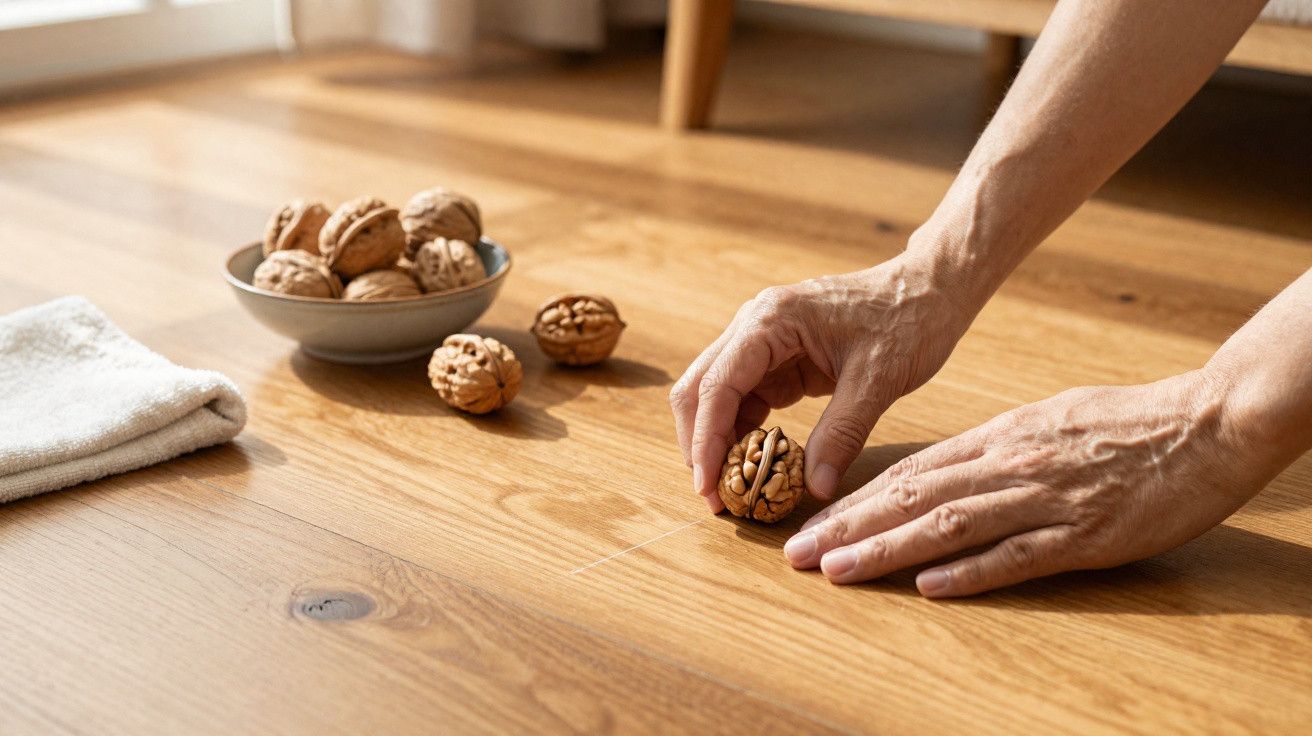
The first time you use a walnut on a scratch, the method can seem far too easy. There are no tools, no sanding and no awkward mixing of tacky products that will sit unused afterwards. It is simply you, the floor and a snack. Press the nut lightly against the damage and move it in small circles, while wondering whether this is slightly absurd.
Then the appearance begins to change. The pale line becomes less pronounced. Its colour grows deeper. The scratch will not vanish entirely, as if it were a special effect in an advert, but it does merge into the finish. It no longer demands your attention. And, naturally, that brings a small, satisfying feeling of success.
Imagine a quiet Sunday afternoon. The children are visiting a friend, the dog is asleep beneath the table and the house is finally peaceful. While vacuuming under the sofa, you notice it: a long, shallow scuff left when the removal team pushed the coffee table across the room last year. You have seen it again and again, only to look away because you did not want to start dealing with repairs.
This time, the walnut trick comes to mind. You take one from the kitchen, crack it open on the worktop and sit on the floor. It takes about 30 seconds. When you get up, the line looks softer, darker and less noticeable. It is not Instagram-perfect, but your gaze no longer lands on it immediately. That small improvement to your everyday peace really matters.
The explanation is remarkably simple. Walnut meat is soft enough to break down slightly as it is rubbed, allowing tiny particles to settle into the scratch. They will not repair a gouge, but they can fill narrow surface marks so they no longer reflect the light like a neon sign. Meanwhile, the nut’s natural oil is released through the warmth of your hand and the friction of rubbing. That oil absorbs into the dry, exposed timber and darkens it so it is closer in colour to the surrounding finish.
It is not magic. It is simply wood, oil and pigment working together naturally in your living room.
Using the walnut trick correctly - and setting realistic expectations
Keep it straightforward. Choose a plain, unsalted walnut in its shell, crack it and use the fresh nut meat inside. Steer clear of roasted, flavoured or coated walnuts. You need natural oil, not barbecue seasoning on an oak floor. Before starting, wipe the scratched section with a dry cloth to prevent dust from being worked into the mark.
Next, place the walnut piece gently on the scratch and rub in small circular motions, keeping to the damaged spot. Take your time. Rub for 20–30 seconds to give the walnut meat a chance to crumble into the gap and release its oil. Leave it for a few minutes, then lightly buff the area with a soft cloth. Particularly stubborn marks may need one or two further applications.
This is where expectations can meet reality. You may have seen viral before-and-after images in which a scratch appears to disappear completely. When you try the method on a deep gouge, though, it may improve a little without looking brand new. That is entirely normal. A walnut is most effective on light to moderate surface scratches: the kind you notice more with your eyes than with your fingertip.
Deep cuts, chipped finishes and gouges that catch your nail are another matter. They require filler, sanding or professional repairs. Do not be disappointed if a walnut cannot work miracles. It is a fast, inexpensive touch-up rather than a complete renovation inside a shell.
“People expect a 20-cent nut to erase ten years of wear,” laughs one flooring installer I spoke to. “What it really does is take the scratch from ‘I see it every single day’ to ‘I forget it’s there most of the time.’ That’s already a win.”
- Use raw, unsalted walnuts – Flavourings and coatings may leave residue or cause staining.
- Test it in a concealed corner – This is especially important for unusually finished or very pale floors.
- Limit it to fine or light scratches – Consider filler or a professional for deep grooves.
- Buff gently once you have rubbed – A soft cloth helps distribute the oil and even out the sheen.
- Do not go overboard – Honestly, no one is likely to do this every day.
Living with imperfect floors and helpful little tricks
There is something reassuring about the walnut trick. It does not insist on flawless results. You do not have to empty the room, purchase specialist equipment or act like an expert carpenter. Instead, it offers a practical reminder that a floor can grow older while still looking looked after. Small efforts matter, even when the timber already has plenty of little marks.
We have all experienced that odd blend of guilt and fondness when a fresh scratch appears. You remember the gathering, the children, the move or the life event that created it. A walnut will not make your floor look like a showroom, but it can move it from “ruined” towards “lived-in and loved.” That difference can alter how you feel each time you cross the room.
Perhaps that is the real secret inside the shell: it is not only oil and pigment, but also a quiet reminder that you can care for what you own without pursuing sterile perfection. A scratched floor that has received gentle attention tells a different story from one that has been neglected or obsessively guarded. Somewhere between those two approaches are you, a handful of walnuts and a home that continues to change with you.
| Key point | Detail | Value for the reader |
|---|---|---|
| Walnut meat fills fine scratches | Soft particles break down into shallow gaps | Makes scratches less obvious without using tools |
| Natural oil darkens exposed wood | Oil soaks into pale marks and blends the colour | Helps scratches better match the surrounding finish |
| Best for light surface damage | Deep gouges still require filler or professional repair | Creates realistic expectations and prevents disappointment |
FAQ:
- Can I use any type of nut, or does it have to be a walnut? Walnuts are the preferred choice because they are soft and contain plenty of oil. Harder nuts, such as almonds, do not break down as easily, while some contain less oil, making the result weaker.
- Will this work on all wood colours? It is most effective on medium to dark floors. With very light or whitewashed timber, walnut oil may darken the scratch too much, so always try it in a hidden corner first.
- Is the walnut trick safe for engineered or laminate floors? For minor scratches on engineered wood with a real-wood top layer, yes. Results on laminate can be inconsistent because its “wood” is a printed layer that does not absorb oil in the same way.
- How long does the effect last? On small surface scratches, the improvement commonly lasts for months and can sometimes last longer. Areas with heavy foot traffic may need a quick repeat treatment occasionally, particularly if they are mopped frequently.
- Can I still use commercial wood polish after using a walnut? Yes. Once the oil has absorbed and the area has been buffed, you may use your usual floor cleaner or polish. Avoid harsh solvents, however, as they could remove the effect too quickly.






Comments
No comments yet. Be the first to comment!
Leave a Comment