
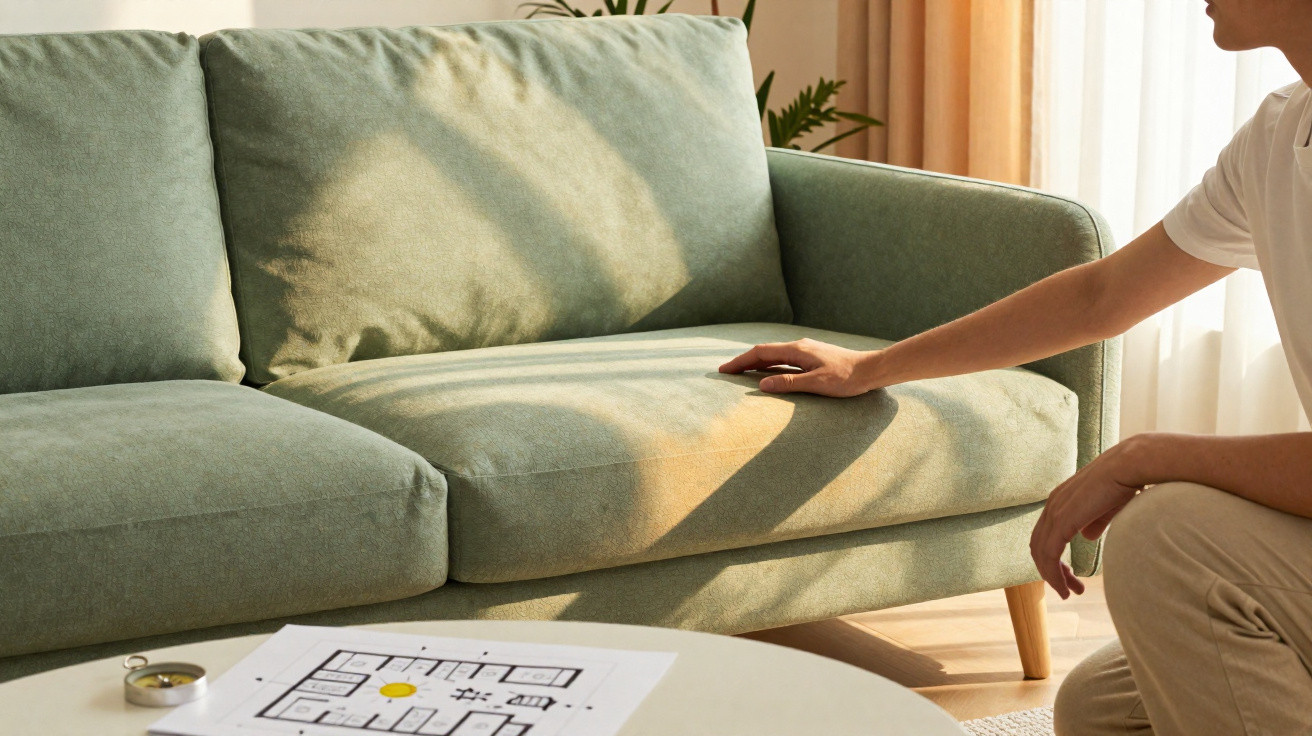
The first time you spot it, you may wonder whether you are imagining it. On the arm of your sofa, the blue no longer looks quite as blue. It is paler and softer, as though somebody has discreetly rubbed out some of the colour while you were out at work. You brush the upholstery with your thumb. There is no mark and no dust - only the gradual effect of time, daylight and an unnoticed daily change in your living room.
A few weeks afterwards, a pale outline appears in the place where a cushion normally rests. The fabric beneath the cushion is darker and almost as good as new, while the surrounding upholstery has become a light halo. This is more than ordinary wear.
It is a map.
A map made by the sun.
The hidden story your fading sofa already reveals
Sunlight does not enter a room at random. It follows a timetable, arrives from favoured angles and repeats a daily routine, with subtle changes between seasons. Without making a sound, your sofa fabric keeps a record of that pattern.
Study the faded areas and you will find that they are seldom even. One armrest may be lighter than the other; the upper part of the backrest may appear older than its side; and a strip across the seat can seem lightly coated in brightness. Across months and years, this is the route of the sun imprinted on the fabric.
You are not simply seeing deterioration. You are seeing a time-lapse.
Imagine a south-facing living room on a late winter morning. The low sun slips beneath the edge of the curtains and falls squarely on the left-hand side of the sofa. For two or three hours, the same cushion sits in that beam, while the right-hand side remains in mild shade.
Jump ahead by six months and the sun is sitting higher in the sky. Its light now skims the top of the backrest and disappears before reaching the seat. After several years, the upholstery on the sunny side begins to lose its richness: red becomes coral, navy becomes smoky and black fades into weary charcoal. Shift a cushion that normally stays wedged into the corner and there is often a clear contrast in colour - a shadowy shape marking the sun’s preferred place.
Most coloured textiles depend on dyes and pigments that respond to UV rays. Sunlight breaks down the chemical bonds responsible for those vivid colours, and the longer and more directly the material is exposed, the more rapidly those bonds deteriorate.
A section receiving three uninterrupted hours of sun each day will therefore age much more visibly than an area that only receives gentle, indirect daylight.
Your living room contains small light microclimates: intense hot spots where beams arrive every day, alongside calmer corners that scarcely alter over time. The pigment in your sofa is simply the most truthful witness. It neither lies nor overstates the case; it fades wherever the sun repeatedly insists on travelling.
Reading your sofa as a sun compass
Begin by watching the room at several points during the day: morning, midday and late afternoon. Sit on the sofa and see precisely where daylight falls. Note which armrest lights up first, which corner remains shaded for longest, and where a white wall reflects the light and makes it brighter.
Next, inspect the upholstery. Raise the seat cushions and compare exposed sections with protected ones. Feel along the backrest to check whether its top centimetre is a subtly different shade from the rest. That narrow pale band marks the sun’s highest daily point in summer.
In effect, you are holding a homemade solar diary.
Most people do not register fading until it becomes striking, when one side of the sofa appears five years older than the other. Yet the first signs emerge far earlier through small, almost hesitant contrasts: a ring left by a throw blanket, or a lighter area beneath the spot where your laptop usually sits.
We have all had that experience of moving furniture to clean and finding that the mark on the floor or fabric resembles an old photograph. It is an opportunity to trace the story backwards: recall the time when that corner is generally sunny, the season when you spend the most time sitting there, and the months when you left the curtains completely open “just to enjoy the light”.
Those everyday decisions become a visible record woven into the fibres.
Physically, this is a slow-motion experiment involving light and material. UV rays are indifferent to the price of the upholstery or the care taken when choosing its colour in the shop. Each clear day, they follow the same route through your windows, arriving a little earlier or later as the months change.
With east-facing windows, the pigments closest to dawn receive the greatest exposure. West-facing windows put late-afternoon glare to work instead. North-facing rooms generally develop gentler, more consistent wear. Your sofa becomes a contour map showing where sunlight pauses and where it only moves through.
Let’s be honest: nobody really tracks the sun’s angle before buying a couch.
Using sofa fading as a guide rather than a frustration
This gradual fading can help you reconsider the layout of the room. After identifying the light hot spots on your sofa, try turning it by only a few degrees. A slight adjustment, rather than moving the couch altogether, can sometimes direct the strongest beam towards a less vulnerable section or onto a removable throw.
Seasonal rotation is another easy habit. Every three or four months, switch the cushions around or turn over the seat cushions if they are reversible. This prevents one area of fabric from bearing the full force of the sun.
A lightweight cotton or linen throw, placed casually over the area receiving the most sun, can offer a soft layer of protection without making the room feel dark.
When the fading finally becomes obvious, a quiet sense of guilt can appear: “I should have closed the curtains more” or “I shouldn’t have put the sofa there.” Before following that thought, pause. Homes are designed to be lived in, not preserved like museums.
You chose that spot because the light felt good. Perhaps it is where conversation comes more easily, where afternoon naps happen, or where coffee tastes different on a winter morning. Do not exchange that for flawless upholstery. Instead, adopt modest routines: draw sheer curtains halfway during the brightest hours, angle blinds just enough to soften the beam, or place a plant on the windowsill to take the full hit of the sun.
The aim is not to eliminate fading altogether. It is to create even ageing that resembles patina rather than damage.
Sometimes the fade line on a sofa says more about how a family spends its days than any timetable on the fridge.
Treat that idea as a prompt rather than a source of regret. Notice where sunlight stays the longest and ask: is this genuinely the best use of that sun? The faded strip behind the sofa may be exactly the right width for a reading chair. The brightest corner might work better as a workspace than as the rear of a large piece of furniture.
- Treat fade lines as evidence, rather than imperfections.
- Rotate cushions and throws to distribute wear over time.
- Adjust sheer curtains and blinds during the strongest sun hours.
- Review furniture positions according to where daylight lingers.
- Accept a little fading as the visible cost of a bright, well-lived-in home.
The quiet cartography of light around your home
After seeing your sofa as a solar map, it becomes difficult to overlook it. Every lighter patch of upholstery begins to resemble a footprint. The armrest that appears “worn out” may instead reflect a thousand weekend mornings spent scrolling on your phone in a shaft of sunlight.
You can apply the same reading to the rest of the room: the yellowed edge of a curtain, a paler band on the rug, or artwork that looks slightly washed out on one side. Together, these marks trace the sun’s route across your home, season after season.
What starts as a minor irritation - “why is this blue fading?” - can become an unusual form of closeness with your home.
Knowing where the light actually moves gives you options. You can protect particular belongings more effectively, give valued books or textiles a shadier home, and deliberately position hardwearing, sun-friendly items - rattan, plants and washable throws - in the places where sunlight is most intense.
You may also decide to let certain things fade naturally, much as jeans wear in over time. A sofa that has gently lightened where you curl up every evening does not only show exposure. It shows presence.
Whether you watch it or not, the sun will continue its daily arc through your living room. Your fabric simply happens to be the surface that retains the memory.
| Key point | Detail | Value for the reader |
|---|---|---|
| Fading reveals sun patterns | Uneven pigment loss identifies the places where light falls for longest and with greatest intensity | Helps you understand the sun’s daily route through your own living room |
| Fabric as a living map | Contrasts beneath cushions, throws and shaded areas work as “before/after” markers | Allows you to visually interpret previous exposure and alter the future layout |
| Small habits matter | Rotating cushions, softening daylight and rethinking placement according to fade lines | Prolongs the life of your sofa while keeping rooms light and comfortable |
FAQ:
- Question 1 Why does one particular area of my sofa fade more quickly than the rest?
- Question 2 Is it possible to reverse fading in sofa fabric?
- Question 3 Does the direction my windows face genuinely affect how my sofa ages?
- Question 4 Are certain colours or fabrics less prone to fading in sunlight?
- Question 5 Which straightforward daily habits can protect my sofa without making the room dark?



Comments
No comments yet. Be the first to comment!
Leave a Comment