
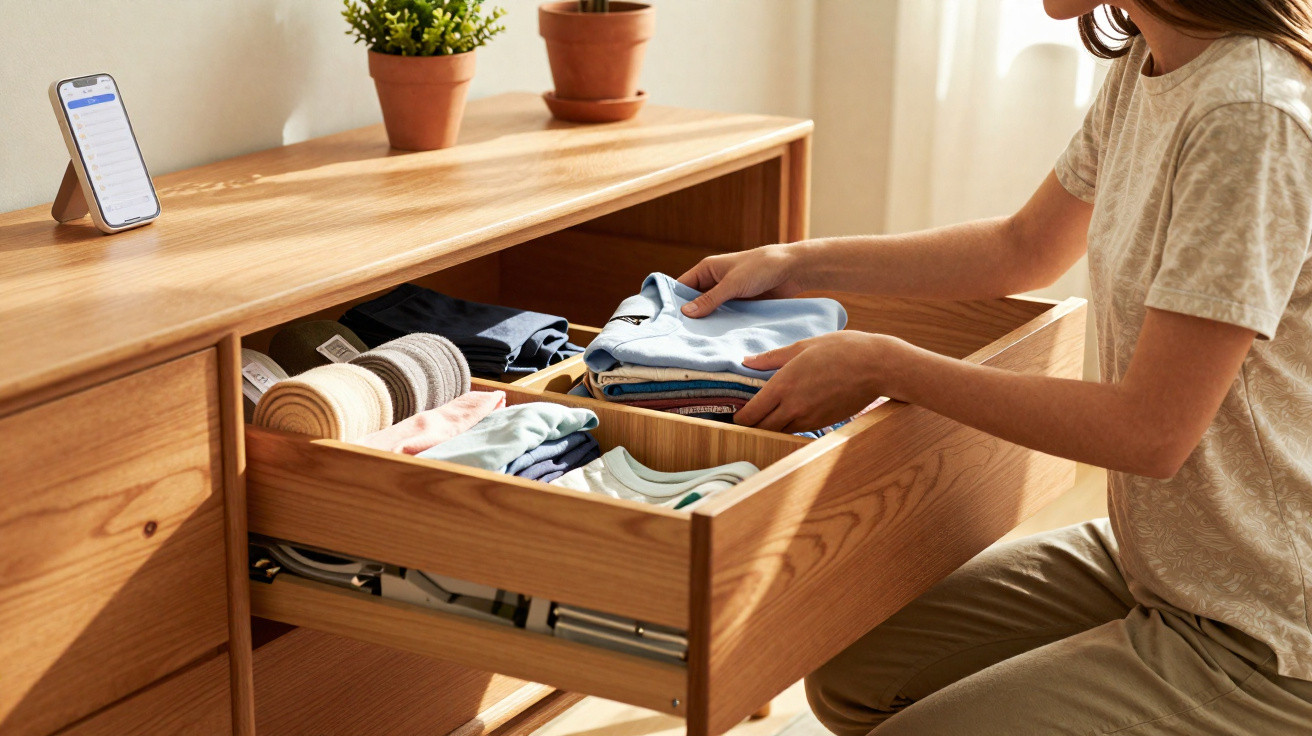
You pull open the kitchen drawer, only for it to catch halfway on a stray spatula. Your bedroom sock drawer tells the same tale: one brief search and it appears as though someone has tipped up the chest of drawers. Ten minutes later, you are running late, irritated, and asking yourself why you spent last weekend folding everything in the first place. The odd thing is that you genuinely make an effort. You purchase attractive organisers, arrange items by colour and fold them as the videos demonstrate. Still, disorder somehow finds its way back.
Perhaps you are not the issue.
Perhaps the issue is the place each item occupies within the drawer.
The unspoken rule your drawers are ignoring
Professional organisers follow a straightforward principle that most people have never been taught: position items according to how frequently you reach for them. It is not simply a matter of category or size, but entirely of frequency. Consider your cutlery drawer. The forks you use every day should not be crammed at the back while the decorative cake slice sits at the front. Your brain is programmed to reach towards the place where it anticipates finding something. If the layout works against that impulse, using the drawer becomes a daily battle.
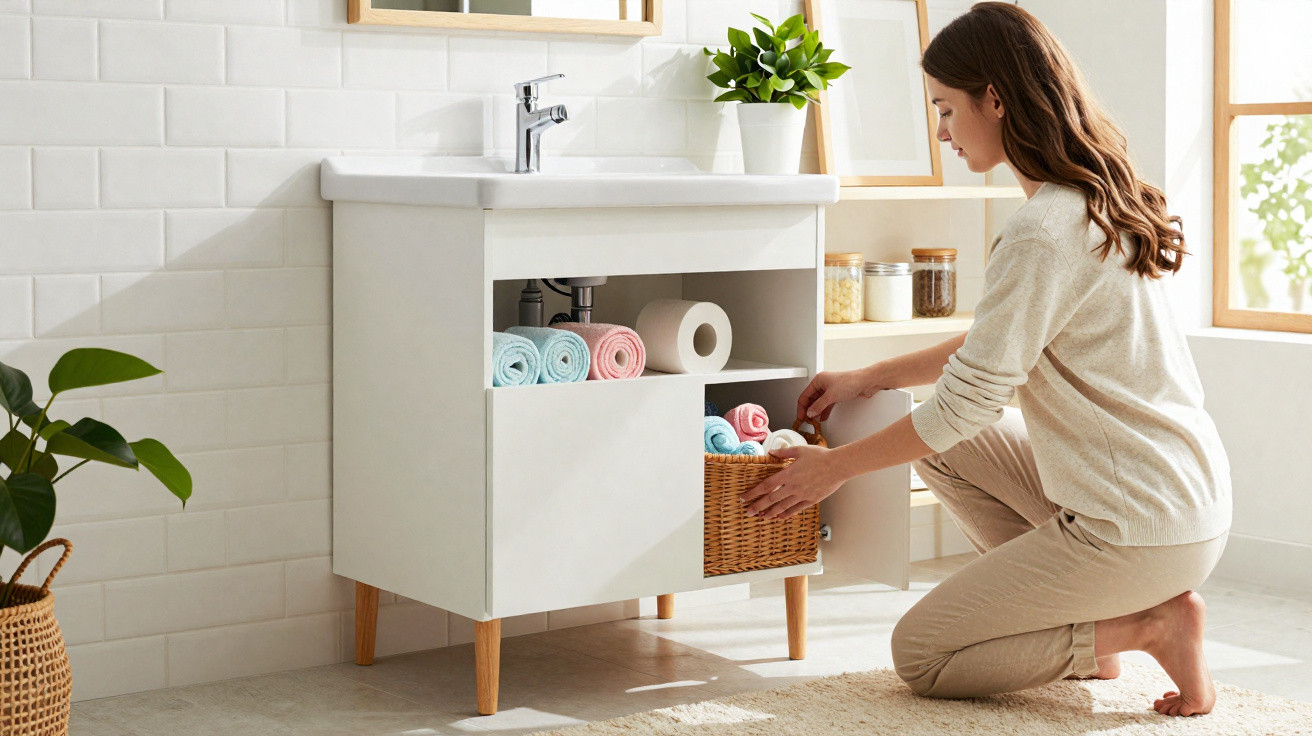
Imagine opening a bathroom drawer on a rushed morning in search of toothpaste. Instead, your fingers first encounter spare razors, travel-size bottles and out-of-date sun cream. You push items around, shuffle them and hunt through the drawer. Eventually, you find the toothpaste lying sideways beneath a hairbrush. Within two days, the drawer is untidy again, regardless of how neatly you arranged it on Sunday. A 2023 home-organisation survey in the U.S. found that people spend an average of 55 minutes each day searching for misplaced belongings. Drawers are among the biggest offenders. That is not because we are untidy, but because our habits are being forced to work against the layout.
This is the point at which object placement silently determines whether drawers remain orderly or descend into chaos. If your most-used belongings are kept in the “hot zone” - at the front and centre, where they can be picked up without thought - your hand repeats the same natural action each time. You open the drawer, reach in, take the item and shut it. There is no searching and no moving other things aside. After a week, that one action forms a track. After a month, it becomes a routine. Over a year, it creates the difference between a drawer that always seems “just tidied” and one that resembles a cave of clutter.
How to arrange items so drawers nearly organise themselves
Choose one drawer to begin with rather than attempting every drawer at once. Empty its contents onto a table. Do not organise anything yet. Simply set aside the belongings you use daily or once every few days. These are your A-list items. In the kitchen, this could mean the coffee scoop, everyday cutlery and the sharp knife you always use. In the bedroom, it could include underwear, everyday socks and the T-shirts that are in constant rotation. Place these A-list pieces at the front and in the middle of the drawer, where your hand lands first with no effort. This is your prime space.
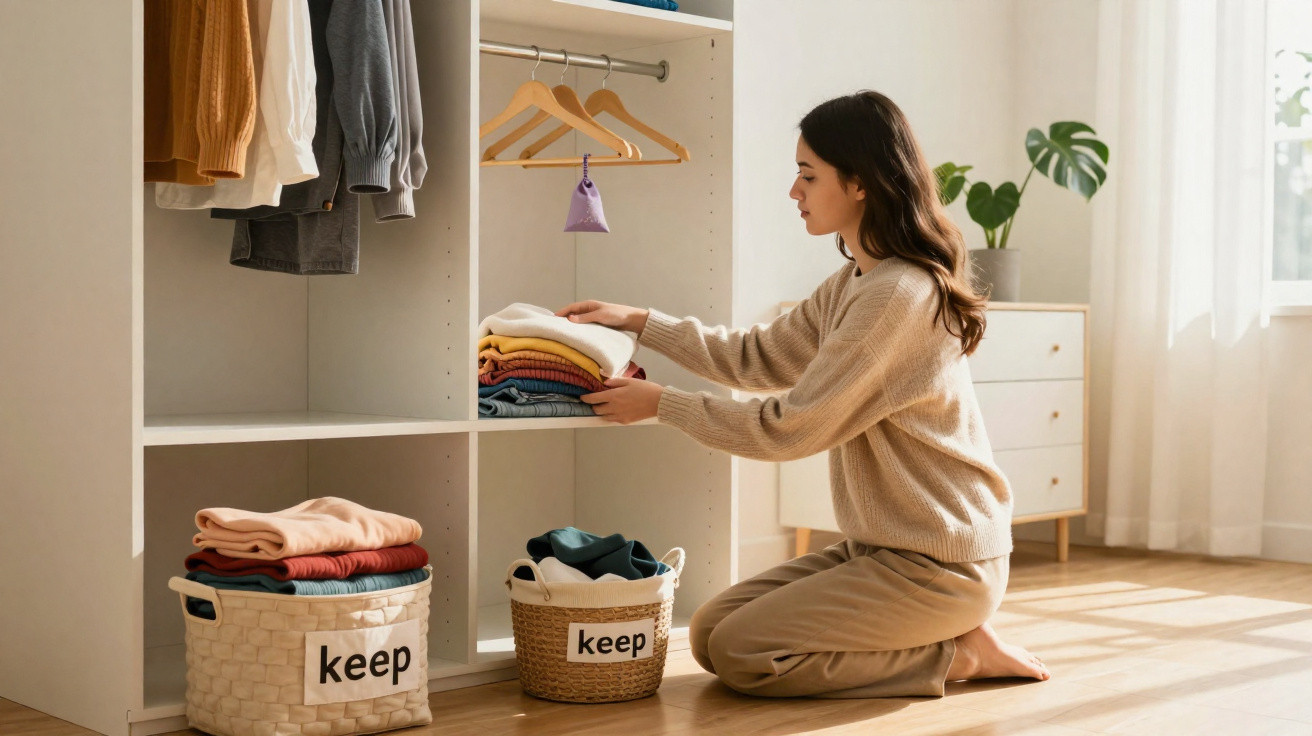
Then sort the B-list items: the things you use each week or each month. Keep these behind the A zone or along its sides. Seasonal items and things kept “just in case” should be placed right at the back, or, preferably, in a different drawer altogether. A common error is to treat a drawer as a storage box rather than a clear route through your everyday routine. We fill it with old phone chargers, odd socks and unidentified keys, promising ourselves, “I’ll deal with this later.” Realistically, no one does that every day. We then accuse ourselves of being disorganised when the drawer layout has worked against us from the beginning.
One Los Angeles organizer told me, “If you put your most-used item behind something else, you’ve basically scheduled future chaos. You’re forcing yourself to drag the mess forward every time you need that thing.”
- Keep everyday items in the drawer’s front-centre area.
- Store items you usually pick up together next to one another rather than in separate places.
- Add shallow trays or boxes to prevent small items from wandering.
- Keep infrequently used or seasonal belongings at the back of the drawer.
- Try the arrangement for a week, then alter anything that still feels inconvenient.
When your drawer layout reflects your actual life
There is a subtle sense of relief on the first morning when you open a drawer and every item is precisely where your hand expects it to be. No rattling and no small-scale search, just one easy movement. It does not resemble a social-media makeover reveal. Instead, it feels like finally breathing out. You may suddenly realise that you no longer slam the drawer shut. You stop leaving it partly open because searching through it was frustrating. You close it automatically because using it no longer feels like a chore.
What is striking is how individual this system can be. Your A-list may consist of a garlic press and chopsticks, while another person’s may include a peeler and a wine opener. Your sock drawer might devote its best space to running socks if you run each morning, or to thick wool socks if you work in a chilly home office. The “right” placement is the one that matches your actual life, not the catalogue version of it. Once that connection falls into place, your drawers begin to cooperate. They will not be perfect, and they will not stay that way forever, but they remain manageable long enough for tidying to become a quick reset rather than a complete excavation.
You may even find yourself reconsidering which items deserve a place in the drawer at all. That third spatula you never use starts to seem out of place. The broken pen at the rear of the desk drawer no longer has a reason to remain. A drawer arranged well does more than remain organised; it quietly reshapes what you choose to keep. It encourages you to own less, make things simpler and focus on what you genuinely use with your own hands each day. Repeated in the kitchen, bedroom and bathroom, that small change can alter the entire feel of your mornings.
| Key point | Detail | Value for the reader |
|---|---|---|
| Prioritise by frequency | Reserve front and centre space solely for items used every day | Drawers remain organised with less work |
| Create simple zones | Keep A-list items at the front, B-list items at the sides or back, and rare items right at the back | Quicker access and less searching |
| Edit while you go | Remove belongings that have not earned their place | Reduced visual clutter and mental overload |
FAQ:
- Question 1 How often should I reorganize my drawers once I set them up by frequency?
- Question 2 What if my drawer is very small and everything feels “front”?
- Question 3 Do I really need organizers and trays, or can this work without them?
- Question 4 How do I handle shared drawers when other people don’t follow the system?
- Question 5 What’s the first drawer you’d recommend fixing if I’m overwhelmed?

Comments
No comments yet. Be the first to comment!
Leave a Comment