
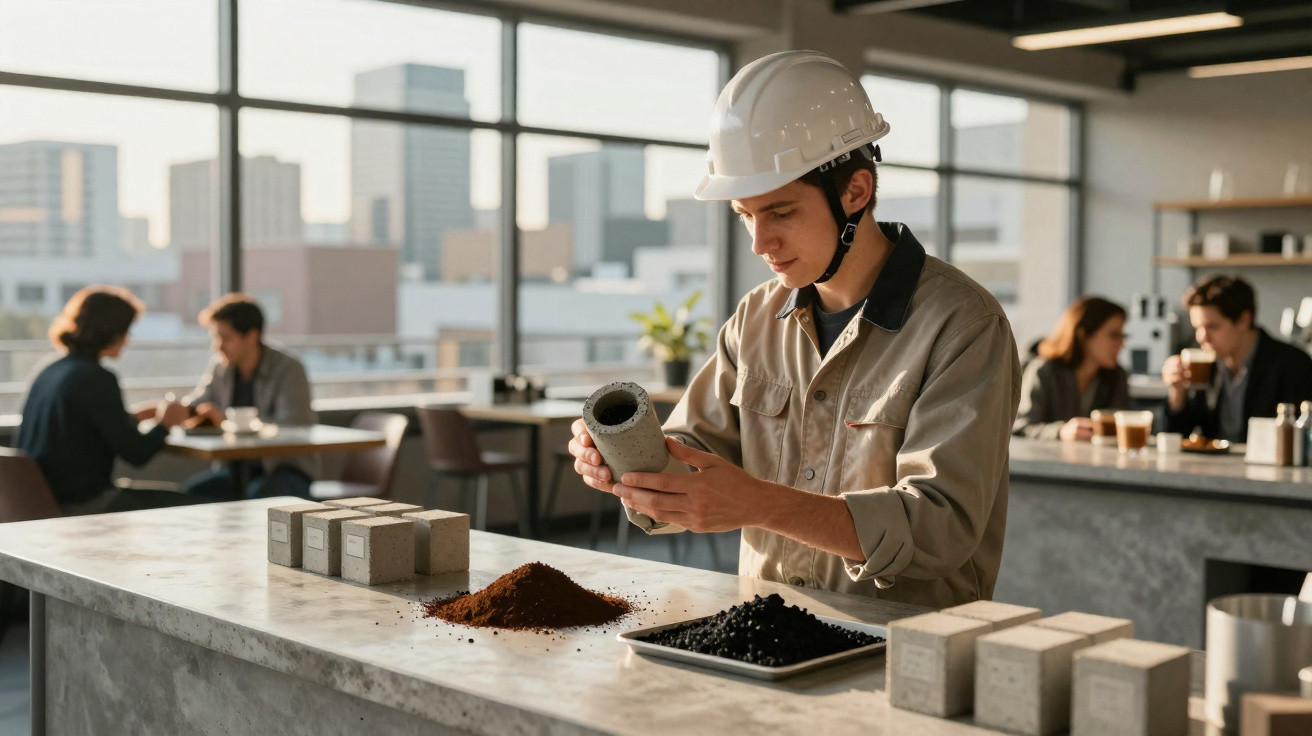
Urban centres brew vast quantities of coffee and lay even larger volumes of concrete, yet these flows almost never intersect. Fresh laboratory findings indicate they could: waste coffee grounds can be upgraded into an ingredient for concrete, reducing the footprint of a material known for heavy resource demand.
Why coffee waste meets concrete’s needs
Spent coffee grounds (SCG) accumulate rapidly in cafés, offices and households. If they end up in landfill, they generate methane - a greenhouse gas about 21 times more powerful than CO₂ over a 100‑year period. Meanwhile, construction consumes huge amounts of natural sand, and extracting it can damage rivers, coastlines and nearby ecosystems. A safe route to replace even a portion of sand while dealing with organic waste is therefore highly attractive.
The problem is that raw SCG are not naturally compatible with cement. They can release organic compounds that disrupt hydration, and their light, porous particles tend to be unstable in alkaline cement environments. The key is to transform the grounds into something more mineral‑like - able to integrate with the cement paste and resist degradation.
Pyrolysis turns grounds into biochar
To achieve this, researchers applied pyrolysis - a heat treatment carried out with very little oxygen - converting SCG into biochar. This thermal process stabilises carbon, removes reactive organic components and adjusts porosity. Tests at two temperatures, 350 °C and 500 °C, produced markedly different results in the resulting concretes.
A low‑temperature sweet spot at 350 °C
Biochar produced at 350 °C integrated effectively with the cement matrix. Its porous structure retained water and then released it gradually as the concrete cured. This “internal curing” supported hydration, refined the microstructure and strengthened the paste–particle bond. With up to 15% of sand substituted by 350 °C biochar, mixes equalled or outperformed the control samples.
Up to 29.3% higher 28‑day compressive strength at 15% sand replacement using coffee biochar produced at 350 °C.
What shifts at 500 °C
When produced at 500 °C, the biochar became more brittle and encouraged microcrack development within the cement matrix. Under load, the particles were less tolerant, and the mechanical results fell away. This points to a relatively tight temperature range in which converting coffee waste into a concrete ingredient delivers the best performance.
| Pyrolysis temperature | Particle behavior | Effect on cement chemistry | 28‑day strength trend | Overall outcome |
|---|---|---|---|---|
| 350 °C | Porous, stable, good interlock | Removes organics that hinder hydration | Improves at up to 15% sand replacement | Promising for structural mixes |
| 500 °C | More brittle, microcrack initiation | Still porous but less beneficial | Declines versus control | Not recommended for performance |
How the team probed the material
- Physico‑chemical checks: 350 °C biochar showed better compatibility with cement paste and a pore structure that supports internal curing.
- Mechanical testing: mixes with up to 15% sand replaced by 350 °C biochar delivered equal or higher strength than reference concrete at 28 days.
- Hydration behavior: raw SCG leached compounds that slowed hydration, while gentle pyrolysis removed the brake on cement reactions.
Raw coffee grounds slow cement hydration; low‑temperature pyrolysis neutralizes that effect and restores healthy reaction rates.
What this means for builders and cities
- Environmental gains: less methane from organic waste and reduced pressure on natural sand sources.
- Economic openings: a new by‑product market for biochar, with local supply chains from cafés to batching plants.
- Community benefits: jobs in collection, drying, pyrolysis, milling, and quality control.
For ready‑mix suppliers, the early recipe is relatively clear: keep pyrolysis close to 350 °C, use conservative substitution levels, and treat the biochar as a performance additive rather than a simple bulk filler. In practice, it behaves like a lightweight, reactive fine aggregate that requires careful control of moisture and grading.
Open questions before scaling
- Durability: long‑term resistance to freeze–thaw, chloride ingress, sulfate attack, and carbonation needs field data.
- Permeability and shrinkage: internal curing can reduce drying shrinkage, but pore connectivity must be balanced to limit permeability.
- Fire behavior: biochar is carbon‑rich; tests should confirm performance under high temperatures and spalling risk.
- Standards: codes must define how to classify coffee biochar among lightweight fines or supplementary materials.
- Supply consistency: moisture content, particle size, ash content, and residual organics vary with coffee type and roasting; QA will matter.
A rough city‑scale scenario
Consider a city of one million residents producing 3,000 to 6,000 tonnes of SCG annually. Assuming a cautious 30% biochar yield at 350 °C, that would provide around 900 to 1,800 tonnes of usable biochar. If 1 m³ of concrete typically contains roughly 800 kg of sand, then a 15% substitution corresponds to about 120 kg of biochar per cubic metre. On that basis, the city could generate enough material to modify approximately 7,500 to 15,000 m³ of concrete each year. That volume could be taken up by footways, cycle lanes, small bridges or low‑rise slabs without creating unmanageable logistics.
These calculations are indicative only. Local coffee consumption, how much waste is captured, moisture levels during transport and losses during milling will all shift the outcome. Even so, the implication is straightforward: consistent urban waste streams can support practical construction demand.
Practical notes for early adopters
- Target 350 °C pyrolysis with oxygen kept low; validate with TGA/FTIR to confirm organics removal.
- Dry and mill to a sand‑like grading curve; screen out oversize particles that act as flaws.
- Pre‑saturate biochar to leverage internal curing and stabilise workability.
- Start at 5–10% sand replacement; test panels before pushing to 15% or beyond.
- Combine with proven SCMs (fly ash, slag, calcined clay) to refine pore structure and balance strength gain.
- Document batch moisture, density, and absorption to tune water demand and admixture dosage.
Related angles to watch
Other biomass‑derived fines - including rice‑husk ash or sawdust biochar - may behave differently in cement systems. Some provide pozzolanic reactivity, while others function more like internal curing agents. Blending multiple waste‑based fines may allow producers to tailor properties for specific applications, from paving units to precast blocks.
Carbon accounting is also relevant. Turning SCG into biochar retains part of the biogenic carbon in a more stable form, potentially locking it into a durable matrix for decades. This storage could support procurement targets for embodied carbon. However, verification approaches will need to quantify both avoided methane emissions and the durability of carbon storage within the concrete microstructure.
Key takeaways worth pinning
- Low‑temperature pyrolysis (around 350 °C) turns coffee waste into a concrete‑friendly biochar.
- Up to 15% sand replacement raised 28‑day compressive strength by nearly a third in lab tests.
- Performance drops at 500 °C due to brittleness and microcracking.
- Environmental, economic, and social signals point to a viable circular‑economy loop-if durability data and standards catch up.
A quick glossary and next steps
Pyrolysis: thermal treatment without oxygen that stabilises carbon‑rich residues. Biochar: the solid, carbon‑heavy product of pyrolysis, typically porous and lightweight. Internal curing: stored water in fines slowly releases during hydration, reducing self‑desiccation and shrinkage. Field pilots should now compare mixes across climates, test de‑icing salts, and monitor pavements for two to three years. Those results will give municipalities and contractors the confidence to write coffee biochar into bid specifications and local green‑procurement rules.
Comments
No comments yet. Be the first to comment!
Leave a Comment