
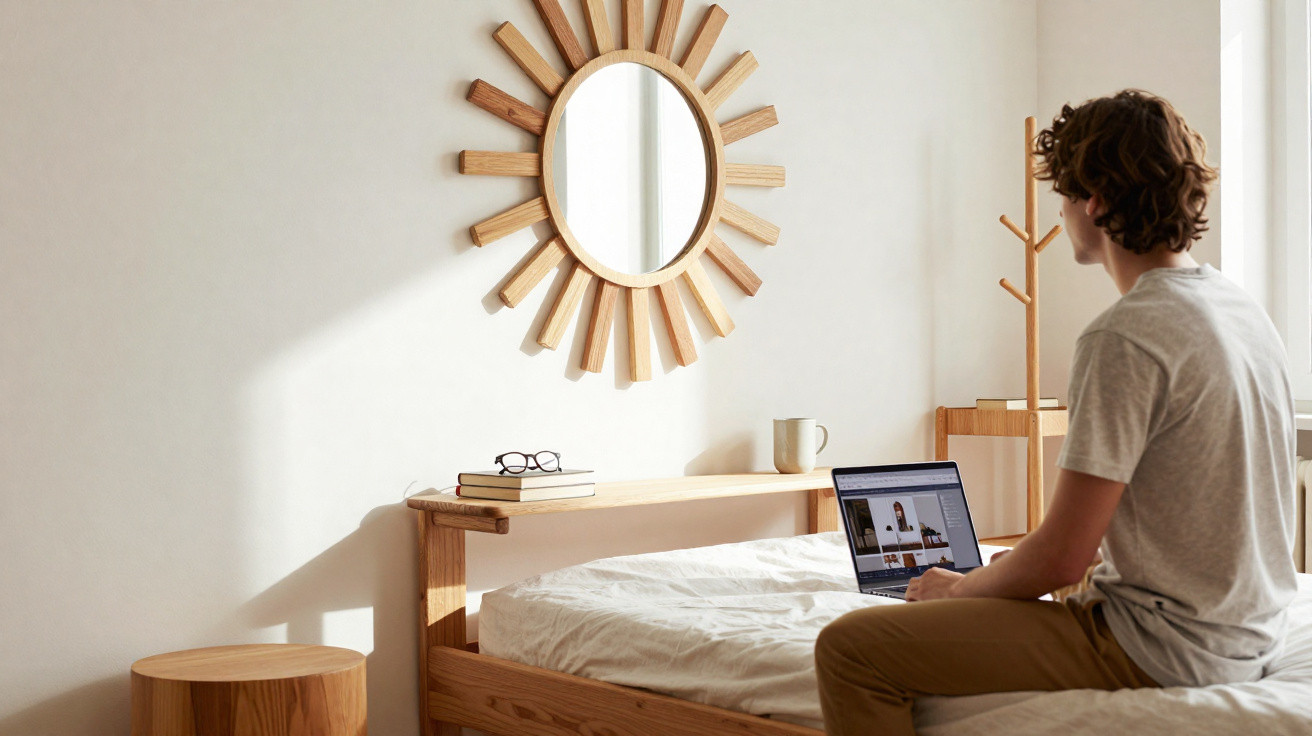
We’re still drawn to warm, touch-friendly materials and furniture that feels at home for years rather than a single season. Even so, many people freeze when they reach a beautifully made wooden piece, expecting the price to bite. A growing group of French makers is pushing back against that assumption, showing that locally produced, environmentally mindful wood design does not automatically mean luxury-only costs.
When gallery-style design doesn’t come with a gallery price
At first sight, these objects could easily be mistaken for pieces from a small contemporary gallery instead of something meant for a normal hallway. The lines are pared back and gentle, with softened forms and edges that feel composed rather than severe. The message is straightforward: timber isn’t only there to hold things up - it’s treated as a visual motif that can shape the atmosphere of an entire room.
One of the names at the heart of this movement is the Toulouse studio Reine Mère. Established in 2006, the brand centres its work on solid oak and beech, favouring crisp outlines and an intentionally quiet look. Everything feels deliberate without being rigid, designed to sit comfortably within daily routines rather than steal the spotlight. That kind of restraint also helps the pieces avoid feeling dated too quickly - a crucial point if you want furniture that still feels right several years from now.
A lot of the value here lies in design that ages slowly: forms that do not scream for attention but reward a second look.
For many first-time buyers, the real surprise is the surface treatment. With cheaper mass-market items, people often anticipate a thick, plastic-like varnish. Instead, they encounter a matt, almost velvety finish that leaves the grain visible and satisfying under the hand. The timber comes across as lively, not sealed under a resinous coat.
Details like that normally point to a substantial price bracket. In this case, though, the figures sit noticeably below what you’d expect from top-tier designer labels. The explanation isn’t some mysterious pricing trick - it’s largely about manufacturing choices and location.
Made in the Jura: local wood, short circuits, lower final cost
A large share of Reine Mère’s wooden items is produced in the Jura, a mountainous area in eastern France with a long-standing tradition of woodworking. For centuries, the region has been associated with precision and smaller-scale making - from toys to turned wooden pieces. That history matters because many workshops already have the equipment, expertise and processes required for high-grade timber work.
The label “Made in France” can inflate prices when production stays fragmented. Here, a tight local network actually pushes them back down.
The brand’s approach depends heavily on short supply chains. The oak and beech used in its furniture and accessories come from sustainably managed French forests, and the cutting and transformation happen near where the trees are grown. Shorter journeys reduce transport costs and strip out layers of middlemen who often add expense without improving quality.
Environmental decisions also influence the way the operation works. Makers favour water-based glues rather than solvent-heavy alternatives. Packaging leans towards recycled paper and cardboard. Power is often sourced from renewables. These steps don’t automatically make products “cheap”, but they do help narrow the distance between eco-conscious local design and competently made imports.
It’s common to assume the price mostly pays for a national badge or a polished marketing story. Here, the breakdown is different: a larger portion of each pound or euro goes into workmanship and materials, and less into container shipping, global ad spend or multi-layer distribution.
| Cost factor | Typical imported furniture | Short-circuit French production |
|---|---|---|
| Transport and logistics | High (sea freight, warehousing, long routes) | Lower (regional shipping, fewer hubs) |
| Intermediaries | Multiple agents and distributors | Direct retailer–workshop links |
| Material traceability | Often unclear | Local forests, documented origin |
| Repair / longevity | Hard to repair, often replaced | Durable construction, easier to maintain |
Key pieces that shift the perception of “too expensive”
Design arguments can feel a bit theoretical until they’re tied to real objects and real price points. A handful of the brand’s best-known pieces land in a range where many shoppers would have expected significantly higher numbers.
Sunrise mirror: an affordable light boost
At the beginning of the year, natural light can feel limited - particularly in compact city flats. The Sunrise mirror takes a simple approach: a curved reflective section is set onto a wooden backboard, which also works as a small shelf. The backing uses MDF with an oak veneer, while the ledge itself is solid oak.
Prices begin at roughly €88, placing it comfortably beneath many design-gallery mirrors. Visually, however, it reads as far more expensive than its price suggests. And because it’s a copper-free mirror, it avoids some of the environmental and durability drawbacks associated with conventional mirror manufacturing.
A single well-placed mirror often shifts a room’s mood more than another lamp or another decorative object ever could.
In a tight hallway or a small bathroom, a single Sunrise mirror can throw daylight further into the space while providing a handy perch for keys, perfume bottles or a favourite ceramic cup.
Morphée bedside shelf: minimal footprint, full function
As rents continue to climb in major European cities, living spaces often contract in step. The Morphée bedside shelf tackles a specific issue: creating a practical bedside surface in a small bedroom without making the room feel more crowded.
It’s a compact, wall-mounted shelf in solid oak, about 31 cm wide - enough space for a book, a glass of water and a phone. There are no legs and no drawer. That lack of visual and physical bulk helps keep a sense of openness and movement, which is particularly valuable when the bed already takes up most of the floor.
Prices start at around €130. Against flat-pack chipboard bedside tables that can sag, split or wobble after a couple of years, the logic shifts towards durability. Solid oak takes everyday knocks better, and the styling tends to work with a wide range of bedding choices and wall colours over time.
Everyday accessories that make “Made in France” reachable
Bigger furniture purchases remain a commitment. Early in the year, smaller accessories are often a more achievable way in. Some of the brand’s strongest sellers sit well below the €100 mark while still showing the same care in proportion, material and finish.
- Fagot trivet – Around €27, made from slim rods of solid oak held together by an elastic cord woven in France. It protects the table and adds a subtle graphic note beneath a saucepan or teapot.
- Verrière photo frame – Around €39, produced in solid beech. Two panes of glass secure the photo so the image appears to float. It offers an alternative to plastic frames that can yellow or crack after a few summers.
Picking up one of these smaller items lets people see how locally made wooden objects fit into day-to-day life before stepping up to more substantial pieces.
Why this French experiment matters beyond France
What’s happening in France reflects a broader shift in how many of us approach interiors. Whether you’re shopping in London, New York or Manchester, the tension is familiar: wanting natural materials and clear provenance, while also working within very real budget limits.
The Jura-made examples suggest that “affordable” doesn’t have to be synonymous with disposable. These items still cost more than the cheapest chains, but they aren’t wildly unattainable either. That middle space may become increasingly relevant as more people start to question what’s hidden behind an unusually low price tag.
The core shift is psychological: moving from the cheapest possible object today to the most sensible cost per year of actual use.
A number of independent studies on furniture lifespan point in the same direction. A low-cost particleboard bedside table may only make it five years before it swells, peels or becomes unstable. A straightforward solid-wood shelf, looked after properly, can readily last twenty years or longer. When you spread the cost across that lifespan, the yearly spend is often closer than the upfront price implies.
How to assess whether local wooden furniture fits your budget
If you’re interested in comparable pieces, a few practical checks can help you spot the difference between a sales story and genuine value. When you compare products online or in shops, these details often explain why one item costs more than another.
- Materials: Solid wood, good veneer and plywood typically wear better over time than hollow honeycomb cores or thin particleboard.
- Origin of wood: Specific mentions of regions or forests usually indicate stronger traceability than vague phrases such as “wood-based materials”.
- Finish: Water-based varnishes and oils release fewer fumes in the home and keep the texture visible.
- Repair potential: Straightforward joinery, accessible screws and standard sizing can make repairs far easier later on.
- Design longevity: Calm forms and natural tones outlast trend cycles and reduce the urge to replace items purely for style.
A quick mental test can help: picture the item in five years. Is the surface likely to be scratched beyond saving? Will the colour still work if you repaint? Could it suit another flat if you move? Pieces that hold up in that scenario often warrant spending a little more at the start.
This French example isn’t an argument that everyone should immediately swap their home for oak and beech from the Jura. Rather, it points to a widening route between disposable flat-pack basics and ultra-luxury design. For many households, beginning with a mirror, a compact bedside shelf, or even a simple trivet can be enough to nudge habits towards furniture that endures - visually and physically - without blowing the budget.




Comments
No comments yet. Be the first to comment!
Leave a Comment