
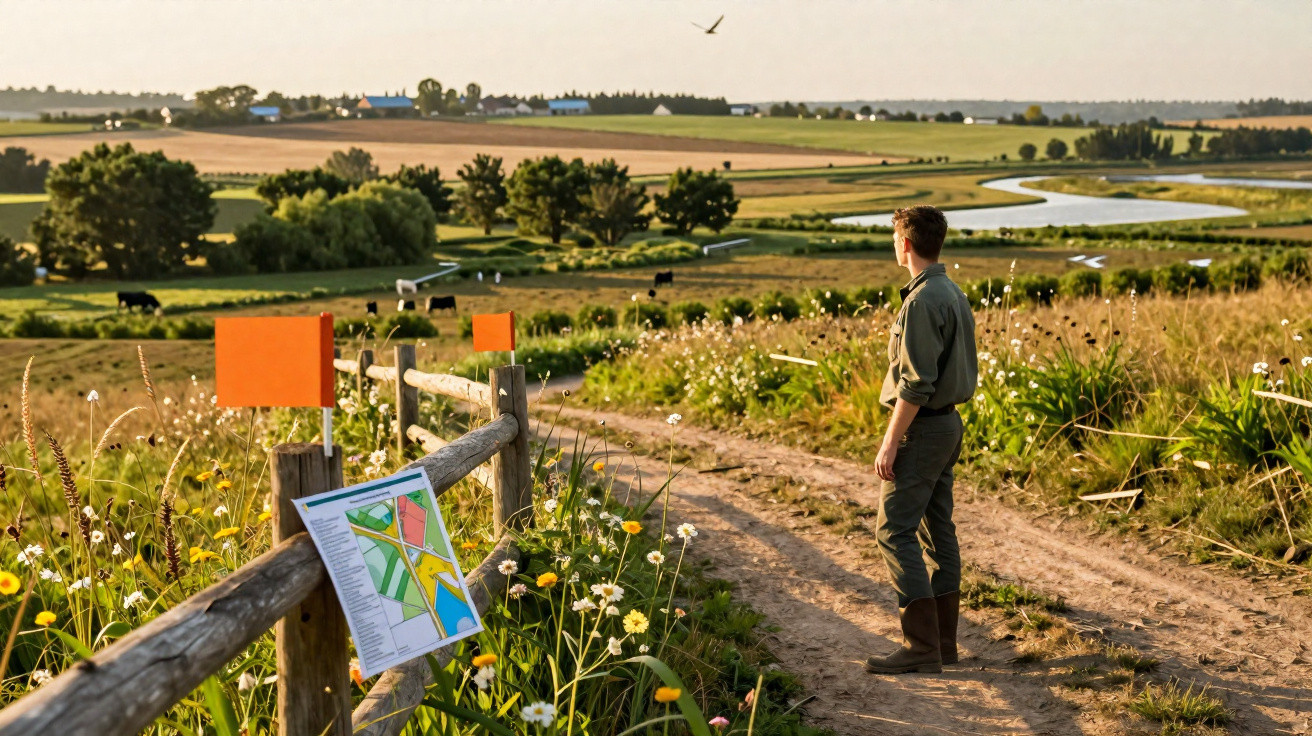
Not the roar of traffic or the clatter of plant, but a thick insect drone, so constant it could pass for static hanging in the air. A decade ago this valley was a neat grid of soya and maize, rock-hard each summer and underwater every winter. Now it reads differently: ponds, hedgerows, scruffy meadows and young woodland, pieced together like a place slowly relearning its older shape.
A farmer with scuffed boots props himself on a gate and watches lapwings corkscrew above a freshly rewetted field. When you ask what happened, he gives a small shrug. “The rules changed,” he says. “So we changed.” Behind him, a digger is doing the opposite of drainage work: it is filling a ditch back in.
Somewhere between policy documents and this noisy, living ground, a long slide in nature quietly began to run the other way. The open question is how much further that turn can travel.
When the rules on land shifted, the land itself followed
For years, policy around land rewarded making every acre work harder. Subsidies favoured output, straight edges and bare earth. The countryside replied in the only terms it could: fewer insects, fewer birds and springs that grew steadily quieter. The hush was noticed, but it was often dismissed as the background sound of “progress”.
Then a new kind of pressure built up - climate commitments, biodiversity charts falling off a cliff, and soils that blew away in summer downpours. The policy direction started to change. Not suddenly, and not without confusion. But funding began to back hedges and ponds, rather than only sprays and ploughing. Permissions for wetlands became easier to secure, while proposals like new golf courses started to look, on planners’ desks, like liabilities.
What seemed like bureaucracy in a department office turned into something tangible outdoors: room, shelter, water and breathing space.
Consider the Knepp Estate in England, now close to folklore in conservation circles. In the early 2000s it was an intensive farm carrying debt, stuck on heavy clay that would not deliver the “efficiency” expected of it. It faced a choice: keep battling the land, or step into newer agri-environment schemes that offered modest payments for letting things become wilder.
The owners took the gamble. Ploughing stopped. Tough cattle and pigs were introduced as “ecosystem engineers”. They followed shifting subsidies that no longer penalised so-called “unproductive” scrub. At first, neighbours described it as chaos. The fields looked neglected, thistles ran riot, and it resembled a slow-motion collapse.
Then came the nightingales. Purple emperor butterflies, turtle doves, rare bats. Monitoring recorded rapid gains in species that were declining almost everywhere else. Knepp became a working example of what can happen when land use policy is less fixated on tonnage and more willing to make space for ecological recovery. Similar echoes can now be heard in former rice paddies in Spain, rewetted peatlands in Germany and ranches across Costa Rica.
Under these headline stories is a straightforward principle: incentives steer land. For a long time, political cues told landowners that neatness, drainage and chemicals meant success. Production rose while ecosystems fell. When the signals switched - money for carbon-rich soils, legal protection for wetlands, tax advantages for conservation easements - behaviour shifted as well. Not everywhere, and not at once, but enough to register.
Ecology does not run on an annual budget timetable, and yet it can respond surprisingly fast once the squeeze is eased. Dormant seeds in the soil begin to germinate. Insects spread back in from nearby refuges. Predators return as prey numbers recover. Policy, in other words, does not “restore nature” by itself; it sets the conditions so nature can do much of the work without charging for it.
This turn away from decline is not mystical. It is what follows when governments stop funding landscapes to stay unwell.
How those policies actually change what happens on the ground
Put the jargon to one side and the shift often comes down to a very ordinary scene: a land manager at a table, pen poised, reading a new agreement. Under older systems, the contract might pay per hectare of wheat. Under redesigned land use policies, the money can attach to actions such as permanent cover crops, restored riverbank buffers, or allowing floodplains to do what floodplains do.
That rewires everyday choices. Rather than draining a wet patch “just to tidy it up”, a farmer may keep it wet and put trees on the slightly higher ground. Instead of permitting housing by a river, an urban planner might designate parkland and wet meadow because flood-risk rules now carry real weight. Policies do not cultivate fields - people do - but people tend to choose the route that will not push them into bankruptcy.
One influential, often overlooked lever is simply ending support for damage. As fertiliser subsidies disappear and pesticide regulation tightens, the sums behind monoculture look less attractive. That creates room for agroforestry, mixed rotations and grazing approaches that store carbon and support wildlife, because they are no longer undercut by artificially cheap “business as usual”.
Rules can also create friction, and that is where reality becomes complicated. A forester locked into 30-year commitments for fast-growing conifers cannot instantly switch to native woodland, even if policy now favours it. A smallholder offered five years of hedge-planting payments may hesitate if they remember earlier schemes that evaporated after an election.
Trust becomes a kind of quiet currency. When programmes are clear, stable and fitted to local conditions, participation rises quickly. When paperwork is impenetrable and requirements swing with each political cycle, land users do the sensible thing: they wait, and they spread their risk. Meanwhile, the ecological clock keeps running as forms stack up.
On the ground, land use policy can feel like a distant game played by people who have never scraped mud from a tractor. That impression has consequences. When farmers and community groups help shape schemes - deciding which habitats matter most, how monitoring is done and how disputes are settled - uptake is quicker and resentment softens.
Most people recognise the feeling of a top-down rule arriving in their lives, obviously written by someone who will never have to live with it. Land is no exception. Where policy comes with listening built in - citizen assemblies on zoning, local cooperatives distributing rewilding funds - recovery can land as a chance rather than a slight.
Turning around decades of decline is not only a technical exercise; it is emotional, cultural and, unmistakably, political.
What this policy shift means for you, even far from the fields
From afar, land use can seem like a niche concern for farmers, researchers and finance departments. In practice, these changing rules already reach into city tap water, supermarket prices and the air drifting through your bedroom window. When wetlands are protected by law rather than drained, flood peaks downstream begin to reduce. Insurance costs in those places can ease, and the brown surge after heavy rain clears more quickly.
Planning policies that prioritise trees, green roofs and pocket parks do more than “support biodiversity”. They lower temperatures during heatwaves, filter traffic pollution and give children somewhere to climb that is not a screen. If your city rewrites its zoning code to insist on green corridors along new roads, that is land use policy stitched straight into your commute.
Let’s be honest: nobody reads the technical annexes of local land-use plans every day. Even so, it pays to keep one eye on local land arguments. The proposed bypass, the “mixed-use” scheme on a former marsh, the plan to restore a river’s natural bends - each one contributes to the same wider pattern of decline or recovery.
A major error many citizens make is treating land use as distant and fixed. It is easy to assume forests disappear or return somewhere far away, driven by forces beyond reach. Yet local councils, regional bodies and even neighbourhood committees often have more say than people realise over what gets surfaced, planted or safeguarded.
For policymakers, a familiar pitfall is chasing fast, visible wins: a single “flagship” project, or photogenic tree-planting drives that ignore soils, water and long-term maintenance. A million saplings in the wrong location can quietly fail within ten years. Decline reverses when the unglamorous work is funded - protecting existing ancient woodland, paying for ecological monitoring, and supporting land stewards to leave that awkward corner rough rather than manicured.
There is also a subdued psychological barrier. People become attached to the landscapes they know, even when those landscapes are degraded. A drained peat field can feel “normal” within one generation. Rewetting it can look, at first, like losing something: a view, access, identity. That deserves understanding, not ridicule. Changes to land touch memory and family history as much as they touch soil.
“We didn’t set out to save nature,” a Dutch dairy farmer told me, watching curlews feed in his rewetted pasture. “We just stopped being paid to fight the land, and after a while, we realised we’d been fighting ourselves.”
- Small daily choices - Buying goods with credible “deforestation-free” or regenerative labels nudges demand towards better land use elsewhere.
- Local planning meetings - Turning up even once a year can influence votes on floodplain building or new urban green space.
- Questions for politicians - Asking how land policies affect soil, water and wildlife keeps those issues in view.
- Support for land stewards - Backing community forests, Indigenous land rights or farmer cooperatives helps anchor policy in practical reality.
The quiet power of letting landscapes heal - and what comes next
Spend enough time in a place where rules have loosened their grip on extraction and you start to notice what charts and briefings overlook. The scent at ground level changes, rich with leaf litter rather than fertiliser. After storms, streams run clearer. Woodpeckers make themselves heard where, ten years earlier, the loudest sound was a sprayer moving through at dawn.
This reversal of long-term decline does not trace a neat upward line. Droughts take their toll, fires tear through young woodland and politics can swing. Some rewetted wetlands are drained again when new leaders take office. Some rewilding efforts falter under local opposition. Yet every clear success - each valley or floodplain that flips from loss to recovery - makes the next one easier to picture and easier to finance.
The central question is no longer whether land can recover under better rules. Evidence from dozens of countries and climate zones suggests it can. The question now is how far societies will go in rewriting the contracts between fields, forests, towns and the people living among them. Those contracts are not theoretical: they influence the taste of drinking water, the cost of food and the weather that arrives on your street.
In the end, policy is just the frame. Inside it sits a living collage: farmers experimenting with different crops, communities pulling out old culverts so rivers can breathe, investors realising that healthy soils can be as bankable as concrete. The collage is incomplete and a little untidy - like a field in the first years after the plough is parked.
Perhaps that is the most hopeful element of this change. Long after the acronyms have been replaced again, the trees will stand taller, the birds will be louder and the soil will be darker. The rules opened a door; the land is stepping through it, one messy step at a time.
| Key point | Detail | Why it matters to you |
|---|---|---|
| Policy can reverse decline | Changes in subsidies, zoning and protection laws are already driving ecological recovery across multiple regions. | Demonstrates that environmental damage is not inevitable and can be turned around within a lifetime. |
| Incentives shape landscapes | Farmers, foresters and planners react to financial and legal signals in highly practical ways. | Helps explain how your taxes, votes and purchases affect distant fields and forests. |
| Local action matters | Council decisions on wetlands, parks and floodplains feed into the wider story of decline or recovery. | Provides realistic ways to help shape the land where you live. |
FAQ:
- How fast can ecosystems recover when land use policies change? Recovery often starts within a few years, with insects, birds and plant diversity responding first, while full soil recovery and forest regeneration can take decades.
- Do these policies reduce food production and push up prices? Land use shifts can alter what is grown and where, but mixed, regenerative approaches often sustain yields while improving resilience to climate shocks.
- Which policy-led recoveries show clear success? Rewilding at Knepp in the UK, peatland restoration in Germany, Costa Rica’s forest rebound and wetland protection in the Netherlands all show measurable improvements.
- Can individual consumers genuinely influence land use? Yes - by creating demand for certified products, supporting local producers using regenerative methods and taking part in local planning decisions.
- What should we look out for in future land use debates? Watch how policies treat wetlands, peatlands and ancient woodland, and whether long-term funding backs the people managing land day to day.






Comments
No comments yet. Be the first to comment!
Leave a Comment