
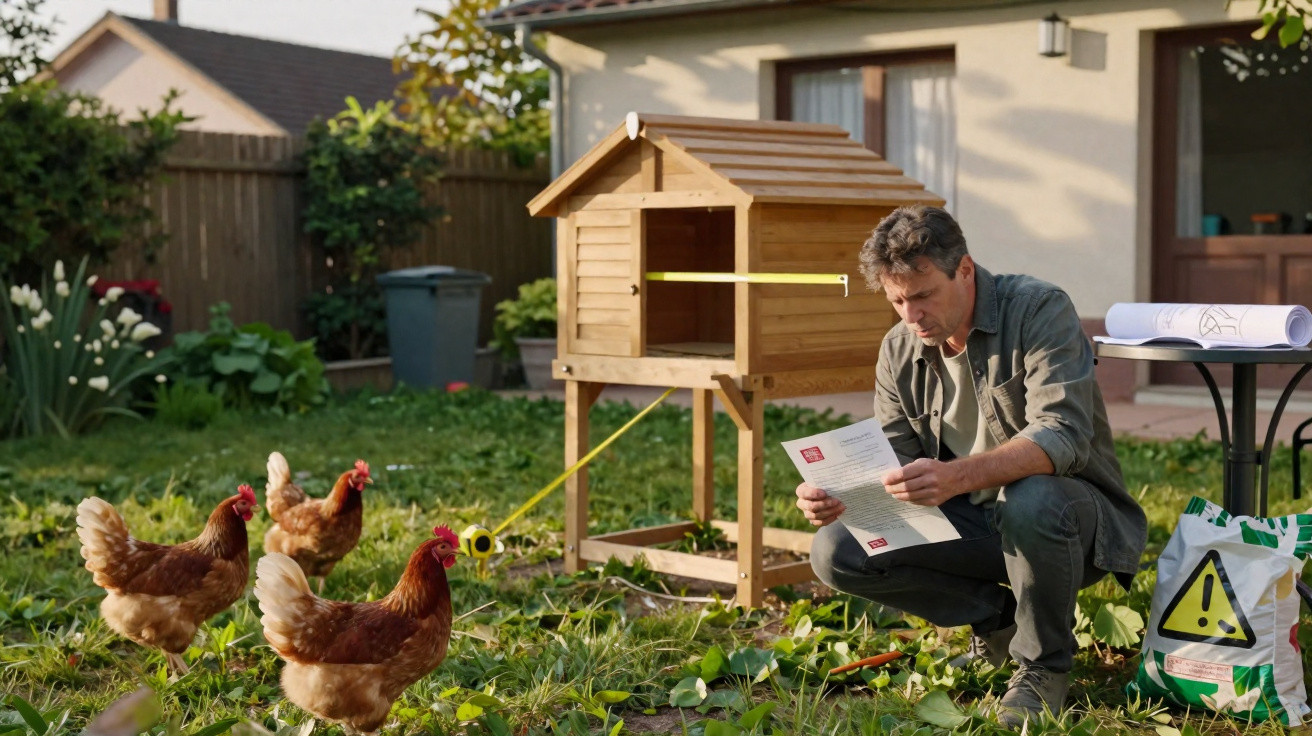
Rules, deadlines and very real costs sit behind the trend.
Anyone planning a chicken coop in their own garden in France quickly runs into regulations. Some communes ban keeping poultry in residential areas, while others require formal steps. If you ignore those hurdles, you could face hefty penalties and disputes with neighbours. Taking a careful look at floor area, location and hygiene helps you avoid stress - and can save thousands of euros if problems arise.
What sits behind the quiet rule
In France, when you put up a chicken coop it is not just the coop itself that matters, but the entire covered area. The authorities treat this as a construction, which brings the Code de l’urbanisme and local planning rules into play.
"If a coop is built without the required authorisation, a fine of 1,200 to 6,000 euros per square metre can be imposed. That can amount to a month’s wage per m²."
The exact level depends on the seriousness of the breach and what the court decides. Repeated non-compliance increases the risk. You may also be ordered to remove the structure, which adds further expense.
When you need a notification or a building permit
The trigger point is the coop’s footprint. A small difference on the tape measure can be what determines whether you need paperwork.
| Coop area | Required step | Practical example |
|---|---|---|
| 5 to 20 m² | Déclaration préalable (prior declaration) | 8 m² wooden coop with a covered run |
| from 20 m² | Permis de construire (building permit) | 20 m² solid construction with storage space |
| under 5 m² | Rules vary by commune | For a mini coop, check with the Mairie |
"Some communes or lotissements ban keeping chickens entirely or in part. Before you buy, ask the Mairie in writing."
Noise, smell, distance: keeping neighbours on side
Cockerels crow loudly and early. Hens also create noise and odours. To reduce the chance of conflict, place the coop well away from property boundaries.
- Choose a site with at least a few metres’ distance from the neighbour’s side.
- Avoid positioning openings towards a neighbour’s bedroom window.
- Store feed in sealed containers to cut odours and deter rodents.
- Clean droppings boards and bedding regularly, at least weekly.
- Use dry bedding such as chopped straw, which absorbs moisture.
A well-maintained coop dramatically reduces flies and smells. A hedge of dense shrubs also helps buffer noise and blocks wind.
Health risks: what the ARS found in 2023
In 2023, the regional health authority (ARS) investigated private chicken keeping around Paris. In 25 flocks, the teams detected traces of organic pollutants in the surrounding environment.
"14 of the holdings examined were close to the three large waste incineration plants at Ivry-sur-Seine, Issy-les-Moulineaux and Saint-Ouen. 11 were further away."
The areas concerned included Yvelines, Val-de-Marne, Seine-Saint-Denis, Seine-et-Marne, Hauts-de-Seine, Essonne, Val-d’Oise and Paris. Organic pollutants can accumulate in soil and have long-term effects. If you produce eggs in your own garden, it is worth choosing the location with care.
Plan the site intelligently
An east or south-east orientation helps avoid the worst of midday heat while giving morning light. A few trees or shrubs provide windbreaks and summer shade. Ideally, the coop should sit on firm, dry ground. A grassed run is beneficial, as chickens can find worms and insects there.
Allow about 1 m² of coop space per hen. That means five birds need roughly 5 m². A smaller coop is quicker to clean, which helps keep odours down. Ensure good ventilation without draughts so moisture can escape and the birds’ respiratory system is protected.
Liability and protection: who is responsible?
Article 1243 of French civil law makes responsibility for damage caused by animals clear. The keeper is liable for scratches to a neighbour’s car just as much as for ruined flowerbeds.
"A sturdy, two-metre-high fence keeps chickens inside the run and discourages foxes, martens and dogs."
Inspect fencing regularly. Shut the gate every time. Stop digging underneath by burying a strip of wire mesh along the base. Use subtle lighting to disrupt nocturnal predators.
How to deliver the project in a legally compliant way
- Ask the Mairie about local rules and any bans in the lotissement.
- Check distances and orientation on your plot plan.
- Prepare simple dimensioned drawings for the prior declaration or permit application.
- File official decisions and acknowledgements of receipt safely.
- Only start building once deadlines have passed or permission has been granted.
Practical example: how expensive a paperwork mistake can be
You build an 8 m² coop without submitting a prior declaration. The authority identifies the breach. The court may apply 1,200 to 6,000 euros per m². That comes to a fine of 9,600 to 48,000 euros - plus any potential removal costs. Submitting the correct declaration would have required only time and a small set of documents.
Useful additions for safe day-to-day operation
A three-step hygiene plan
- Daily: scrape droppings boards; clean feeding and watering points.
- Weekly: replace bedding; check ventilation; clear the run.
- Quarterly: clean the coop with a suitable product and allow it to dry.
This approach reduces disease pressure and smells over the long term. It also keeps the timber dry and extends the coop’s lifespan.
Insurance and paperwork
Many French household liability policies cover damage linked to keeping small animals. Check your policy before you begin. Keep receipts for materials and the coop itself. These records can help in disputes and if you need to claim under a guarantee.
If you live in the named départements close to major incineration plants, you may want to arrange precautionary soil testing in the vegetable patch and around the run. A basic soil test can indicate pH, heavy metals and organic contamination. If results are concerning, relocate the run or use raised beds for feed plants.
A good mix of shade, dry ground and a hedge creates a stable microclimate. Chickens stay healthier, feed remains dry and neighbours hear less. With the right permissions and a clear maintenance routine, the project runs smoothly - and the eggs taste better too.




Comments
No comments yet. Be the first to comment!
Leave a Comment