
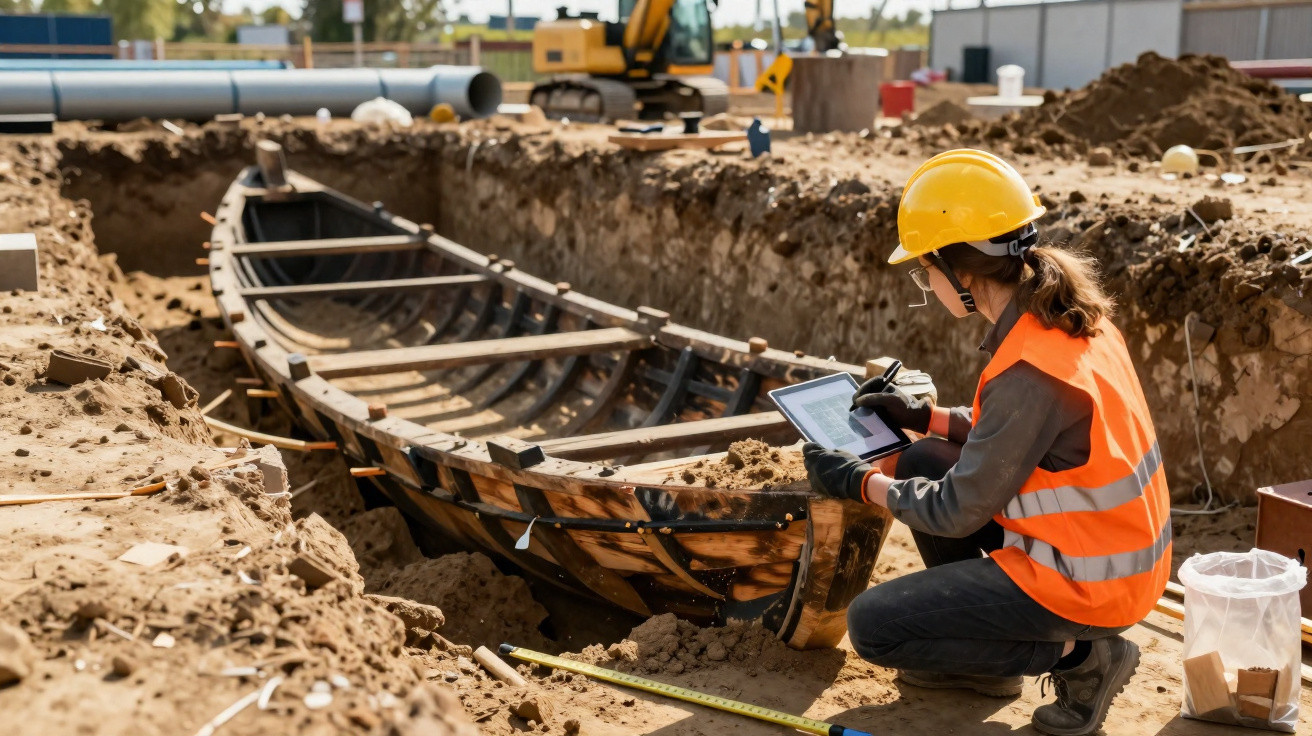
In Wijk bij Duurstede, roughly 25 kilometres south-east of Utrecht, what was meant to be a straightforward civil-engineering job has unexpectedly uncovered something of serious archaeological weight. While sewer lines were being replaced, workers hit a hefty, carefully shaped wooden plank. It is now considered highly likely that the timber is a load-bearing rib from a larger medieval vessel - potentially dating to the Viking Age or the peak period of North Sea commerce.
From a sewer trench to an archaeology hotspot
The story starts as routine: on the Promenade in Wijk bij Duurstede, ageing wastewater pipes are being swapped out and a rain swale is being created to take the edge off heavy downpours. Diggers, temporary fencing and residents’ complaints - standard fare. Then a worker notices a large, dark piece of wood protruding sideways from the wall of the excavation.
Local hobby archaeologist Danny van Basten, part of the ArcheoTeam group, takes a closer look. The silhouette, the tool marks and the sheer thickness do not match an ordinary, more recent beam that happened to be buried. He alerts the municipality, which in turn calls in specialists from Museum Dorestad and a foundation focused on historic ships.
From a “strange beam” it becomes, within hours, a possible key to 500 years of trading history on the Rhine and the North Sea.
Once the piece is finally lifted out, its scale becomes clear: about 3.20 metres long, roughly 30 centimetres thick, with distinctive notches and rounded shaping. Shipbuilder Kees Sterreburg, asked to examine the find, recognises the characteristic profile of a frame (a rib) - one of the structural elements that gives a hull its curvature.
Why this location is especially sensitive
A discovery like this would be compelling anywhere. Here, it is charged with extra significance. Beneath modern Wijk bij Duurstede once lay Dorestad in the early Middle Ages - among the most important trading centres in northern Europe between the 7th and 9th centuries.
Dorestad sat exactly where branches of the Rhine split and the route out towards the North Sea opens up. From this hub moved:
- pottery and glass in every direction
- textiles and wool from the hinterland to the coasts
- metal goods, weapons and luxury items both southwards and northwards
- coins, silver and jewellery along rivers and across the sea
Whoever held Dorestad benefited from tolls, trading privileges and political leverage. Written sources report that, in the 9th century, the settlement was repeatedly targeted by Scandinavian raids. A period of partial control by Nordic groups is also regarded as plausible.
That is why a wreck - or even a single substantial frame - found right here is far more than a technical curiosity. It is another piece in the larger puzzle: who used these waterways, when, and for what purpose?
Vikings or a Hanseatic forerunner? The dating question remains open
The headline “Viking ship found!” is tempting, but the specialists are resisting that shortcut. For now, two leading scenarios are being weighed up.
Hypothesis 1: A vessel from the Carolingian era
Based on the layer in which it was found and the associated pottery, archaeologists initially place the timber broadly between about 700 and 900. That is the period when Dorestad flourishes and is already closely entangled with Scandinavians - through trade, but also through raiding.
If that dating holds, the frame would belong to an era in which:
- Frankish influence along the Rhine and Meuse grows strongly
- Scandinavian groups deliberately call at river ports
- new ship types show hybrid traits suited to both rivers and coastal waters
Whether the vessel was built by Nordic craftspeople or simply adopted their techniques would then become the next question.
Hypothesis 2: A late-medieval cog
City archaeologist Anne de Hoop cautions against attaching a Viking label too quickly. A markedly younger merchantman is also on the table: a medieval cog, the kind of ship that shaped long-distance trade in the North and Baltic Seas in the 13th and 14th centuries.
A date in that range would shift the picture entirely. The focus would move away from early Viking contacts and towards the rise of large urban trading networks and early forms of the Hanseatic world.
| Time window | Possible ship type | Trading context |
|---|---|---|
| ca. 700–900 | Early-medieval river or coastal vessel, possibly with Scandinavian influences | Contact zone between Franks and Scandinavians, local and inter-regional markets |
| ca. 1200–1300 | Cog or similar cargo ship | intensive long-distance trade across the North Sea and Baltic, urban alliances |
High-tech meets waterlogged wood: how the dating is done
To move beyond speculation, a strict protocol is now being followed. The frame was carefully wrapped on site, kept cool and damp, and is being cleaned in stages. The reason is simple: waterlogged timber that has survived for centuries can split apart if it dries too quickly.
In the laboratory, dendrochronology will be used - the analysis of growth rings. In central Europe, each tree species forms distinctive sequences of wide and narrow rings. These patterns can be matched against reference curves, allowing researchers in many cases to pinpoint, to within a few years, when the tree was felled.
Dendrochronology reveals not only the felling date, but often the wood’s origin as well - and with it, small-scale trading routes.
If the pattern aligns with the references, it can often be narrowed down whether the tree came from a local floodplain, a slope in the Eifel, or even a distant Scandinavian forest. For a potential Viking-era ship or a cog, that provenance would be a decisive piece of evidence.
What a single ship’s frame can say about trade and daily life
Even if the final verdict is “only” that the timber belonged to an anonymous merchant vessel, the discovery is still a stroke of luck. Complete ships are exceptionally rare in archaeology; far more often, only scattered fragments remain.
Even one large component can support a long list of questions:
- How thick is the timber - in other words, what loads could the hull carry?
- How pronounced is the curvature - was it designed more for shallow rivers or open water?
- Which tools produced the marks - axe, broad axe, saw?
- How were frames and planks joined - wooden pegs, iron nails, mortise-and-tenon?
Those details translate directly into real-world capability: how many barrels of beer, salt or grain could it take? How quickly could it tack upstream? Was it built with a flatter keel to cope with shoals, or a deeper one for steadier offshore passages?
More than raids: what the find suggests about Viking narratives
The discovery also feeds into a debate that repeatedly resurfaces: the place of the Vikings in early medieval Europe. Popular culture and television favour raids, burning monasteries and warrior imagery. Research has long painted a more complex reality.
For Scandinavian groups, ships were first and foremost logistical tools. With vessels that were seaworthy yet still shallow-draught, it was possible to:
- travel upriver to Cologne, Mainz or Paris
- reach remote markets where others struggled
- link the flow of goods between inland regions and the sea
- move warriors, craftspeople and traders rapidly
If the frame is ultimately dated to a Scandinavian-influenced context, it would provide tangible evidence of that dual role: ships as transport for both commerce and warfare.
How the public benefits from a building site discovery
Museum Dorestad has already said it intends to display the timber once analyses are complete. That would move the frame from a muddy construction trench into a climate-controlled gallery - turning it into a physical, relatable piece of everyday life from past centuries.
Many people encounter the Middle Ages mainly through textbooks or television documentaries. Standing in front of a real ship component is different: you can see cuts, cracks and tool traces. You can grasp the scale of such a rib - and how substantial the effort must have been to build an entire vessel.
Objects like this give visual substance to abstract terms such as “trading hub” or “naval power”. A teenager looking at the frame can immediately understand that every journey on the Rhine was a logistical gamble - shaped by currents, shoals, storms and political tensions along the banks.
What the find means for future groundworks
The Wijk bij Duurstede case also underlines how carefully modern infrastructure work must be planned in historically sensitive areas. Diggers cutting through former harbour zones or old town centres without archaeological oversight can destroy valuable traces beyond recovery.
Across many Dutch cities - and in Germany as well - clearer rules are now in place: for major building work in historic areas, archaeologists are often on hand, or can be called in at short notice as soon as anything unusual appears. This discovery is a strong argument for expanding such standards rather than trimming them back, even under cost and scheduling pressure.
For researchers, the frame is only the beginning. In the coming months, it may become clear whether further parts of the hull lie nearby. Even a handful of additional fragments - a section of side planking, a frame foot, a remnant from the keel area - could sharpen the identification of the ship type and push reconstruction forward significantly.






Comments
No comments yet. Be the first to comment!
Leave a Comment