
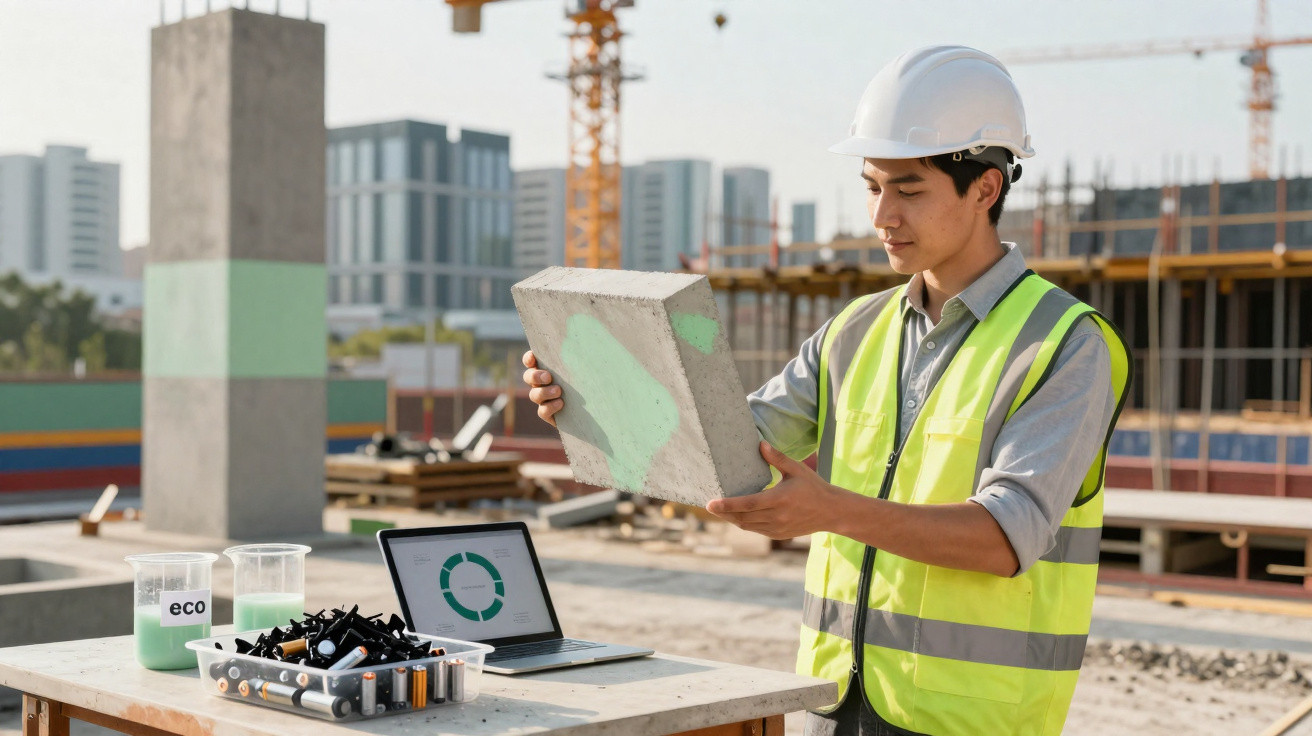
On a planet criss-crossed by towers, flyovers and motorways, one unassuming material accounts for an enormous share of the world’s climate impact.
Concrete underpins almost everything we call “modern civilisation”, yet it comes with a steep environmental price tag. Researchers in Australia now say they have identified an unexpected way to lessen that damage by making use of a leftover from the global rush for lithium batteries.
An ocean of concrete and a bitter climate bill
Each year, humanity produces roughly 30 billion tonnes of concrete. Put another way, about 952 tonnes leave plants and batching stations every second. It is the fabric of cities, roads, dams and airports - unobtrusive, grey and seemingly ordinary.
That sheer volume has consequences. Portland-cement-based concrete accounts for around 8% of global CO₂ emissions, according to recent IPCC reports. On its own, it emits more than commercial aviation.
"Concrete is, at the same time, a symbol of urban progress and of a way of building that puts pressure on the climate, natural resources and air quality."
The core issue sits with cement itself - the powder that binds sand, aggregate and water. Making it requires kilns operating at extremely high temperatures, burning fossil fuels and releasing CO₂ both from combustion and directly from the breakdown of limestone. With conventional approaches, this double source of emissions is hard to avoid.
From battery waste to “green concrete”
What β‑delithiated spodumene actually is
At the other end of the climate puzzle is lithium, a key metal for batteries in electric cars, mobiles, laptops and grid-scale energy storage. Extracting and refining lithium also brings impacts and waste streams. One such residue is β‑delithiated spodumene, referred to in the literature as DβS.
DβS is produced as a by-product of lithium refining: a solid material in powder or fragment form that would typically end up in tailings facilities, landfill, or open-air stockpiles. It takes up space, can generate dust, requires environmental oversight and has struggled to find large-scale applications.
A team at Flinders University in Australia, led by Professor Aliakbar Gholampour, set out to flip that logic. Instead of treating DβS as a disposal headache, the researchers approached it as a potential ingredient.
Geopolymers: an alternative route to Portland cement
The group tested DβS in a different kind of concrete from the standard mix: geopolymer concrete. In this system there is no Portland cement. The binder comes from combining silicon- and aluminium-rich materials (such as industrial ash or slag) with alkaline solutions that trigger polymerisation reactions.
By introducing DβS into this matrix, the scientists found the residue could work as an additive and, in part, as a replacement for other inputs - including fly ash from coal-fired power stations. The outcome stood out.
"The tests indicated gains in mechanical strength and increased durability, with the potential to outperform traditional concretes in certain formulations."
In effect, a battery-industry “waste” begins to behave like structural reinforcement inside a lower-carbon concrete.
Less waste, more circularity
Why this approach is worth attention
What the Australian team proposes speaks directly to two challenges that are accelerating in parallel: surging lithium demand and the need to cut emissions from construction. Some immediate implications of linking mining residues with concrete production include:
- reducing the volume of lithium-refining waste sent to landfill or industrial tailings dams;
- lowering reliance on traditional raw materials associated with heavy impacts, such as coal fly ash and cement clinker;
- creating economic value from a residue that currently imposes storage and environmental monitoring costs;
- making the circular-economy idea more tangible, where one sector’s by-product becomes another sector’s qualified feedstock.
This kind of re-use matters because lithium mining is expected to expand as transport electrifies. For every new megawatt-hour of battery capacity produced, waste streams are generated in parallel and must be managed safely.
| Challenge | Current risk | Role of DβS in concrete |
|---|---|---|
| Lithium residues | Stockpiling, potential contamination | Converted into a construction input |
| Cement emissions | High CO₂ per tonne of clinker | Partial replacement via a geopolymer matrix |
| Infrastructure demand | Consumption of non-renewable resources | More durable, more material-efficient concrete |
How the new concrete behaves in practice
Mix designs, testing and today’s limits
To reach solid results, the Australian team varied the geopolymer recipes incorporating DβS: different alkaline activators, different ratios between the residue and other aggregates, and curing at ambient temperature.
Some combinations performed particularly well, reaching strengths comparable to - and in certain cases higher than - ordinary concretes used in everyday structural applications. Performance also matched established fly-ash-based geopolymers, with a clear environmental upside: reduced dependence on coal and its by-products.
Even so, there are hurdles still to clear before broad adoption: consistent quality standards for DβS sourced from different mines, long-term durability assessment, behaviour under cycles of moisture, heat and cold, resistance to chemical attack, and alignment with construction codes.
"The scientific leap has already happened in the laboratory; the next challenge is turning that knowledge into a certified product that is price-competitive and scalable."
Where this kind of concrete could be used
In a realistic rollout, DβS concrete would likely begin in controlled, lower-risk applications, expanding as it builds a track record. Natural early candidates include:
- paving for pavements, car parks and cycle lanes;
- blocks for retaining walls, non-load-bearing partitions and precast components;
- non-critical infrastructure, such as light industrial sheds and temporary structures;
- pilot schemes in social housing developments, linked to innovation programmes.
Over time - if durability results hold up - bridges, flyovers and multi-storey buildings could come into view.
Other attempts to “decarbonise” concrete
Bacteria, wood and self-repair
The push for cleaner concretes is not new. Research groups worldwide have been pursuing alternatives to, and add-ons for, the classic Portland-cement route. Frequently discussed directions include:
- powders containing dehydrated bacteria that, when reactivated with water, urea and calcium, produce bio-cement that “glues” sand grains and seals cracks;
- concretes using microcapsules of enzymes that rupture when fissures appear, releasing healing agents that mimic bone repair;
- projects that turn wood waste into cementitious additives, partially replacing clinker and lowering the carbon intensity per cubic metre.
None of these approaches alone solves construction’s global emissions problem, but together they point to a sector in transition - increasingly focused on whole-life impacts and on opportunities to re-use industrial residues.
Risks, safeguards and next steps
Using industrial by-products at scale inevitably raises safety questions. With DβS, regulators and communities will want clear answers about potential leaching of chemical elements, effects on groundwater, and air-quality impacts during handling and future demolition.
Toxicology tests, decades-long use simulations and independent assessment help build confidence. A particular sensitivity is variability: each lithium mine has its own ore chemistry. That may mean batch-by-batch classification or standardised processing routes to ensure the finished concrete delivers predictable performance and safety.
How this could affect cities and construction in Brazil
Brazil is still at an early stage in lithium mining compared with Australia and Chile, but it is beginning to position itself as a relevant supplier. If the DβS route gains traction, it could open windows for:
- partnerships between miners, universities and local precast manufacturers;
- new industrial clusters focused on regional geopolymer concretes, using residues close to construction sites;
- public projects that require a minimum percentage of recycled content in infrastructure works.
One way to picture the potential is to imagine a large logistics complex built near a lithium extraction region. Instead of lorries hauling waste long distances, that flow could be redirected to concrete plants, cutting transport needs and creating local value.
Terms such as “geopolymer” and “β‑delithiated spodumene” may sound far removed from everyday life, yet they sit precisely on the frontier between materials chemistry and climate policy. Every percentage point of cement displaced by solutions like this equates to thousands of tonnes less CO₂ emitted over years of construction activity.




Comments
No comments yet. Be the first to comment!
Leave a Comment