
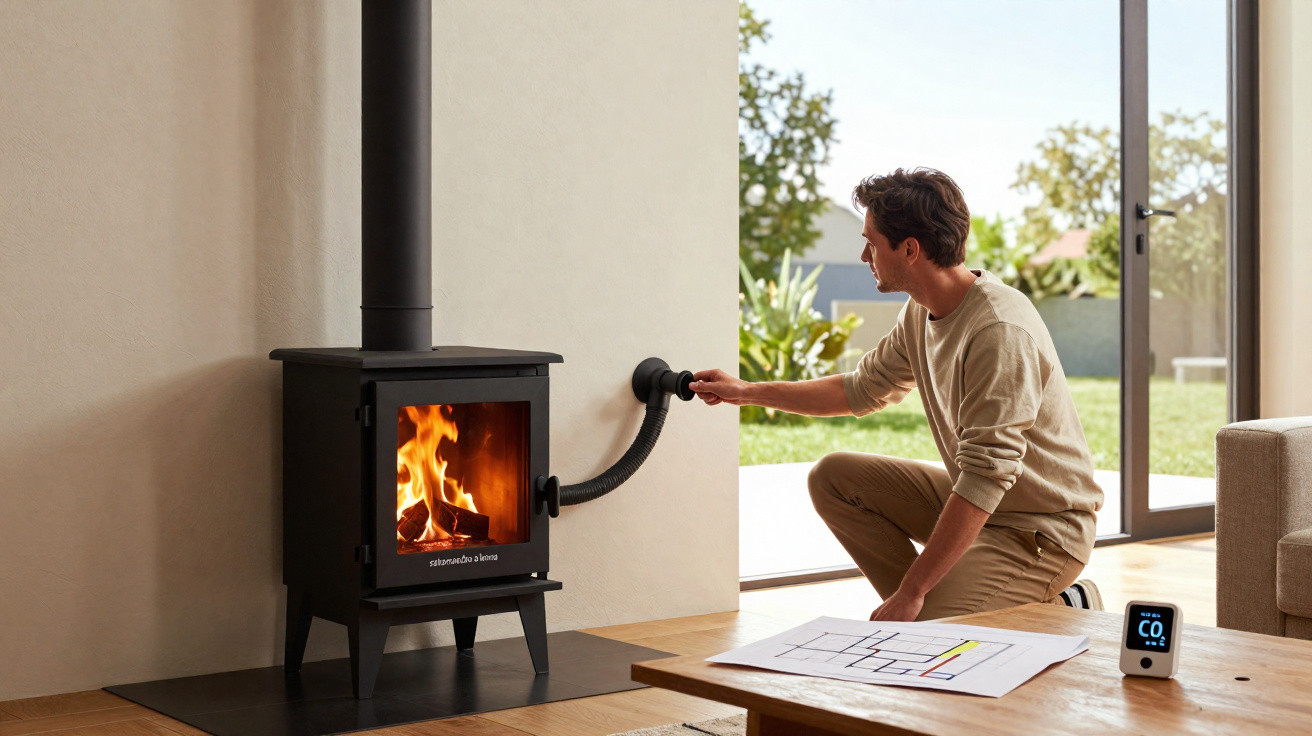
One small, easily overlooked feature has an outsized impact on how safe and effective a stove is.
Beneath the glow of every log burner sits a basic question: where does the fire get its air from? As homes become more airtight and regulations become stricter, the once-humble air inlet has become a central design choice for anyone planning a wood stove.
Why the air supply question is back in the spotlight
In the past, older draughty properties effectively let a stove “help itself” to air through gaps around windows, doors and floorboards. Because the building fabric leaked so much, few people gave dedicated air inlets much thought.
That landscape is changing fast. Across Europe, the UK, the US and Canada, newer rules promote low‑carbon heating alongside better insulation and higher airtightness. At the same time, many of these improved homes still include a modern wood stove-either as a low‑emission back‑up or as the main source of heat.
A powerful wood stove in an airtight house behaves like a mechanical lung: if it can’t inhale clean air, it starts dragging air and fumes from wherever it can.
This creates a built‑in conflict: sealing a home reduces energy loss, but any combustion appliance still requires oxygen. That tension sits at the centre of today’s debate over whether an external air supply is merely optional, strongly recommended, or simply non‑negotiable.
What the rules say: when an air inlet becomes non‑negotiable
Exact requirements vary by country, but several broad patterns appear across most Western markets:
- Highly airtight new builds typically need a direct air supply for any solid‑fuel appliance.
- Installers are expected to demonstrate that the stove will not deplete oxygen in the room or interfere with mechanical ventilation.
- Certification bodies and insurers are increasingly looking for recorded compliance rather than informal “best effort”.
In France, for instance, professional installers commonly work to DTU 24.1, which specifies a permanent air supply for combustion that cannot be shut off. Comparable expectations show up in British Standards and in North American codes, particularly where modern “room‑sealed” stoves are intended to run on outside air.
Energy performance rules (such as RT 2012 and RE 2020 in France, Part L in the UK, and various state regulations in the US) reinforce the same direction of travel. As airtightness targets become tougher, the old assumption-“there will probably be enough leakage for the stove”-leaves almost no safety margin.
Regulators no longer assume that a building will naturally leak enough air for safe combustion. The design now has to prove that the stove can breathe.
Why a wood stove actually needs its own air
The underlying science is straightforward: wood only burns properly with sufficient oxygen. When a stove is short of fresh air, three issues tend to show up quickly:
- Burning becomes incomplete, producing more smoke and fine particulate matter.
- Carbon monoxide (CO) concentrations increase, often with no obvious smell or visible cue.
- Chimney draw weakens, raising the risk of smoke spilling back into the room.
In an airtight home, the stove can also end up competing with other equipment that moves air-kitchen extract hoods, bathroom fans, or a mechanical ventilation system. When these devices extract air, indoor pressure drops. The stove then finds it harder to push flue gases out and may even start pulling air down the chimney rather than sending smoke up and out.
A dedicated air supply works like a private lane on a motorway: the stove receives a predictable flow of oxygen, no matter what the rest of the house is doing.
How the fire breathes affects more than safety. It also influences heat output, how clear the stove glass remains, and how often the chimney needs sweeping. Appliances that are starved of air frequently develop blackened glass, heavy soot deposits in the flue, and underwhelming warmth compared with their stated rated power.
Direct vs indirect air supply: two main strategies
Direct external air connection
The most robust approach is to feed fresh air from outdoors directly to the stove. Typically, a rigid (often insulated) duct connects an external grille to a spigot on the appliance or to the immediate intake area around it.
This setup brings clear benefits:
- The stove no longer relies on room air, so it has less impact on the indoor environment.
- Chimney draw is generally steadier, even during windy weather or when powerful extractor fans are running.
- Heat loss caused by uncontrolled air leakage through the home can be reduced markedly.
On the outside wall, installers usually add a grille that deters rodents and helps manage fire risk while still providing adequate airflow. Duct diameter is matched to the stove’s output: a modest 4–5 kW stove does not require the same air volume as a larger 12 kW heater.
Indirect air supply from an adjacent space
If routing a duct directly outdoors is impractical, some installations draw combustion air from a nearby room-such as a garage, utility space, or a ventilated corridor. This indirect method can work, but only under stricter conditions.
The adjacent “donor” area must:
- Stay well ventilated throughout the year.
- Not be a fire hazard or used to store volatile fuels.
- Provide sufficient volume to avoid large pressure changes when the stove is operating at full output.
Because this arrangement is more fragile, it demands more careful planning and ongoing checks. If the neighbouring space is later upgraded with extra insulation, fitted with a tighter door seal, or filled with stored items that obstruct vents, the airflow balance can deteriorate quickly.
Are there cases where a dedicated air inlet is not mandatory?
In some older properties with very leaky building fabric, a stove may still get enough air through uncontrolled infiltration. Gaps around windows, porous stonework, and unsealed floors can all behave like ad‑hoc vents.
Legally, certain standards still permit this in specific cases-particularly with lower‑output stoves or in homes that have not been through energy‑efficiency refurbishments. In practice, however, expectations are shifting.
Many installers now treat a direct external air supply less as a luxury and more as basic good practice, even in “breathable” homes.
Several practical factors drive that mindset:
- Air leakage can vary dramatically with weather and wind, sometimes by a factor of three from one day to the next.
- Later renovations may unintentionally tighten the building, leaving the stove short of air.
- Insurers and certification schemes often prefer evidence of controlled, predictable air management.
In the end, the call usually lies with the competent, certified installer after a site visit. They will assess (by measurement or estimation) the home’s airtightness, how the stove will interact with existing ventilation, and the stove’s size and type. In many borderline situations, they now advise fitting an air inlet even where the strict wording of the code might still allow a room‑air approach.
Key risks when the stove has no proper air supply
| Risk | What happens | Typical warning signs |
|---|---|---|
| Carbon monoxide build‑up | Incomplete combustion allows CO to enter the room. | Headaches, nausea, drowsiness, CO alarm activation. |
| Chimney fires | Unburnt tar and soot accumulate in the flue and later ignite. | Strong odour, loud roaring in the chimney, visible sparks. |
| Back‑drafting | Smoke and fumes reverse into the living space. | Smoke escaping around the door on opening, smell of fumes indoors. |
| Poor heating performance | The stove fails to reach its rated output. | Lazy flame, room stays cool despite high wood consumption. |
Even newer “clean burn” or “double combustion” stoves suffer when airflow is inadequate. Their secondary air systems-intended to reburn gases and cut emissions-depend on a steady primary air supply to function properly.
What homeowners can check before installing a stove
Many people start with the wood stove as an aesthetic feature and only later treat it as the engineering device it is. A brief checklist helps keep the decision practical:
- Confirm whether the property is new or has been recently refurbished to a tight energy standard.
- Note every other appliance that moves air: extractor fans, mechanical ventilation, and tumble dryers that vent outside.
- Identify realistic routes for a small duct to the outside near the intended stove position.
- Ask the installer to calculate the air volume needed for the chosen stove model and output.
- Plan from day one for a CO alarm and routine chimney sweeping.
With that information, the installer can more confidently choose between direct, indirect, or (in rare cases) room‑supplied combustion air.
Beyond regulation: performance, comfort and long‑term costs
An air inlet is not only about passing inspections. It can also change day‑to‑day comfort. When the stove draws air from outdoors, occupants are less likely to feel cold draughts tracking along the floor towards the fire. Heat distribution is often more even, and the rest of the home is less prone to pressure imbalances.
Running costs can improve as well. Cleaner, more efficient combustion extracts more heat from each log, and a cleaner flue lowers the chance of costly repairs after a chimney incident. Over ten years, the savings and avoided problems can readily match-or exceed-the upfront cost of adding the air supply during installation.
For households considering a future heat pump, a wood stove with its own air circuit can also provide complementary heat without upsetting the fine balance of low‑energy ventilation systems. This paired approach is becoming more common in areas where winter electricity demand peaks and where people want resilience during power cuts.
A final point that is often missed relates to indoor air quality beyond CO. Well‑aired, efficient stoves are less likely to release fine particles into the home when the door is opened for refuelling. For people with asthma or other respiratory conditions, the difference can be noticeable on smoky winter evenings. In that sense, a simple metal duct behind a stove can support a wider health choice-not just compliance with a building regulation.



Comments
No comments yet. Be the first to comment!
Leave a Comment