
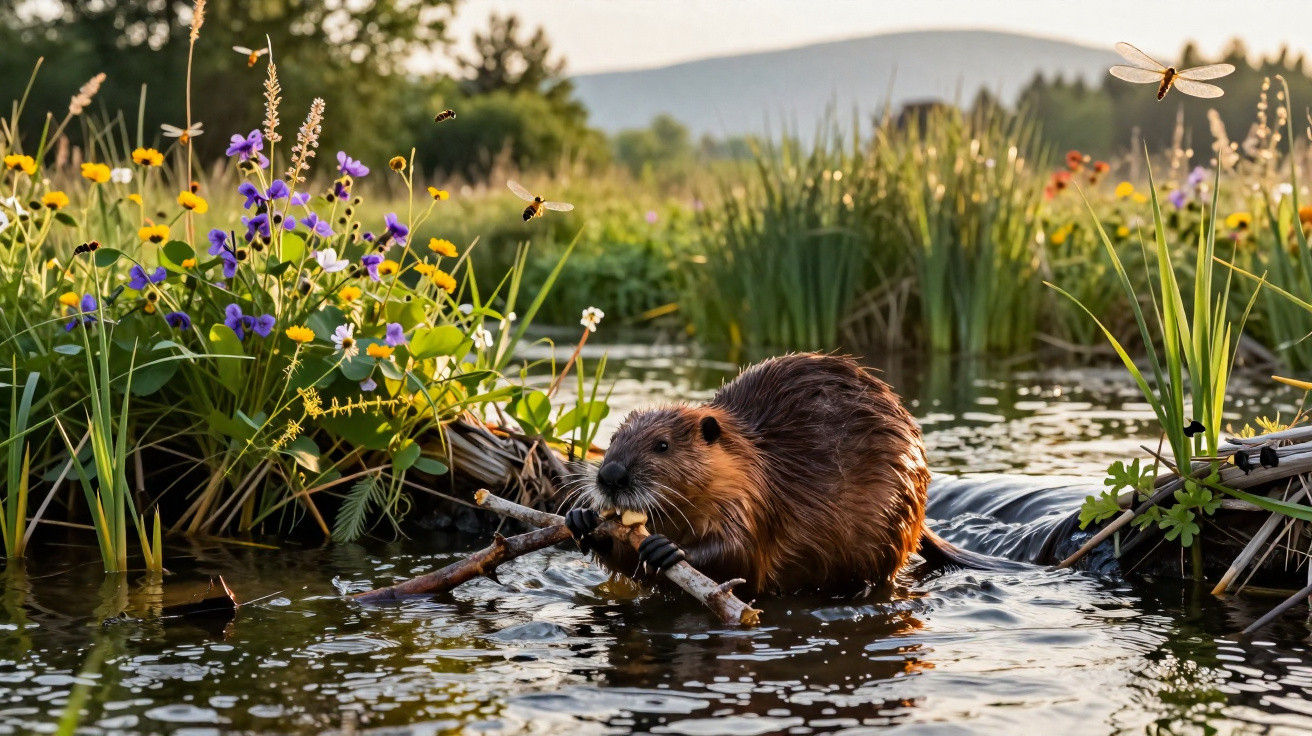
International Beaver Day is marked every year on 7 April, celebrating one of the natural world’s most influential engineers and acknowledging the long-running work to safeguard the species.
Launched in 2009 by the Beaver Institute, the date was chosen to align with the birthday of Dorothy Richards, a trailblazing campaigner who devoted decades to observing and protecting beavers at her sanctuary in New York.
International Beaver Day and the ecological significance of beavers
Beavers are steadily altering rivers, wildlife communities and even climate-related processes. They do far more than put up dams - they can restore whole ecosystems.
After being hunted to the brink of extinction, beavers are now quietly reappearing in many areas. As populations recover, researchers are finding that their influence extends well beyond ponds and small streams.
By cooling waterways, providing support for pollinators and locking away carbon, beavers are increasingly recognised as some of nature’s most effective environmental engineers.
To mark International Beaver Day, three recent studies highlight the scale of what these animals achieve - often in ways that contemporary engineering finds difficult to replicate.
Beaver dams help protect rivers
In plenty of landscapes, beavers have not yet fully returned. In response, scientists and land managers are attempting to copy their approach.
Research from Washington State University Vancouver indicates that human-made beaver dams - assembled from sticks, mud and other natural materials - can help rivers adapt to climate change.
These installations, referred to as “beaver dam analogs,” reduce the speed of water, enabling it to spread out across floodplains and percolate into the soil.
As a result, streams can hold on to water further into the summer - precisely the period when higher temperatures and reduced snowpack make rivers most at risk.
By keeping water on the landscape, these dams can lower stream temperatures, support wetland recovery and improve habitat for fish and other wildlife.
They are not a complete replacement for living beavers. Even so, in places where beavers are still missing, artificial dams offer a low-cost, nature-based option for boosting climate resilience.
Beaver wetlands are pollinator hotspots
Work led by the University of Stirling shows that beavers do not only reconfigure rivers - they also reshape entire food webs.
When beavers construct dams, they create wetlands with slow or still water, lush plant growth and a range of microhabitats. These conditions prove especially attractive to pollinators such as bees, butterflies and other insects.
The researchers found that wetlands created by beavers can function as biodiversity hotspots, supporting a far broader range of pollinators than nearby landscapes.
Those insects are pulled in by the plentiful flowering plants that flourish under wetter conditions.
The implications extend well beyond the wetlands. Pollinators are essential for ecosystems and farming, and their worldwide decline has become a serious concern.
By generating habitat on their own, beavers could help offset some of that loss - without any human intervention.
Beavers turn rivers into carbon sinks
One of the most unexpected findings relates to climate.
A recent study reports that beaver activity can convert rivers into substantial carbon sinks - systems that take up more carbon dioxide than they emit.
The study was carried out by specialists from the University of Birmingham, Wageningen University and the University of Bern.
By slowing flows, capturing sediment and enlarging wetlands, beavers significantly alter the way carbon is transported through a landscape.
Rather than being carried downstream or released into the air, carbon is retained in mud and sediment, stored in plant biomass and buried within wetland soils.
The researchers describe this as a major change in the carbon cycle, with beavers effectively transforming streams into long-term carbon storage systems.
This positions beavers as an unlikely partner in tackling climate change - a natural process that operates continuously.
A small animal with an outsized impact
Beavers are often described as “ecosystem engineers,” and these studies make the case clearly. Using only their teeth, wood and mud, they can store water through droughts, bolster pollinators and broader biodiversity, and capture and lock away carbon.
As the world looks for answers to climate change and biodiversity loss, beavers provide something unusual: a single system that eases several challenges at once - simply by doing what they have always done.
Despite their benefits, beavers still face growing pressures across much of their range.
Habitat loss, expanding development and river-modification schemes frequently remove the slow-flowing channels and floodplains that beavers rely on.
In many places, beavers are also treated as a nuisance because their dams can flood roads, farmland and infrastructure, leading to trapping or removal before their ecological value is fully appreciated.
Climate change adds further strain by shifting water availability and disrupting the very systems beavers help to stabilise. Ironically, the areas that could benefit most are often those where beavers find it hardest to persist.
Rebuilding and protecting beaver populations may be among the simplest routes to healthier ecosystems - but doing so depends on changing how we value, manage and live alongside these exceptional animals.




Comments
No comments yet. Be the first to comment!
Leave a Comment