
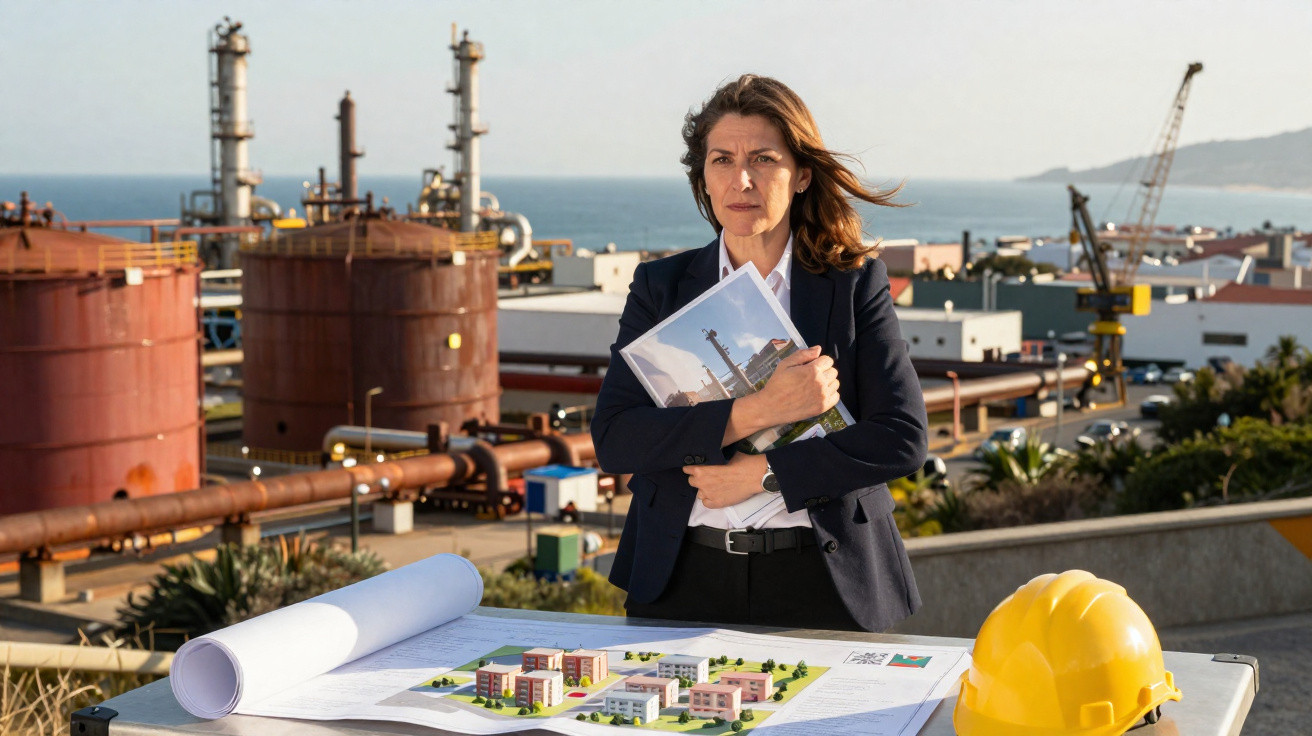
Luísa Salgueiro, the Mayor of Matosinhos, dismisses the idea that 50% of the land at the former Petrogal refinery should be used for housing and says cleaning up the site is likely to take 10 years. She also points to mobility in Leça da Palmeira as one of the biggest concerns.
Galp’s timetable to begin building an “innovation district” in 2029 on the roughly 250 hectares of the former refinery in Leça da Palmeira - where dismantling work is still under way - is, in her view, “very ambitious” and unlikely to be met. Before anything can move forward, she says, the area needs credible mobility solutions, such as a metro line, and above all the soils must be decontaminated. On that process, she says she will not compromise and estimates it will take about “a decade”.
Salgueiro told JN that there is “no agreement regarding the 50% of housing” included in the scenario Galp has presented for use of the land, with the remainder earmarked for economic activity. “There is no definition of building-area criteria or percentages, but it will not be 50/50. Our PDM [Municipal Master Plan] sets that, in economic-activity areas of that size, it should be 10% for housing,” the Matosinhos mayor notes, while acknowledging that the share could end up “being more, but it will not reach 50%”.
She reiterates that “it is the Council that ensures compliance with planning parameters, and there is no provision for 50% housing development”. In other words, the figure of 19,000 new residents cited in the PwC study for Galp - a projection based on a scenario in which half of the land is allocated to housing - “has not been demonstrated”, she warns. The mayor stresses that such a proposal does not match the project the municipality intends to approve for the site.
She adds that Galp’s estimate of new residents is broadly comparable to the current population of Leça da Palmeira. That would mean concentrating, on the former Petrogal refinery land between Boa Nova and Cabo do Mundo, a doubling of residents - with inevitable knock-on effects for traffic and public transport in a small area where roads are already overloaded.
Affordable rents
Whatever distribution is ultimately chosen between the planned uses - which also include education, research and green space - Salgueiro insists the residential component “will not be only luxury housing”, because “the Council will require there to be a lot of affordable-rent homes there”.
The condition of the ground where oil refining took place for half a century is another of her major concerns. The refinery opened in 1970, under the then oil company Sacor, and shut in 2021. “Matosinhos Council will not compromise on the strict defence of compliance with environmental standards and respect for the polluter pays principle,” she says.
Salgueiro also doubts the practicality of a solution outlined last week by Pedro Dias, Galp’s lead for the refinery redevelopment project, who suggested decontamination could progress in step with construction. Once dismantling ends - currently expected by the end of this year - she believes “another decade will be needed to decontaminate and build”. “I estimate that is the reasonable timeframe. We do not want decontamination done as it was done for the Expo [in the Parque das Nações area of Lisbon], and for what happened there to happen again,” she says, referring to homes built on the former Cabo Ruivo refinery site, which she says remain contaminated to this day. She underlines that the Portuguese Environment Agency (APA) “will be decisive in this process”.
Mobility proposals
With several large-scale developments planned for Leça da Palmeira - which only gained city status when it was merged with the parish of Matosinhos - mobility has become the main puzzle in managing the area. The A28 has been at capacity for a long time, and the movable bridge, currently closed for works, is not a solution.
For that reason, Salgueiro has asked for a meeting with the Minister for Infrastructure, Miguel Pinto Luz. No date has been set yet, but she says she will bring multiple proposals to the discussion: extending the Leixões rail line to Leça; and “a metro line that stitches together the whole urban fabric and goes to Leça da Palmeira, which is essential” and “will have the demand to justify the investment”. The municipality also wants to debate “a road running alongside the A28” and “building a new bridge either downstream or upstream”.
She argues the challenge goes well beyond the Petrogal site itself, given the additional traffic generated by other schemes: projects linked to Exponor - which has been sold and will include two hotels (directly opposite the residential towers that have been going up in the former Facar metalworks area in Amorosa) - the expansion of the Leixões container terminal, and, to the north, Jomar (housing and a hotel are planned at the former Perafita timber factory) and Tertir, in Santa Cruz do Bispo, which will include housing, retail and services.
Learn more
Rejected project
A “masterplan” Galp presented four years ago proposed that housing would dominate the roughly 250 hectares of the refinery site, which does not fit the current PDM. The project was rejected by the head of the municipality.
Mitigation
After the refinery closed in 2021, a study by the University of Porto’s Faculty of Economics pointed to a negative impact of 200 million euros per year on Matosinhos’s economy. However, Luísa Salgueiro says that a 17% increase in the number of companies and the creation of 16,000 jobs in the municipality ended up mitigating that effect.






Comments
No comments yet. Be the first to comment!
Leave a Comment