
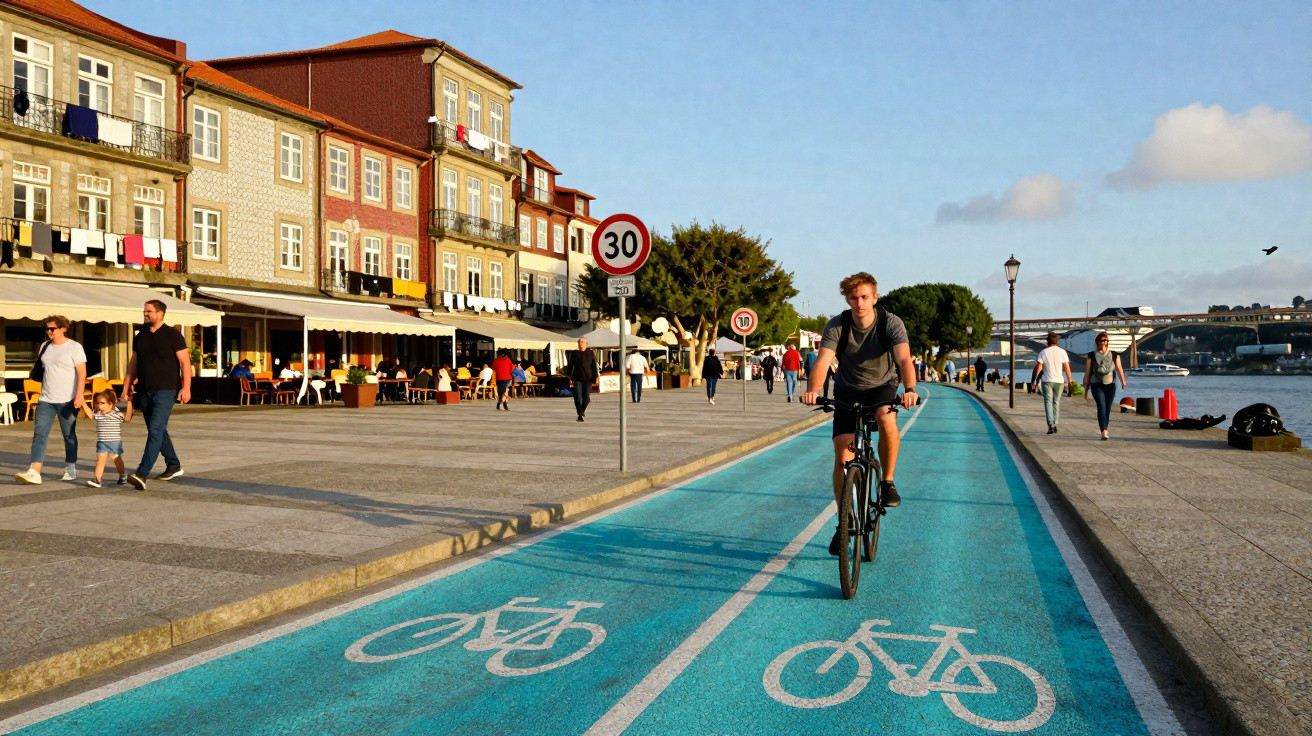
A sustainable urban mobility plan for Porto proposes bringing in a 30 km/h limit across city-centre blocks. It also includes reviving an old branch line to connect Alfândega to Campanhã.
Cutting driving speeds to 30 km/h within defined blocks inside the city, adding more bus corridors, and bringing the tram back to Baixa are among the measures set out in Porto’s Sustainable Urban Mobility Plan (PMUS), due to be presented tomorrow.
"We want to roll out the Rede 30, based on a block concept. As for bus corridors, the Mayor (Pedro Duarte) had promised four kilometres, but we will try to implement six kilometres by the end of this year. Buses will spend less time stuck in traffic and the service for passengers will be more reliable", Hugo Beirão, Porto City Council’s councillor for Mobility and Transport, tells JN.
The move to a 30 km/h limit is being framed as a national first. "There are the structural roads and the main roads, and those will certainly keep the usual road rules. But everywhere inside those main networks, we can apply the Rede 30. It will be a first, but a major step, and it could change how each of us sees everyone else. If we are driving a car but realise that bicycles are there too, we will look at that mode of travel differently", says the councillor, who also holds the Economy and Entrepreneurship, Internationalisation and Tourism portfolios at the council.
The plan also highlights the tram’s return. Once work on the Metro’s Pink Line is complete, the tram will run through the city centre again, starting from Batalha. "It brings back memories and it is different. It is an alternative that will serve residents and tourists", he explains.
Two routes are planned: one via Rua de 31 de Janeiro and another via Rua de Passos Manuel. It will continue as far as the Rectorate and then descend to the riverside along Rua da Restauração.
Another standout measure in the PMUS-designed to be delivered over a decade-is the reactivation of the former branch to link Alfândega and Campanhã. "It connects different levels and can be used by different profiles of people. It will reduce car traffic and pressure on the Historic Centre. The branch could be used on rails or with rubber tyres. We will take the most realistic decision", the councillor promises.
Batalha without cars
"Making use of the branch is an idea that is many years old, but for some reason it never became reality. There is nothing that engineering cannot solve. Easier or harder, we will get there. We need to revisit the studies and check every condition of the old tunnels. From there, we can truly understand what type of transport is most suitable, namely in terms of investment and cost-benefit. I do not know if it will see the light of day in this term, but in this political cycle, certainly", he says.
As part of the city’s mobility policy, the PMUS also sets out an expansion of the Controlled Vehicle Access Zones (ZAAC). After Ribeira and Carmelitas, Praça da Batalha and nearby streets are next.
The ZAAC will cover the streets of Santo Ildefonso, Cima de Vila, Madeira and Cativo. "They will only be open to residents, loading and unloading, and occasional access", the plan specifies.
Batalha will also see another change. If cars have been barred from the square on Sundays since April, the same rule will be extended to Saturdays, turning it into a pedestrian area at weekends. "We listened to shopkeepers, hoteliers and other economic stakeholders, and we are going to take a step forward", he says.
Montenegro announcement
Building the Via de Cintura Externa-"so that in the future the VCI can be a more urban road"-is presented as another key project, intended to "solve the problem of road traffic entering and leaving the city".
Beirão notes that the future road "was announced by Porto City Council and by the Prime Minister, Luís Montenegro", as a project backed by the Government and Infraestruturas de Portugal. "But we took the reins of the process and we are producing the first reports, so we can move on to the next stages, which will be numerous. It is a structuring project and on a very large scale", he stresses.
The PMUS also addresses Porto residents who cycle, with plans to establish a network of cycle lanes across the municipality. And boat journeys between Cais do Ouro and Afurada (Gaia) will resume, this time operating all year round.
Hugo Beirão: "We want cycle lanes as a network"
What is planned for the cycle lanes?
It is a topic that is, I would not say on the agenda, but almost on the minute-by-minute agenda. Everyone talks about it and so do we, and we have for a long time. There is a new policy we want to bring to the whole city and we cannot separate this issue from the Rede 30. So coexistence is something important.
What will be proposed?
We want cycle lanes to be a network, truly. When I enter a place, I should not reach a point where there is no continuation. That is the commitment we are going to present. Cycle lanes have to be connected; it cannot be a plan where each cycle lane simply has a beginning and an end.
Can you name a street that could have a cycle lane?
Of course, we have already studied the streets. There is one that has already been made public, Rua de Costa Cabral. But I do not want to go into detail here; I will keep that for the plan’s presentation. We are not going to focus on one street or one specific area. We will not put a cycle lane on street A or B only for it to have no consequence at the end of that cycle lane. We want to look at the city as a whole.


Comments
No comments yet. Be the first to comment!
Leave a Comment