
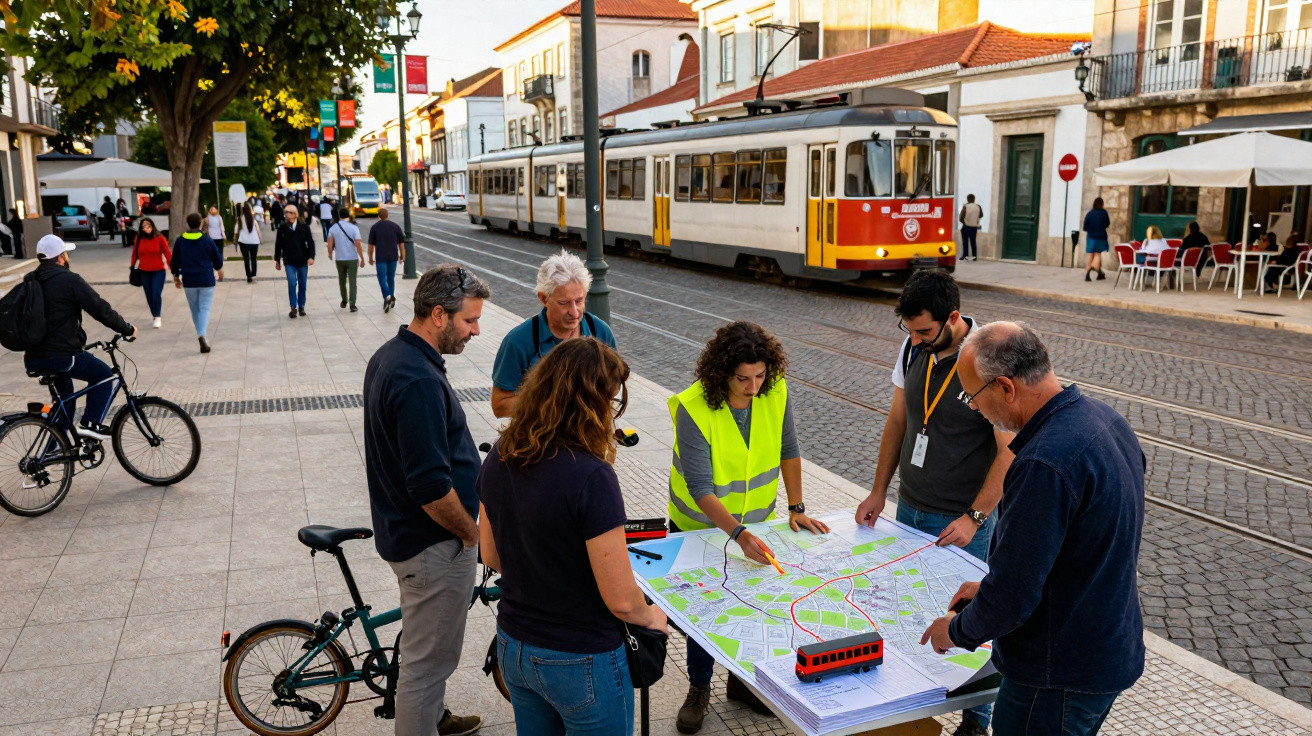
Municipal leaders and transport specialists are urging councils to back public transport with proper planning, so networks run as they should. The discussion opened the Between the Lines – Railway Workers’ Festival, which runs until Sunday at the Cultural Forum and Ermesinde Urban Park, in Valongo.
Reclaiming street space in the Porto Metropolitan Area
One of the central messages of the opening conference was the need to win back space currently dominated by private cars and return it to pedestrians, cycling and public transport, as a way to tackle the mobility challenges facing the Porto Metropolitan Area.
Paula Teles, who leads Valongo’s Municipal Accessibility Plan for All, offered a practical example: "In the city of Porto we have streets connecting to metro stations where people are forced to walk in single file." For the urban mobility specialist, that reality shows why decision-makers must be willing to take back road space now allocated to individual transport and instead commit to rail.
Measures to prioritise pedestrians, cycling and rail
Teles argued that mobility shapes citizenship itself: "Mobility is absolutely dominant in the formation of the citizen. Having mobility is having freedom, it is being out on the street, it is meeting other people." Among the steps she proposed were traffic lights that prioritise pedestrians, creating shared streets, removing parking spaces, increasing parking charges, and building cycle lanes longer than 100 metres.
Those ideas were echoed by the chair of Transportes Metropolitanos do Porto (TMP), although he stressed that sequencing matters and that planning has to come first.
TMP: planning and integration before expansion
"The word is planning. At TMP, we are working on the metropolitan sustainable urban mobility plan. If these plans had existed in the 1980s, today we would be in a different place," said Nuno Neves de Sousa.
He added: "From my point of view, it is not very relevant in spatial planning to understand whether it is better for transport or housing to arrive first. There has to be integration in housing or in services." In his view, it is the heavy modes that must provide the backbone of public transport into Porto city centre.
STCP: make the current bus system run better
Luís Osório, chair of STCP, said improving mobility is not about putting more buses on the road, but about making sure the existing system performs properly. "There is no point thinking that by having ten more buses at five o’clock in the afternoon in central Porto I will solve any problem. I will make it worse. What I have to do is make the ones that exist run better. That, yes, is a solution," he said.
"What was done to Trofa should not have been done"
Porto Metro is working to launch, still this year, the public tenders for the new connection to Gondomar and the extension of the Green Line to Trofa, according to the company’s chair.
Emídio Gomes criticised a process that has left people in Trofa without either train or metro for more than 20 years. "You don’t tell a population you are going to take away their train and that two years later they will have a metro and, 24 years later, that hasn’t happened. The State has to be a force for good and what was done to Trofa should not have been done," said Gomes, who also attended the Between the Lines – Railway Workers’ Festival.

Comments
No comments yet. Be the first to comment!
Leave a Comment