
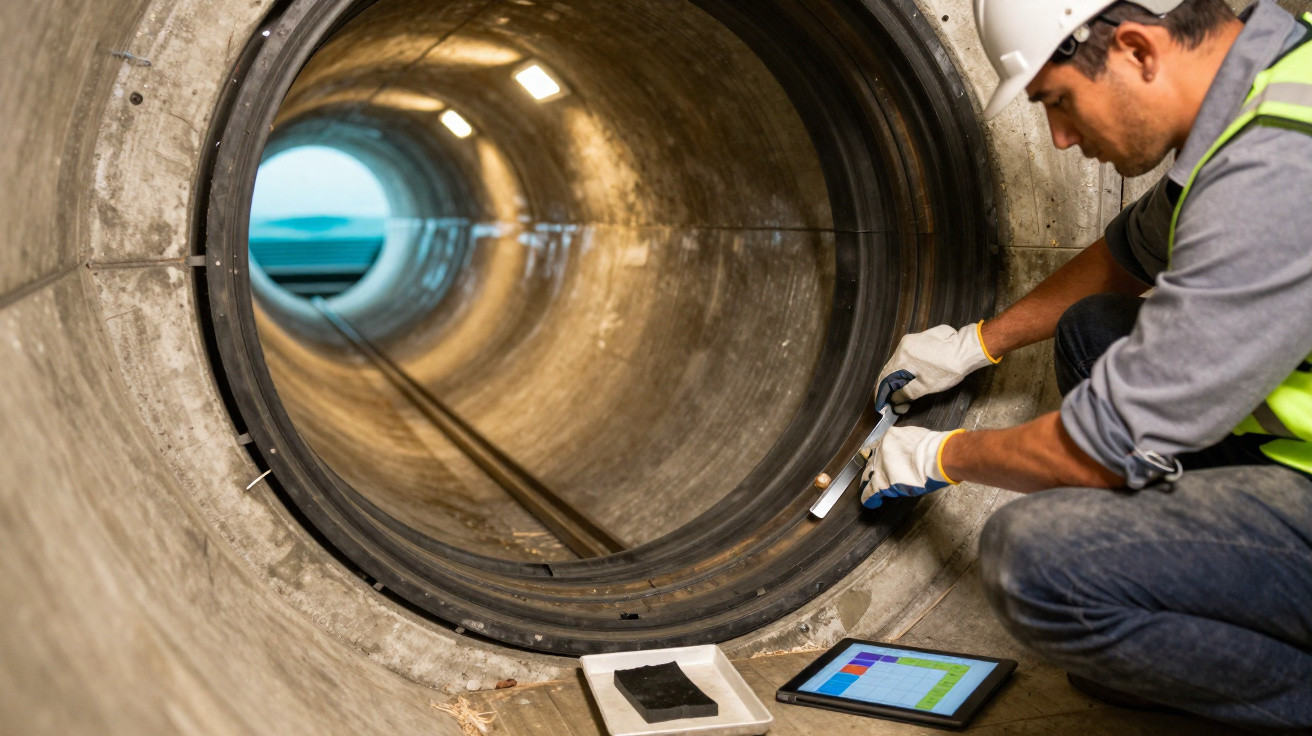
Engineers once expected a rubber seal used in undersea tunnels to keep joints watertight for at least 100 years, but testing under real pressure and seawater conditions shows it can shed 67.66 percent of its sealing force far sooner than laboratory assumptions suggested.
This shifts the durability question from obvious surface wear to a quieter issue: an unseen drop in the force that actually keeps water out.
Rubber seals and tunnels
Where two tunnel elements meet, a rubber gasket is compressed to take the load that prevents seawater entering.
Using material taken from China’s Yuliangzhou tunnel, researchers at Shijiazhuang Tiedao University (STDU) examined how hydrostatic pressure and salt exposure age the seal in combination.
Those samples showed the GINA gasket (the primary rubber seal) becoming stiffer and more compact even as its ability to maintain sealing force continued to decline.
This is a critical mismatch for inspections: a gasket can appear stronger on the surface while losing the key property that stops leakage.
Why joints stay dry
Immersed tunnels are assembled from prefabricated sections that are floated into position, lowered into a trench, and connected underwater.
After the joint is closed, the seal remains clamped between steel faces. The squeeze creates contact stress-the pressure at the interface that resists water paths.
Earlier analysis of the same tunnel indicated the lower edge is the most vulnerable area because contact stress there is typically lower. If that pressure falls further, seepage can begin well before the rubber shows severe visible damage.
What the tests saw
When compression and seawater exposure were applied together, the seal’s ageing did not follow a single smooth trend; instead, the force-loss curve split into three distinct stages.
The load-carrying capability dropped sharply at first, then settled into a long period of moderate decline, and finally levelled towards a slower tail-off.
By 90 days of accelerated ageing, chemical connections within the rubber had already reduced, and the material had become less able to flex.
That initial rapid fall may matter most, because it effectively sets the long-term trajectory for performance over the decades that follow.
Why rubber hardens
Continuous compression and seawater exposure altered the gasket from the surface inward-raising surface roughness while disrupting the internal network responsible for rubber’s rebound.
At the surface, oxygen and salt water drove attack, while damage deeper in the material shortened long molecular chains into smaller segments.
As chains were cut down, elasticity at room temperature decreased, and the temperature at which the rubber becomes markedly stiffer shifted about 5.8 degrees Fahrenheit higher (around 3.2°C).
By the end of the testing, hardness had increased by 14.18 percent and density by 5.88 percent, underlining how a tougher-feeling exterior can conceal more serious internal deterioration.
Where force disappears
The clearest warning was not simply cracking, but the continuing reduction in the pressure the gasket could sustain against steel.
In the updated long-term projection, that pressure fell to 1.51 megapascals (about 219 pounds per square inch) after 100 years.
In contrast, an earlier seawater-only study by the same team had projected 2.32 megapascals (about 336 pounds per square inch) after a century.
Including long-term compression alongside seawater therefore indicated that real in-service conditions strip sealing capacity more aggressively than seawater exposure alone.
Tunnel leaks caused by rubber
Leakage most often begins at the gasket’s lower edge, where tunnel movement can reduce local pressure enough for water to force a route through.
The size of the opening between tunnel elements proved especially influential, with previous tests placing the failure threshold at roughly 1.85 inches (about 47 mm) before waterproofing broke down.
Rotation also increased the likelihood of leakage, because it changes how the seal sits within the joint and reduces pressure at the lower edge.
Together, these points show why ageing cannot be assessed by chemistry alone: joint geometry determines where a loss of force becomes an actual leak path.
Why 100 years?
Even after the modelled decline, the gasket remained above the waterproofing index-the minimum pressure required to prevent seepage.
That limit is 0.61 megapascals (about 88 pounds per square inch), so the projection still leaves a meaningful buffer.
For owners and operators, this reframes the 100-year target from a pass/fail promise into an input for planning inspection and maintenance intervals.
The tougher challenge is detecting when a seal that still works has started losing its cushioning effect faster than the original assumptions allowed for.
Why forecasts matter
Because nobody can run a 100-year experiment on a gasket, engineers use accelerated ageing and infer long-term behaviour from shorter exposures.
In this case, 90 days of accelerated testing produced enough measurable change to chart the gasket’s early chemical deterioration.
This type of projection cannot perfectly replicate in-service influences such as waves, sediment shifts, pollution, and construction tolerances.
Even so, the study provides a rare output: a whole-life estimate tied directly to the joint conditions that keep an immersed tunnel dry.
What engineers watch
Future inspection regimes may need to prioritise whether the joint continues to maintain sufficient contact pressure, rather than relying mainly on surface hardness.
Teams may also need to focus first on the lower edge, where joint geometry and ageing effects combine in the same limited zone.
At the design stage, findings like these can inform rubber formulations, target compression levels, and inspection timing so that performance loss is addressed before leaks begin.
This is a practical benefit of testing that stayed close to real tunnel conditions, rather than evaluating rubber behaviour in isolation.
What lasts underwater
Underwater tunnel gaskets do not simply weaken in a straight line; they can harden, degrade chemically, and lose sealing force at different speeds.
Seeing those processes together improves the odds of protecting ageing joints before early, hidden force losses develop into visible leakage.






Comments
No comments yet. Be the first to comment!
Leave a Comment