
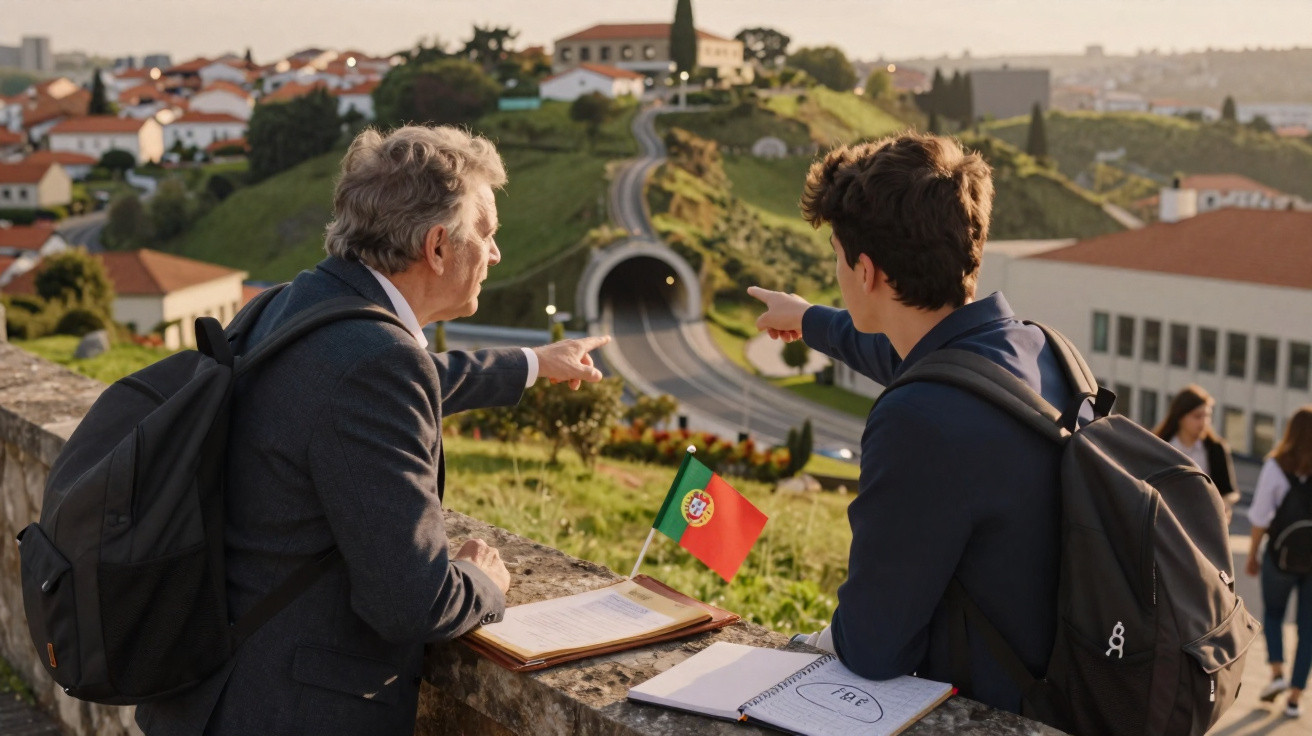
Rui Santos and Alexandre Favaios traced 50 years of Local Government alongside the transformation of the municipality and district capital. Sanitation, the university, mobility and jobs have shaped that change.
Four decades ago, students walked across the iron bridge, flinching as lorries went by, and relied on a single bus service to reach UTAD. Vila Real had no municipal theatre, Parque Corgo did not exist, and the city’s sporting and cultural offer was limited. Today, the city has a larger population, a university with nine thousand students, new facilities and projects designed to ease traffic.
That picture was set out by Rui Santos, who led the City Council between 2013 and 2025, and Alexandre Favaios, the current mayor, during a JN and TSF round-table on 50 years of Local Government, held yesterday on the city’s 101st anniversary.
Former mayor Rui Santos recalled a place where many university students walked to campus, and where the shortage of student accommodation and transport put real constraints on academic life. “When we wanted to develop a cultural activity, it was very difficult. We didn’t have a theatre,” the Socialist politician said.
"I imagine the city of Vila Real growing, adapted to the new times, connected to the world and able to welcome well those who choose to live here and build a family with pride" (Rui Santos, PS MP in the Assembly of the Republic and former mayor)
Sanitation coverage increased from 63% in 2013 to 87%, UTAD gained around 1500 students, and the municipality reversed the population decline recorded up to 2016.
Tunnel brought centrality
The Marão Tunnel strengthened the city’s central position. Rui Santos sums it up by saying that “Vila Real is the last city of the Interior and the first of the Coast”. The municipality also gained two private hospitals, sports facilities and a new business area, whose first phase has 80 plots. The second stage is expected to have 56.
This new zone will be one of the key tests of Vila Real’s ability to attract investment and secure jobs. The first phase alone received 178 expressions of interest, including some from the technology and hydrogen sectors. Alexandre Favaios acknowledges that growth has brought opportunities, but also increased pressure on mobility.
"I want a municipality of Vila Real where there is quality of life and more companies, and connected by rail to Spain and Europe, without forgetting its past and its memory" (Alexandre Favaios, Mayor of Vila Real City Council)
Vila Real City Council is finalising the project to connect 1 May Avenue to the metal bridge and is studying an outer ring road between Mateus, the IP4, the A4 and the business area. The current mayor points to UTAD’s Medicine degree, due to begin in September, as another “decisive step” to “strengthen healthcare” and “attract students and qualified professionals”, Alexandre Favaios explains.
The mayor and the former mayor align on one challenge still unfinished: rail. They argue for a fast link between Porto, Vila Real, Bragança and Zamora, for both passengers and freight. “We cannot fall behind on rail,” they agree.
Statistical curiosities
Vila Real stands out for combining history, culture and nature, set between the Marão mountain range and the Corgo river valley. As the district capital, it is also the region’s administrative, commercial and university hub in Trás-os-Montes.
7818 university students
were studying in Vila Real in 2024. The municipality managed the feat of reversing population decline, and UTAD’s ability to attract students has been central to that shift.
Technical note
Pordata’s statistics for municipalities generally go back to 2009, but from 2011 onwards there is a greater volume of data that can be compared across different years, thereby ensuring methodological consistency.
Comments
No comments yet. Be the first to comment!
Leave a Comment