
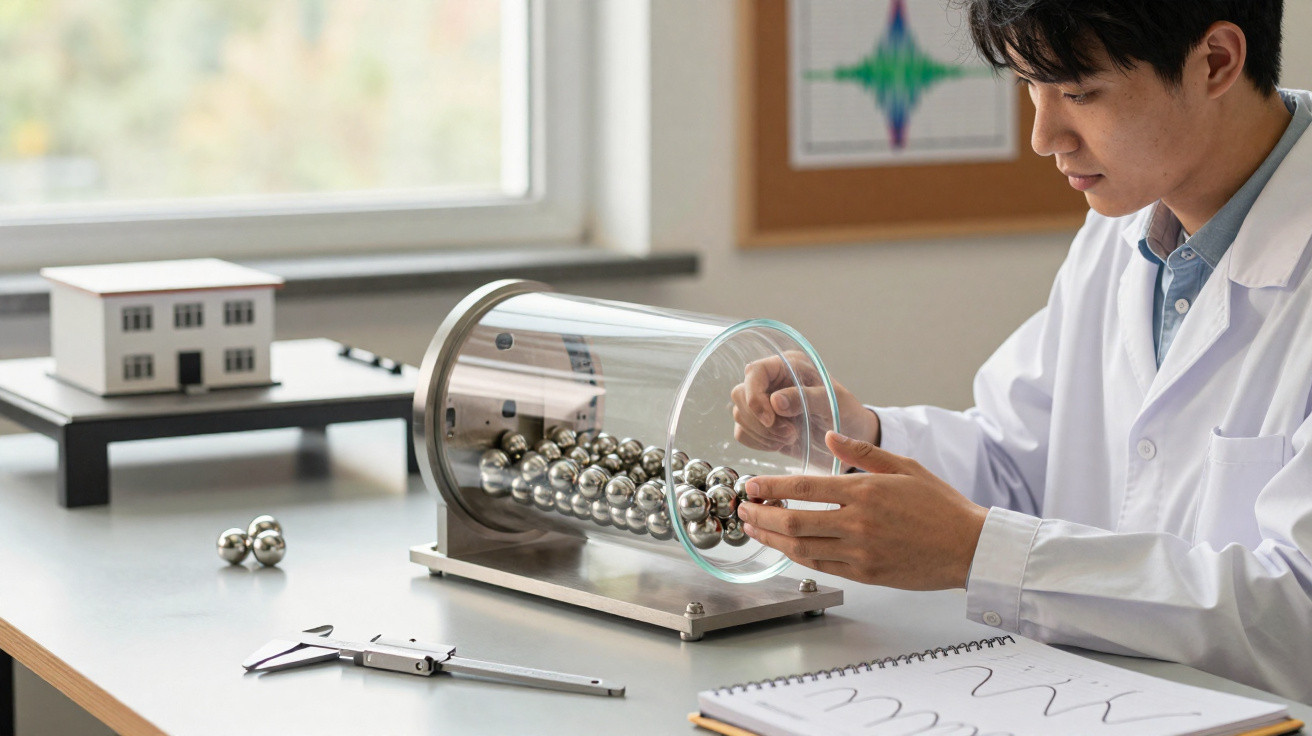
Researchers have shown that a hollow cylinder filled with steel balls can soak up around 14% of vibration energy that would otherwise pass through a structure.
The finding suggests a more straightforward route to reducing the damage buildings, bridges and sensitive equipment can suffer during earthquakes and other intense shaking.
Inside the cylinder
A US patent, issued in December 2025, describes the device and places the design on the public record.
Building on that idea, Moussa Leblouba, an engineering professor at the University of Sharjah in the United Arab Emirates, developed a frame damper.
In simple terms, the unit consists of a hollow cylinder packed with steel balls, plus a central shaft that carries short rods.
The deliberately pared-back arrangement is intended to control movement through contact and friction, rather than relying on pumps, electronics or sacrificial metal elements.
How friction helps
As a building rocks from side to side, the shaft moves backwards and forwards, and the rods push their way through the densely packed balls.
That contact converts some of the earthquake’s motion into heat, leaving less energy available to crack concrete or deform steel.
“The friction generated between the balls and the rods absorbs and dissipates the vibration energy,” Leblouba said.
With energy being consumed inside the damper itself, the surrounding structure should experience a reduced, more gradual shove.
No power needed
Existing dampers often dissipate motion by compressing fluids, using friction interfaces or allowing metal to yield, and each approach brings different maintenance compromises.
“Our device needs no power at all; it works through pure physics, through friction; it is passive,” Leblouba said.
That means a power cut during an earthquake would not disable it, and if parts are damaged they could be replaced without scrapping the entire unit.
This sort of robustness can be most important after an initial shock, when repair teams need protective systems that continue operating.
Fitting older structures
Upgrading older buildings is frequently more practical with dampers than with base isolators, and this design is aimed squarely at that role.
Base-isolation systems decouple a structure from ground motion, but they can require far more extensive alterations than installing a compact damper.
Likely early uses include bridges, towers and framed equipment racks-especially where owners want improvements without shutting down or emptying a whole site.
Take-up will still hinge on engineering specifics, but hardware that suits retrofits typically reaches real projects sooner.
What tests showed
Initial laboratory work translated the device’s performance into specific metrics rather than general promises.
Leblouba reported that the design achieved about a 14% damping ratio, indicating how quickly oscillations die out.
For small movements of about 1 to 5 millimetres (0.04 to 0.20 inches), it also averaged roughly 28,500 pounds (12,927 kilograms) of resisting force for each inch of travel-equivalent to about 5.0 kN per millimetre.
These results are encouraging, but they reflect small displacements rather than the full severity of a major, real-world earthquake.
Beyond quake zones
Damaging vibration is not limited to seismic events, and the patent was drafted with wider sources of shaking in mind.
High winds, rail traffic, industrial machinery and repeated impacts can all drive equipment and frames into harmful back-and-forth motion.
As a result, the same cylinder concept could be applied to communications hardware, laboratory instruments or transport systems that are sensitive to vibration.
A damper that addresses multiple vibration problems can become more attractive because development costs can be spread across different industries.
From sand to steel
The patent follows earlier work from Leblouba’s lab on particle-based dampers.
In a published study, the group tested a box-style damper filled largely with sand, again relying on particle motion to dissipate energy.
Switching to a steel-ball cylinder changes the shape and the contact conditions, while retaining the core approach of using inexpensive particles to do the hard work.
That through-line suggests this is part of a planned research programme rather than a one-off invention.
Cost and accessibility
The component list is uncomplicated: a cylinder, a shaft, short rods and steel balls-items that could be assembled on site.
In earthquake-prone countries, straightforward parts matter because maintenance teams can swap a damaged element instead of replacing an entire system.
That can reduce costs twice over: at installation, and again after a damaging event when repairs often become especially expensive.
For regions facing high seismic risk alongside tighter budgets, that mix of affordability and practicality may be as important as headline performance.
From patent onward
The next step is to confirm whether the small prototype behaves similarly under larger, more complex loads.
Planned shake-table tests-controlled trials that reproduce earthquake motion-will push scaled structures fitted with the device through more realistic movements.
The researchers also plan to adjust rod shape, rod spacing, ball size and ball material to tune the damper’s response.
Until those results are available, the invention stands mainly as a strong concept backed by encouraging early behaviour.
Impact of the new design
A damper that depends on steel-ball friction instead of pumps or complex electronics could broaden access to seismic protection.
Its ultimate worth will be decided by larger-scale testing and real deployments, but the concept already helps close the gap between engineering research and practical hardware.




Comments
No comments yet. Be the first to comment!
Leave a Comment