
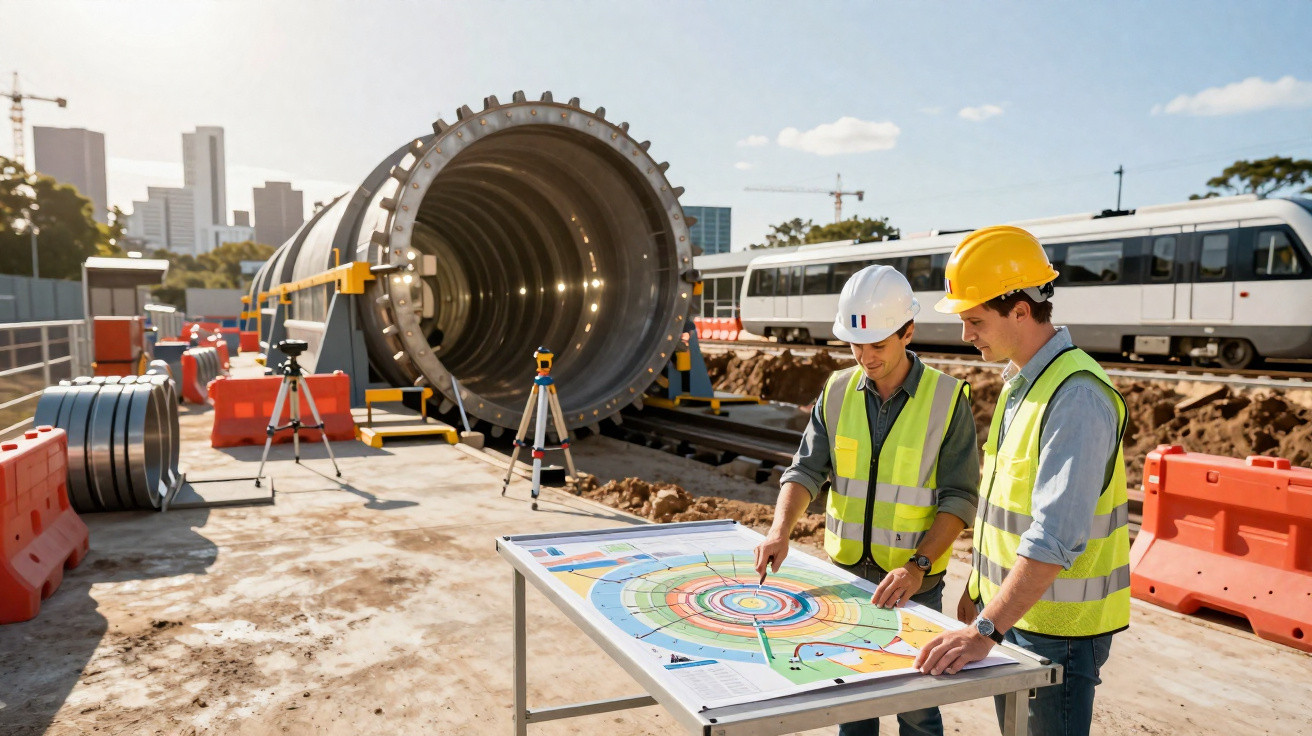
The Australian city has set in motion a rail megaproject that runs beneath its suburbs rather than cutting through the postcard skyline. Well away from the CBD high-rises, a 90‑kilometre underground loop is attracting long-horizon investment, international suppliers and some notably strategic French expertise.
What is the suburban rail loop, exactly?
The Suburban Rail Loop (SRL) is planned as an underground orbital railway encircling Melbourne, deliberately sidestepping the familiar hub‑and‑spoke set-up in which most trips are forced through the centre. The complete loop is expected to span around 90 kilometres, fully underground, linking major employment zones with health and education precincts across the suburbs.
With a projected price tag above 125 billion Australian dollars - roughly 75 billion euros - it stands as the biggest single infrastructure programme ever undertaken in Australia. It is a cornerstone of Victoria’s “Big Build” agenda, a broad effort to rework roads, rail and tunnels for a city forecast to grow to 6.5 to 7 million people over the coming decades.
Launched as part of Victoria’s “Big Build”, the Suburban Rail Loop is reshaping Melbourne’s growth model around suburban hubs rather than the CBD.
The first deliverable is SRL East: a 26‑kilometre stretch running from Cheltenham in the south-east to Box Hill in the city’s east. Even this initial section is substantial, featuring six deep underground stations, twin tunnels and a fleet of fully automated metro trains.
France lands a strategic role beneath Melbourne
Alstom at the core of the east section
The SRL East contract - worth about 8.8 billion Australian dollars (around 5 billion euros) - has gone to TransitLinX, an alliance that includes John Holland, KBR, WSP and several major operators. Inside that consortium, French rail group Alstom has secured a portion valued at roughly 1 billion euros.
This is not simply a matter of ordering new trains. Alstom’s responsibilities cover:
- Supply of fully automated metro trains
- Signalling based on CBTC technology
- Onboard and trackside digital systems
- Cybersecurity and communications
- System integration across all subsystems
- Maintenance services over a 15‑year period
In other words, it reaches into the most mission-critical layer of any metro: the practical mechanics of keeping it running, every day. The system has to cope with electricity price volatility, workforce constraints, spikes in passenger demand and political expectations around punctuality.
By taking responsibility for trains, signalling, cyber and integration, Alstom positions itself as the operational backbone of Melbourne’s new orbital line.
For the Victorian government, handing a single supplier a broad systems role is also a way to limit delivery risk. Alstom already operates automated metro technology in Sydney and has deep experience in Paris, Singapore, Dubai and other high-capacity networks. Reusing mature, proven design principles - rather than building an untested set-up from scratch - helps cushion both technical setbacks and political blowback.
Local assembly in Dandenong, not imported from Europe
Rather than exporting complete trainsets from France, Alstom will assemble the SRL East Metropolis trains at Dandenong, its industrial facility roughly 40 kilometres from central Melbourne. The site has a long track record of manufacturing rolling stock for Australian operators.
Local content is politically significant. Major rail schemes in Australia are now judged partly on domestic employment, apprenticeships and the strength of local supply chains. Using Dandenong links French technology with Victorian labour and regional SMEs - a connection that can become crucial when megacontracts are reviewed, extended or re-scoped.
Maintenance is included for 15 years under Alstom’s FlexCare Perform offer. A purpose-built depot at Heatherton will be able to support up to 36 trains, enabling higher service levels as patronage increases. By designing operations and maintenance early - instead of adding them after construction - the project aims to avoid the gradual reliability erosion that has affected some ageing fleets internationally.
Fully driverless, but heavily supervised
GOA4 trains and CBTC signalling
SRL East will be worked by 13 Metropolis trains, each configured as four cars, operating at Grade of Automation 4 (GOA4). GOA4 implies no driver’s cab and no driver on board, with traction, braking and door control executed automatically.
A digital control layer - the CBTC Urbalis Forward signalling system - continuously manages separation, speed profiles and station stopping. It also governs emergency braking, degraded operation and incident recovery. In reality, a central control room and on-platform staff still oversee the network, while software makes the rapid, repeatable decisions.
GOA4 automation allows higher frequencies, shorter headways and more predictable journeys, but pushes cybersecurity and system resilience to the foreground.
Since 2019, Sydney has operated a fully automated metro line supplied by Alstom, with tight headways and platform screen doors. Melbourne’s SRL applies that approach to an orbital route that will eventually interface with the existing suburban rail, tram and bus network, reshaping travel across the east and south-east of the metropolitan area.
Geological headaches and political pressure
A complex underground landscape
Melbourne’s ground conditions are far from straightforward. Tunnelling teams must contend with a mix of soft clays, tougher rock and substantial groundwater. Above ground, dense development adds further limits: tunnel boring machines have to pass beneath houses, roads, utilities and existing rail corridors without causing settlement or water ingress.
These realities increase spending on ground treatment, instrumentation and construction logistics. They also reduce excavation speed, influencing programme timelines and the public’s sense of whether the project is progressing.
Cost overruns and long time horizons
The SRL is being delivered during a period of worldwide construction inflation. Through the early 2020s, the costs of steel, concrete, skilled labour and energy rose sharply. Australia’s tight labour market adds another squeeze, with mining, infrastructure and defence all competing for engineers, electricians and plant operators.
It is therefore unsurprising that estimates for the full loop have trended upwards. Opponents argue the funding would be better spent upgrading existing suburban lines, improving local hospitals or strengthening schools. Supporters respond that a city on Melbourne’s scale requires a fundamental change in mobility, and that true network benefits only materialise when an orbital railway is built at meaningful scale.
Backers of the loop argue that the payoff must be measured over 50 to 70 years, not within a single election cycle.
That push-and-pull frames each update: every contract award and milestone is simultaneously an engineering achievement and a political stress test.
France’s double footprint: from tunnels to operations
RATP Dev prepares to run the line
France’s involvement goes beyond Alstom. RATP Dev - the international subsidiary of Paris’s public transport operator - has joined the Linewide Alliance for SRL East alongside John Holland, Alstom, KBR and WSP. The Suburban Rail Loop Authority formally confirmed this role in December 2025.
Notably, RATP Dev is embedded long before passenger service begins. For roughly ten years it will help shape design and construction as a “future operator”, feeding operational realities into engineering decisions. That influence spans station configuration, passenger circulation, incident response planning and maintenance access.
From 2035, a joint venture between RATP Dev and John Holland, operating as TransitLinX, is expected to operate and maintain SRL East for 15 years. RATP Dev draws on experience across 14 operational GOA4 metro lines worldwide, from Paris’s Line 14 to driverless networks in Riyadh and Sydney.
Bouygues takes charge of key tunnels
On the civil works side, Bouygues Construction has also secured a role, with a contract worth around 343 million euros for one of the principal northern tunnelling packages. The company will use large tunnel boring machines launched from major sites, progressively excavating twin bores for the future railway.
Together - Bouygues underground, Alstom delivering systems, RATP Dev shaping and later running operations - this forms a French delivery chain stretching from concrete to software. Because these firms have collaborated on complex metro schemes overseas, the arrangement can lower coordination risk compared with a team assembled from unfamiliar partners.
Why Melbourne is betting on an underground orbital
Shifting away from the CBD‑centric model
Much of Melbourne’s post-war rail network was designed around a daily commute into the centre and back again. However, employment and tertiary education have dispersed, with major campuses and job clusters now concentrated in the south-east, east and north. Hospitals, research precincts and technology parks are increasingly generating demand for suburb-to-suburb travel.
SRL is intended to connect these activity centres directly. Stations including Clayton, Monash and Box Hill are planned as major interchanges, bringing together metro services with existing rail, buses and new residential or commercial development. The concept mirrors other orbital schemes - such as London’s Overground arc and Paris’s Grand Paris Express - which have influenced where people live and work.
| Aspect | Today | With suburban rail loop east |
|---|---|---|
| Typical suburban trip | Bus + train via CBD | Direct orbital metro between hubs |
| Journey time between eastern hubs | Often over 1 hour with transfers | Targeted to drop significantly with direct tunnels |
| Network resilience | Disruption in CBD hurts whole system | Orbital route offers alternate pathways |
These shifts also have clear implications for property. Land near future SRL stations is already drawing speculative interest, while planning rules attempt to steer growth towards higher-density, mixed-use development. That, in turn, intensifies debates around gentrification, housing affordability and whether lower-income communities will share in improved access to jobs.
Risks, side effects and what to watch next
An orbital metro of this scale carries obvious downsides. If schedules slip, communities could face years of disruption from excavation, including noise, dust and traffic impacts. If budgets blow out, governments may be forced to scale back later SRL stages or delay other priorities such as regional rail upgrades or hospital investment.
Technically, full automation raises the stakes for software integrity and cyber protection. If a signalling network is compromised, service could be severely disrupted. This is why cybersecurity sits prominently within Alstom’s scope, and why experienced operators such as RATP Dev are involved early, when incident procedures and fallback modes are defined in detail.
The upside, however, is equally structural. If SRL East performs as intended, it would strengthen the case for Melbourne evolving into a polycentric city: multiple strong suburban centres connected by fast, frequent rail. That could ease motorway pressure, lower emissions per trip and make alternatives to private cars more viable for everyday journeys.
For industrial suppliers, the scheme is also a potential international benchmark. The mix of GOA4 automation, an orbital layout, challenging ground conditions and tightly integrated French–Australian alliances could influence metro projects in North America, Asia and the Middle East. Should Melbourne succeed in delivering a dependable loop under real-world political and budget constraints, the underground ring is likely to be studied well beyond Australia.






Comments
No comments yet. Be the first to comment!
Leave a Comment