
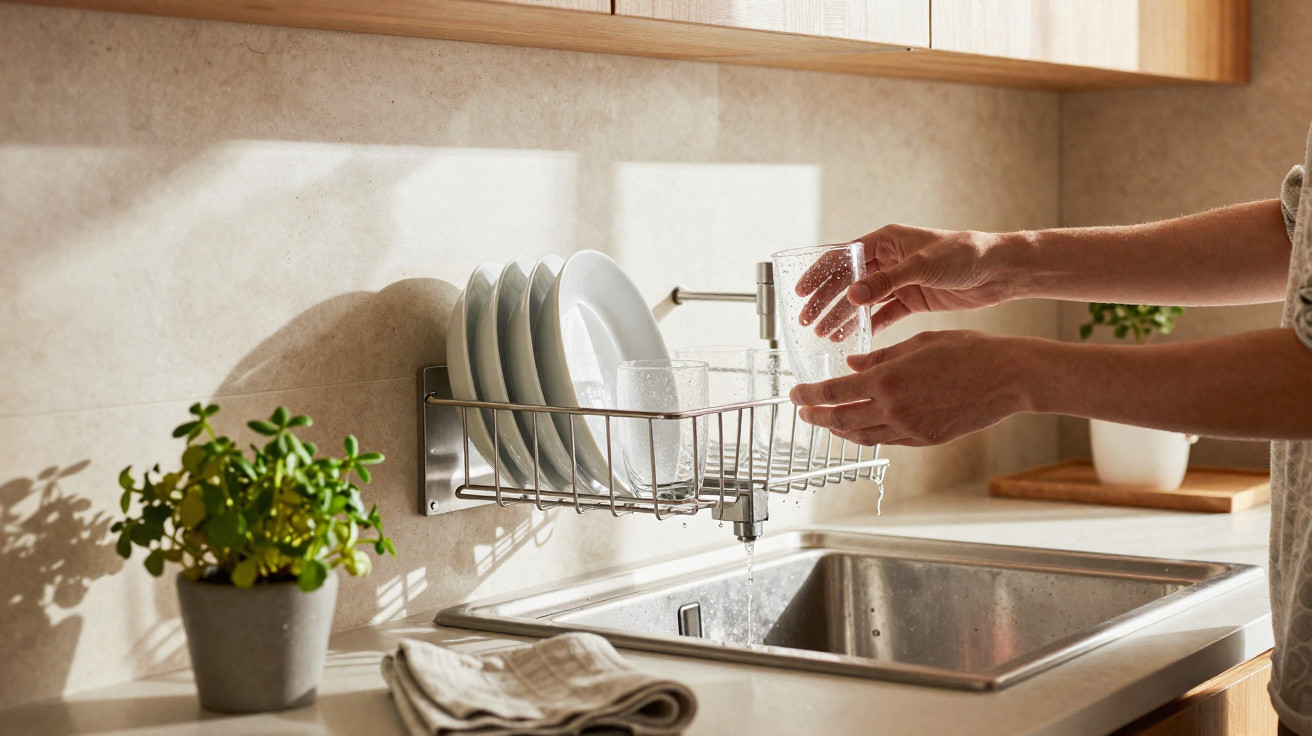
Many households know the issue: plates, glasses and mugs pile up beside the sink on an unsteady dish-drying rack. It drips, water splashes and the area looks untidy. A solution is now gaining popularity, particularly for making small kitchens feel less cramped: the space-saving wall-mounted dish-drying rack.
Why the traditional dish-drying rack is becoming increasingly irritating
For a long time, the dish-drying rack beside the sink was seen as indispensable. Put wet dishes in it, wait for everything to dry, and that is that. Yet everyday reality often looks rather different.
- Constant moisture on the worktop: Water collects in drip trays or runs over the edge. This can lead to water marks, swollen seals and, in extreme cases, mould behind the sink.
- A permanently cluttered appearance: The rack soon looks crammed. Even in an otherwise clean kitchen, the corner by the sink can look as though “the washing-up is never finished”.
- Valuable space is lost: In small kitchens, a dish-drying rack occupies precisely the area needed for chopping, kneading or plating food.
- Demanding to clean: Food residue and grease collect between bars, in drainage channels and on grids. Without regular cleaning, this quickly becomes a rather unappetising corner.
For this reason, many people in city flats with tiny kitchens are looking for ways to clear the worktop without giving up on air-drying hand-washed dishes.
A wall-mounted dish-drying rack moves the mess from the worktop to the wall – solving several problems at once.
The modern alternative: a wall-mounted dish-drying rack
A wall-mounted dish-drying rack works on much the same principle as a conventional rack, except it is positioned vertically. It is fixed above the sink or to the wall beside it, providing room for plates, bowls, cups and cutlery.
The difference is noticeable straight away: the space around the sink is freed up, water drips directly into the sink or a small channel, and the kitchen feels considerably calmer.
The key day-to-day benefits
- More effective use of space: Wall space remains unused in most kitchens, while worktops are overcrowded. A wall rack makes use of this otherwise wasted area.
- Drier and more hygienic: As dishes hang or stand freely, air can circulate well. There is less build-up of moisture, making conditions less favourable for bacteria.
- A tidier look: Many models resemble simple metal or wire shelving. Dishes are arranged in an organised way rather than piled into a heap.
- Surprisingly generous capacity: Multi-level versions can easily hold several rows of plates, glasses, bowls and a cutlery holder – often up to around ten kilograms.
- Straightforward installation: Depending on the model, only a few wall plugs and screws may be needed. Some systems use strong adhesive pads or clamping rails, which can suit rented homes where extensive drilling is undesirable.
In many kitchens, these racks do more than replace the traditional dish-drying rack: they also serve as an open wall cupboard for everyday crockery.
What to consider when buying a wall-mounted dish-drying rack
Before reaching for the drill, it is worth assessing the kitchen carefully. A wall rack only works well when it is installed in the right spot and suits the needs of the household.
1. Finding the right wall position
Ideally, the rack should be placed so that water can run straight into the sink. If it is mounted to the side, check whether a small drip tray or drainage channel can be fitted.
- Measure the distance from the sink.
- Leave enough height for plates to fit in comfortably.
- Allow sufficient depth without knocking your head while washing up.
As a practical guide, the bottom level should sit roughly at shoulder height or slightly below, so that children and shorter people can also put plates away easily.
2. Size and capacity
The number of people in the household has a major influence on the right model:
- One-person or couple households: A two-tier rack with areas for plates and cups will usually be sufficient.
- Families with children: A wider system with several levels or modular sections is the better choice.
- Lots of cookware: Special holders for boards, frying pans and lids can be useful.
Manufacturers generally state the maximum load capacity clearly. Anyone who prefers to wash up a large amount at once should choose a model with sturdy bars and secure wall fixings.
3. Material and maintenance requirements
It is worth looking critically at the material, as the rack will come into contact with water every day.
- Stainless steel: durable, resistant to rust, easy to clean and modern in appearance.
- Chrome-plated steel: less expensive, but more prone to surface rust over time if the coating becomes damaged.
- High-quality plastic: lightweight and quieter when loading dishes, though less refined in appearance.
Removable drip trays or inserts make cleaning easier. Smooth surfaces with fewer small corners and edges also reduce wiping time.
4. The water drainage system
One clever feature that many people only consider after buying is the water drainage system. Some racks have an angled drip tray with a small spout that ends directly above the sink. This ensures every drop goes where it belongs, rather than onto the wall or floor.
A good wall-mounted dish-drying rack should direct water in a controlled way – not simply collect it.
Who really benefits from making the switch?
A wall-mounted dish-drying rack is particularly suitable for three groups:
- Residents of small city flats with limited worktop space
- Families where dishes are constantly in use
- People who cook frequently and need every available surface
Even those who already use a dishwasher can benefit. Hand-washed items such as sharp knives, pans with specialist coatings or wooden chopping boards have a designated place without blocking the worktop.
Common planning and installation mistakes
A few simple rules will help ensure the new rack does not become a source of frustration.
- Installing it too high: Every plate then becomes a small effort to lift. Before fitting it, test the height with an empty plate to make sure it feels comfortable.
- Using the wrong wall plugs: Standard plugs often do not hold in plasterboard walls. Cavity wall fixings or specialist heavy-duty anchors are more suitable here.
- Positioning it too close to the wall: Plates placed at an angle need a little room behind them. Otherwise, water will run down the wall.
Anyone living in a rented property who does not want to drill large holes can consider adhesive rail or clamping systems. These usually support less weight, but are often sufficient for everyday dishes.
Practical everyday tips for a wall-mounted dish-drying rack
A well-planned rack can do more than dry dishes. With a few useful touches, it can become a compact kitchen organisation hub.
- Store only everyday dishes: The rack should hold only items used daily. Special-occasion dinnerware belongs in the cupboard.
- Use the cutlery holder twice: Keep clean knives, spoons and forks there during the day. When washing up, the same container becomes a drying space.
- Add hooks for cloths and brushes: Many systems can be extended with S-hooks. Washing-up cloths can finally hang freely to dry instead of remaining wet over the tap.
People who prefer a minimalist lifestyle can also use the change as an opportunity to sort out unnecessary dishes. The wall rack creates a natural limit: items that do not fit are generally rarely used anyway.
Why this trend is here to stay – rather than being just a social media gimmick
Many interior trends disappear again after a few months. The wall-mounted dish-drying rack is different because it addresses a very specific daily problem: a lack of worktop space and moisture around the sink.
The visual effect matters even more in new-build homes with open-plan kitchens. Nobody wants guests arriving for dinner to be greeted by a full dish-drying rack. A discreet wall rack above the sink attracts far less attention and looks tidier and more modern.
There is also a sustainability aspect: allowing hand-washed dishes to dry efficiently can often avoid the extra drying cycle in the dishwasher, saving energy. A well-designed system can therefore even help reduce electricity use.
Ultimately, the choice depends on everyday routines. Anyone who makes use of every centimetre of worktop space will quickly find they do not want to lose the newly cleared area beside the sink. And once someone has seen how dry and orderly the washing-up zone can look, the old plastic rack will usually not return.






Comments
No comments yet. Be the first to comment!
Leave a Comment