
In the Nordic countries, this problem scarcely arises. The answer is neither a particular window routine nor a wonder plant, but an unobtrusive system that exchanges energy between outgoing and incoming air. We have all known the feeling: the room is stuffy while the radiator is working overtime.
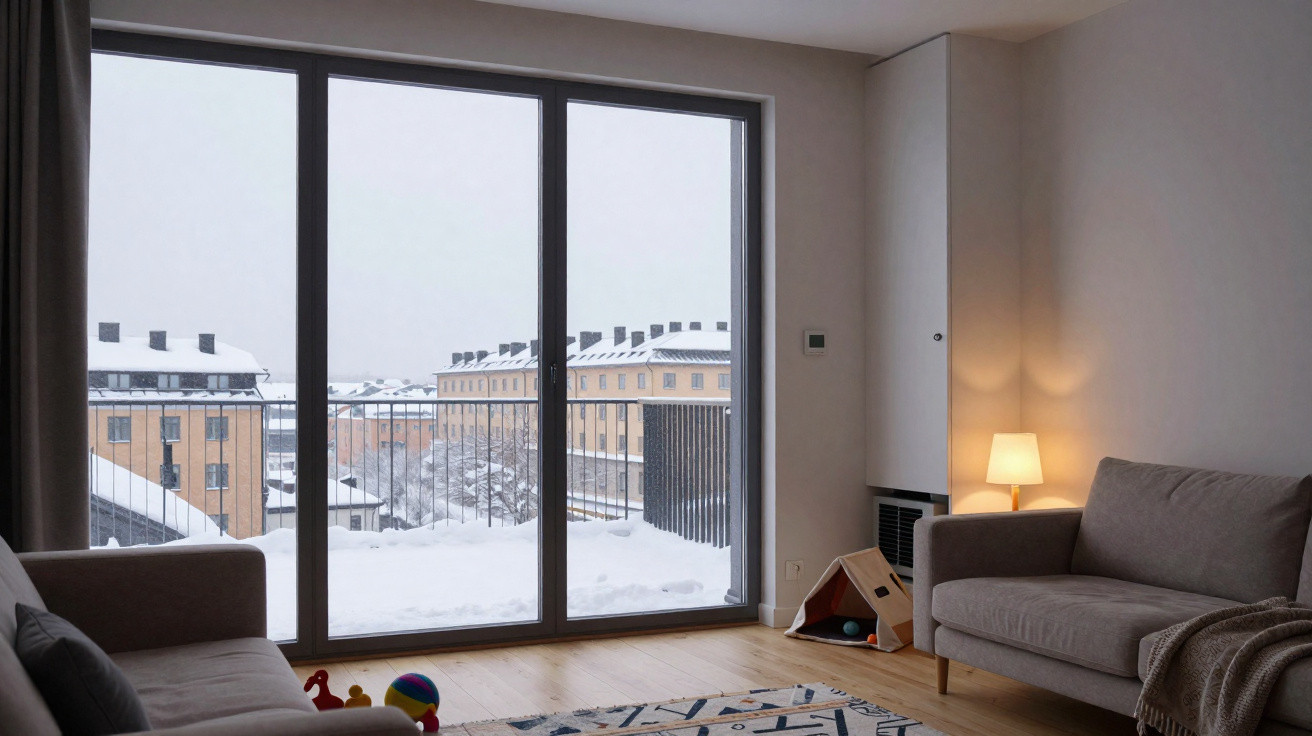
Snow spiralled beyond a fifth-floor window in Stockholm, yet the sitting room had the freshness of a forest after rain. Not a window was ajar, and no one needed a jumper. Behind a laundry cupboard, fans murmured softly, moving air as naturally as breath: clearing away the previous evening’s cooking odours while introducing a clean, cool flow without any sharp chill. The children made a den; their socks dried quickly, with no damp patches or misted windows. The glazing remained clear, and the quiet was almost amusing. As more people entered, I saw the wall thermostat raise the fan speed slightly. The house is breathing.
The quiet system behind Scandinavian comfort
In a Nordic home, you do not see the solution so much as experience it. It is heat-recovery ventilation (HRV), also known as MVHR or FTX in Sweden. Two narrow ducts do the work: one admits outdoor air, while the other removes stale indoor air. At their centre, a heat exchanger transfers warmth from the outgoing air to the fresh, crisp stream coming in. You get outdoor freshness, while retaining the heat your home has already paid for.
A family of four in Bergen told me that, after fitting an HRV, their winter CO2 readings fell from 1,800 ppm to below 900, while their heating requirement dropped by a quarter. During a week of minus ten, engineers on a Helsinki retrofit recorded 80–90% heat recovery from a counterflow core. Bathroom mirrors remain clear after showers, and the kitchen no longer carries the smell of yesterday’s onions by bedtime. Energy costs ease slightly, while comfort improves dramatically-in the best possible sense.
The principle is straightforward. Contemporary Nordic homes have highly sealed envelopes, meaning there are few accidental air changes. A balanced system addresses both needs together: fans extract stale air from bedrooms and moisture-prone rooms, supply fresh air to living areas, and exchange temperatures within a plastic or aluminium core. The air streams never mix; they simply make a continuous transfer of heat. With intelligent sensors-humidity sensors in bathrooms and CO2 sensors in bedrooms-the system adjusts smoothly as needed. Some models include enthalpy cores that transfer a little moisture as well, preventing winter air from becoming desert-dry.
How to bring the Nordic approach into your home
Begin by mapping the route air will take. Extract air from bathrooms and the kitchen, supply it to bedrooms and the sitting room, and connect it all to a compact unit in a cupboard or loft. Where ductwork is difficult, two through-wall devices in essential rooms can create a similar result. Target approximately half an air change per hour under normal conditions, then use boost settings for showers and gatherings. Position the inlet above areas where snow and pollen collect, and keep the extract outlet away from the patio.
This only remains effortless when it is kept simple. Select a quiet unit matched to your floor area rather than one chosen for excessive capacity. Fans that are too large consume needless energy, while undersized models become noisy. Wash or replace filters every three to six months, and vacuum the intake grille whenever it occurs to you. Let’s be honest: nobody actually does that every day. Whistling usually means a duct bend is too tight. If the rooms seem dry, choose an enthalpy core or reduce the shower boost duration.
Many people are uneasy about leaving their air quality to a box. They picture draughts, humming fans and another device that needs constant attention. Trusting a box with your air can feel strange-until you notice the difference in your lungs. A Swedish inspector once shrugged and told me,
“The best systems are the ones you forget. You notice them when they’re off.”
- Fit supply vents high on walls; extract air low down in bathrooms and kitchens.
- Keep ducts short and smooth, as lengthy runs hum and reduce pressure.
- Seal the building envelope first; ventilation performs best without competing leaks.
- Use holiday mode during unoccupied weeks to save a little more energy.
Why it matters beyond watts and widgets
Nordic homes regard air in the same way as light and water: as an essential service rather than a luxury. That perspective makes the whole building feel calmer. Sleep gets better as CO2 levels fall. Kitchens smell of the meal you have just eaten, rather than one from three days earlier. Mould has fewer opportunities. Fresh air without the chill stops being a winter contradiction and becomes an everyday background condition. For many people, it is the first experience of truly “good air” without opening a window and hearing the thermostat struggle.
This benefit is social as well as technical. You can pack a room with guests without fretting over steamed-up glass or pausing in a draught to “air the place out”. You can cook fish on Tuesday and still want breakfast in the same room on Wednesday. Children with colds spread fewer germs when air is moved steadily, quietly and out of the home. Quiet, steady, invisible becomes a new kind of comfort-one you tend to notice only once it has gone.
There is a modest form of thrift in this too, one that suits the present moment. Heat you have paid for is not simply released into the snow. Filters intercept fine dust at the threshold. The machine uses a small amount of electricity and gives back tranquillity. You receive the feeling of outdoors without its bite. Let’s be honest: nobody really does that every day. No-the Scandinavians designed that decision out of the process altogether. The routine becomes automatic, and the home finally breathes on its own.
| Key point | Detail | Why it matters to the reader |
|---|---|---|
| Heat recovery (HRV/ERV) | Transfers 70–90% of heat from exhaust to incoming air | Fresh air without losing warmth or money |
| Balanced duct layout | Supply to living rooms/bedrooms, extract from kitchen/bathrooms | Consistent comfort, fewer odours and damp corners |
| Filter and sensor basics | Change filters every 3–6 months; CO2/humidity boost modes | Cleaner lungs, smarter operation with less fuss |
FAQ:
- What exactly is HRV/MVHR? It is a ventilation system that brings outdoor air in and expels indoor air through a heat exchanger, retaining warmth while renewing the air.
- Will it help if my climate is not as cold as Scandinavia? Yes. Even in milder climates, it reduces humidity, odours and pollutants, while saving energy for both heating and cooling.
- How much room does a system require? The unit needs roughly the footprint of a small washing machine, plus slim ducts. Flats often use compact units or through-wall pairs.
- Is it noisy? When correctly sized and ducted, it is a background hush. Most units operate at 20–30 dB in living areas, similar to a library.
- What about dry winter air? Choose an ERV (enthalpy core) to retain some moisture, shorten boost times, and add localised humidification where necessary.






Comments
No comments yet. Be the first to comment!
Leave a Comment