
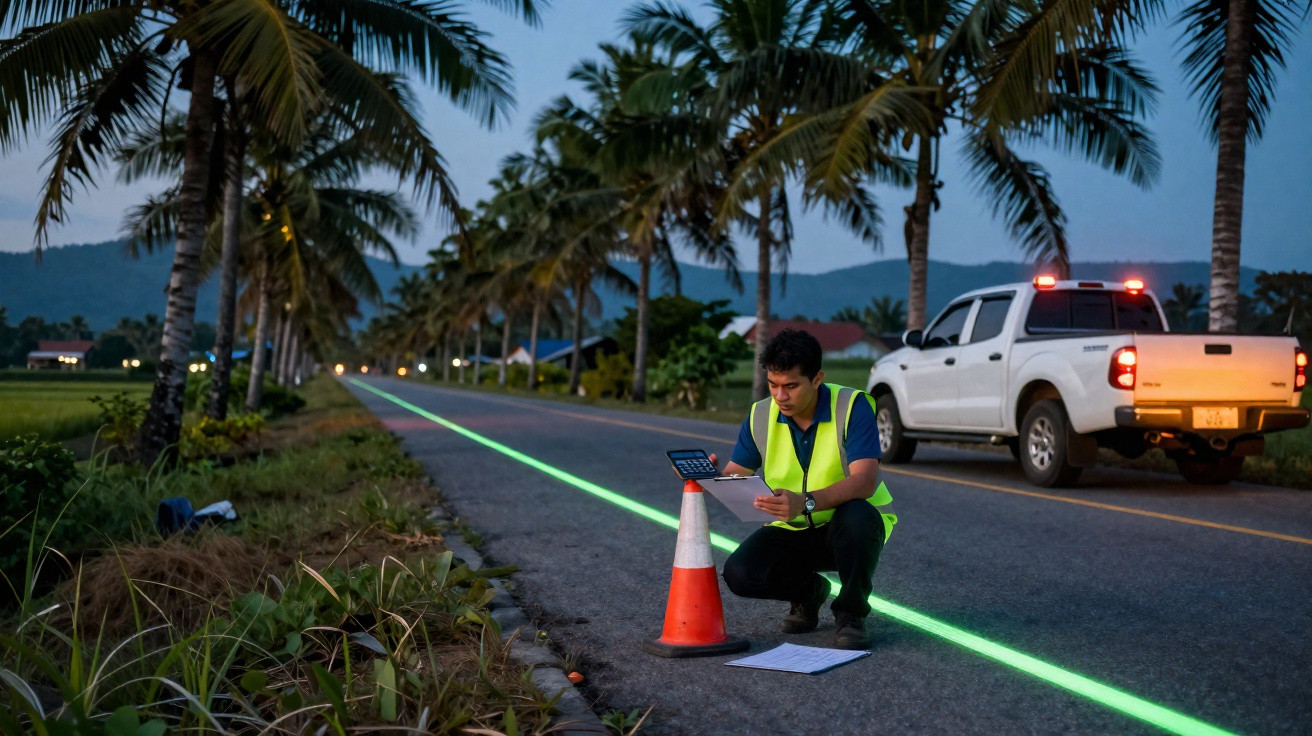
No street lamps, just glowing road markings: In Malaysia, a future-facing trial was meant to make unlit rural roads safer - until an awkward bill arrived.
On the outskirts of Kuala Lumpur, Malaysia turned an otherwise ordinary stretch of tarmac into a small real-world test site for next-generation traffic safety. The plan was simple: lane markings that charge in daylight and glow on their own after dark, improving guidance on blacked-out roads without installing conventional lighting. The concept drew attention well beyond the country - and ultimately ran aground on price, durability and the judgement of technical specialists.
How a rural road suddenly looked like science fiction
The trial took place in Hulu Langat, Selangor, at the junction of Jalan Sungai Lalang and Jalan Sungai Tekali near Semenyih. The area still lacks standard street lamps, and the road section is widely regarded as difficult to see at night.
In late October 2023, authorities replaced the usual lane lines along a roughly 245-metre section with photoluminescent markings. The coating uses a special paint that absorbs light during the day and then releases it gradually once darkness falls. In daylight the road looks nearly normal; after nightfall, the lines are clearly visible as they glow against the dark.
The authorities framed the scheme from the outset as a safety measure for unlit roads - not as a light show designed for social media.
Malaysia’s Public Works Department publicly presented it as an attempt to bring “innovation into road construction”. Works Minister Alexander Nanta Linggi said the markings could remain visible for up to ten hours and were still discernible even in wet conditions.
Why the idea quickly became a beacon of hope
The pilot struck at a familiar problem for many countries: remote and rural routes where lighting is absent, budgets are tight and crash risk rises once daylight disappears. On such roads, lane lines that are hard to pick out can become a genuine hazard.
On paper, the upsides were straightforward:
- no electricity costs, because the markings charge from daylight
- improved lane visibility at night
- no additional poles to install, and no lamp maintenance burden
- alignment with modern mobility and climate objectives through energy-saving measures
In Malaysia, the glowing lane markings were also positioned as an alternative to so-called road studs - commonly known as “cat’s eyes” - which reflect headlight beams but do not emit light themselves.
The underlying concept was not entirely new. In the Netherlands, the “Smart Highway” project generated headlines earlier: glowing lines, developed by Studio Roosegaarde and construction firm Heijmans, made a test stretch readable for months. There, the markings reportedly shone for up to eight hours. The logic was the same - the road itself becomes the light source.
Expansion plans: from 245 metres to 15 kilometres
Early feedback from Malaysian drivers was largely favourable. Social media posts praised the improved sense of direction and the futuristic look, especially on rural roads that are otherwise pitch-black.
Officials moved quickly. By February 2024, the Selangor state government announced an expansion: 15 new locations across all nine districts were meant to receive the glowing markings, covering about 15 kilometres in total. Areas mentioned included parts of Sepang, Kuala Langat and Petaling.
Other states also showed interest. Johor identified 31 roads for trial projects, including a roughly 300-metre section of Jalan Paloh J16 in Batu Pahat. What began as a pilot in Semenyih was starting to look like a potential new standard - or at least a serious tool within transport policy.
The cost blow-out, in detail
While the public discussion focused on visibility, ministries and technical units were already running the numbers. That is where momentum started to drain away, because photoluminescent paint is expensive - extremely expensive.
| Type of marking | Price per square metre (RM) |
|---|---|
| Conventional road-marking paint | 40 |
| Glowing specialist paint | 749 |
That makes the glowing material almost twenty times the price of ordinary paint - before questions of service life, repairs and cleaning effort are even settled. Heavy rain, roadworks and lorry tyre abrasion all reduce the lifespan of the coating and, sooner or later, force maintenance work.
The line in Parliament that changed everything
In November 2024 came the hard stop. Deputy Works Minister Ahmad Maslan told Parliament the glowing markings would likely not be pursued further. The reason given: the costs were too high.
“The costs are too high, so we will probably not continue with the glowing lanes,” Maslan said - adding that the trials had not convinced the ministry’s specialists.
That second point mattered almost more than the budget argument. It suggested the system was not only costly, but also fell short technically in certain respects. Potential issues include:
- the glow fading too quickly as the coating ages
- reduced performance in heavy rain or on a dirty carriageway
- difficulties with upkeep and patch repairs
- failure to meet standards for viewing distance and contrast
Although detailed official reports have not been made public, the message is clear: the visibility was sufficient to impress motorists, but not enough to satisfy strict engineering and safety requirements - especially not for wide deployment funded from limited tax revenues.
What the failed road says about modern road safety
Malaysia’s pause does not mean the underlying safety challenge has disappeared. Traffic-safety specialists worldwide wrestle with the same question: how can road markings remain reliably visible at night, in rain and under heavy wear?
Japan, for example, has spent years studying how to measure markings, maintain them and replace them on time. Its National Institute for Land and Infrastructure Management develops indicators for the point at which lines are deemed “no longer safely recognisable” and must be renewed. Markings are treated not as a minor detail, but as a core part of the safety system - comparable in importance to crash barriers or speed limits.
The Semenyih trial offers lessons that extend well beyond Malaysia:
- Innovation on its own is not enough: a project may look compelling and deliver short-term benefit, but still fail if costs and standards do not align.
- Operating costs beat showpiece effects: photoluminescent paint can look spectacular, yet it can consume budgets needed for resurfacing, bridge upkeep or conventional lighting.
- Public approval is only one input: positive driver feedback helps, but it does not replace long-term laboratory testing and extended real-world trials.
What is technically behind glowing road markings?
The paint contains pigments that store light energy and then release it slowly. Many people know the principle from glow-in-the-dark toys or emergency exit signs. In road traffic, however, the demands are far higher.
The material must provide, for example:
- high abrasion resistance against tyres and tracked vehicles
- resilience to UV exposure, rain and heat
- stable luminance over several years
- clear recognition even with oncoming traffic and on wet surfaces
The pigments and binders capable of meeting these requirements are complex and costly. At the same time, any additional layer on the asphalt can affect grip, noise levels, and how easily markings can later be overpainted or removed.
Where glowing roads could still make sense
Malaysia slowing its major rollout does not mean the technology is finished altogether. Sensible use cases could include:
- short high-risk spots such as sharp bends, bridge approaches or construction-site entrances
- cycle routes where lighting is absent but traffic volumes are lower
- tourist roads where the effect also has marketing value
- airport aprons or industrial sites where night-time visibility is critical and budgets are higher
In these niches, the extra cost is easier to justify, because targeted sections can be enhanced rather than trying to retrofit entire networks.
What the Malaysia case means for Germany and Europe
Across Europe, local authorities also report rising energy prices, deteriorating road surfaces and squeezed budgets. Concepts such as “smart asphalt”, embedded LEDs or luminous coatings appear regularly in innovation strategies. Malaysia’s experience functions as a practical reality check.
Three points stand out:
- Simple solutions tend to win: correctly applied standard markings, renewed on schedule, can deliver major safety gains without blowing budgets.
- A whole-road view matters: a safe road needs more than glowing lines - drainage, surface condition, signage, speed limits and enforcement all play a part.
- Testbeds remain valuable: pilots like Semenyih generate useful data even when they end up being halted, showing where limits lie and where research may be worthwhile.
For engineers, planners and policymakers, that means photoluminescent paint remains an interesting materials approach - but it must prove itself against standard options on safety outcomes, cost and practical deliverability.
The sober takeaway is this: the most eye-catching road is not automatically the safest. Sometimes the simple, highly visible white line in “boring” paint beats even the brightest vision of the future.




Comments
No comments yet. Be the first to comment!
Leave a Comment