
The ancient Romans excelled as builders and engineers, nowhere more clearly than in aqueducts that still operate today. Many of these feats depended on a distinctive construction material: pozzolanic concrete, an unusually long-lasting mix that helped Roman structures achieve extraordinary strength.
A striking example survives in Rome itself. The Pantheon remains standing and, at nearly 2,000 years old, still holds the record for the world’s largest dome made from unreinforced concrete.
Roman pozzolanic concrete and its ingredients
For a long time, the remarkable performance of this concrete has been largely credited to what went into it: pozzolana - volcanic ash named after Pozzuoli in Italy, where major deposits exist - combined with lime. With water added, these ingredients can react to form a robust concrete.
Yet that explanation, it seems, is incomplete. A multinational research group led by the Massachusetts Institute of Technology (MIT) has shown that the materials are not quite what many assumed - and that the way the Romans blended them also differed from the standard picture.
Lime clasts: the clue that prompted a rethink
The key evidence lay in small, pale-white pieces of lime embedded within concrete that otherwise appears thoroughly mixed. Previously, these chunks were often explained away as the result of careless mixing or inferior materials - an interpretation that did not sit comfortably with MIT materials scientist Admir Masic.
"The idea that the presence of these lime clasts was simply attributed to low quality control always bothered me," Masic said in a January 2023 statement.
"If the Romans put so much effort into making an outstanding construction material, following all of the detailed recipes that had been optimized over the course of many centuries, why would they put so little effort into ensuring the production of a well-mixed final product? There has to be more to this story."
To investigate, Masic and colleagues - led by MIT civil engineer Linda Seymour - analysed 2,000-year-old Roman concrete collected from Privernum, an archaeological site in Italy. The samples were examined using large-area scanning electron microscopy and energy-dispersive X-ray spectroscopy, powder X-ray diffraction, and confocal Raman imaging, with the aim of clarifying what the lime clasts are and how they formed.
One central question concerned the type of lime involved. The prevailing model of pozzolanic concrete assumes the use of slaked lime. In this conventional sequence, limestone is heated to very high temperatures to create quicklime, a highly reactive and caustic powder also known as calcium oxide.
When quicklime is combined with water, it turns into slaked lime - calcium hydroxide - producing a paste that is less reactive and less caustic. Standard theory has long suggested that it was this slaked lime that Roman builders mixed with pozzolana.
However, the team’s results indicate the clasts in their samples do not match what this method would produce. Instead, the researchers argue that Roman concrete was likely made by mixing quicklime directly with pozzolana and water at extremely high temperatures - either on its own or alongside slaked lime. The team refers to this approach as "hot mixing", and it naturally leads to the formation of the lime clasts.
"The benefits of hot mixing are twofold," Masic said.
"First, when the overall concrete is heated to high temperatures, it allows chemistries that are not possible if you only used slaked lime, producing high-temperature-associated compounds that would not otherwise form. Second, this increased temperature significantly reduces curing and setting times since all the reactions are accelerated, allowing for much faster construction."
Self-healing behaviour and modern replication
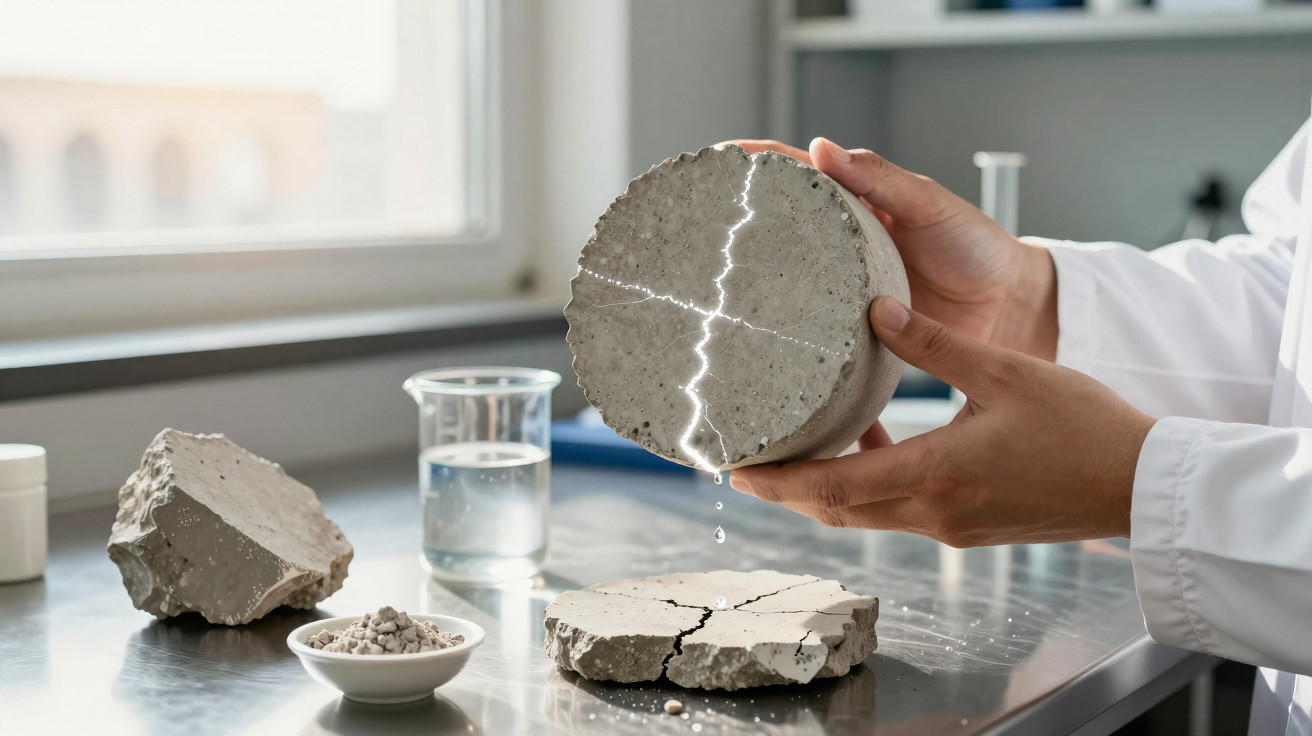
There is a further advantage as well: the lime clasts appear to give the concrete an impressive capacity to heal itself.
As cracks develop, they tend to propagate towards the lime clasts because these clasts have a greater surface area than other particles in the concrete matrix. If water penetrates a crack, it can react with the lime to create a calcium-rich solution. This then dries and solidifies into calcium carbonate, effectively bonding the crack shut and stopping it from widening.
Such effects have been seen in material from another 2,000-year-old site, the Tomb of Caecilia Metella, where calcite has filled cracks in the concrete. The same mechanism could also help account for why Roman concrete seawalls built 2,000 years ago have remained intact for millennia despite continual pounding by the sea.
To check their interpretation, the researchers produced pozzolanic concrete using quicklime, following both ancient and modern-style recipes. They also prepared a control mix without quicklime and then carried out crack tests. The outcome matched their expectations: concrete made with quicklime healed completely within two weeks, whereas the control concrete remained cracked.
The team is currently working to commercialise this formulation as a greener alternative to today’s concretes.
"It's exciting to think about how these more durable concrete formulations could expand not only the service life of these materials but also how it could improve the durability of 3D-printed concrete formulations," Masic said.
The study has been published in Science Advances.
A version of this article was first published in January 2023.




Comments
No comments yet. Be the first to comment!
Leave a Comment