
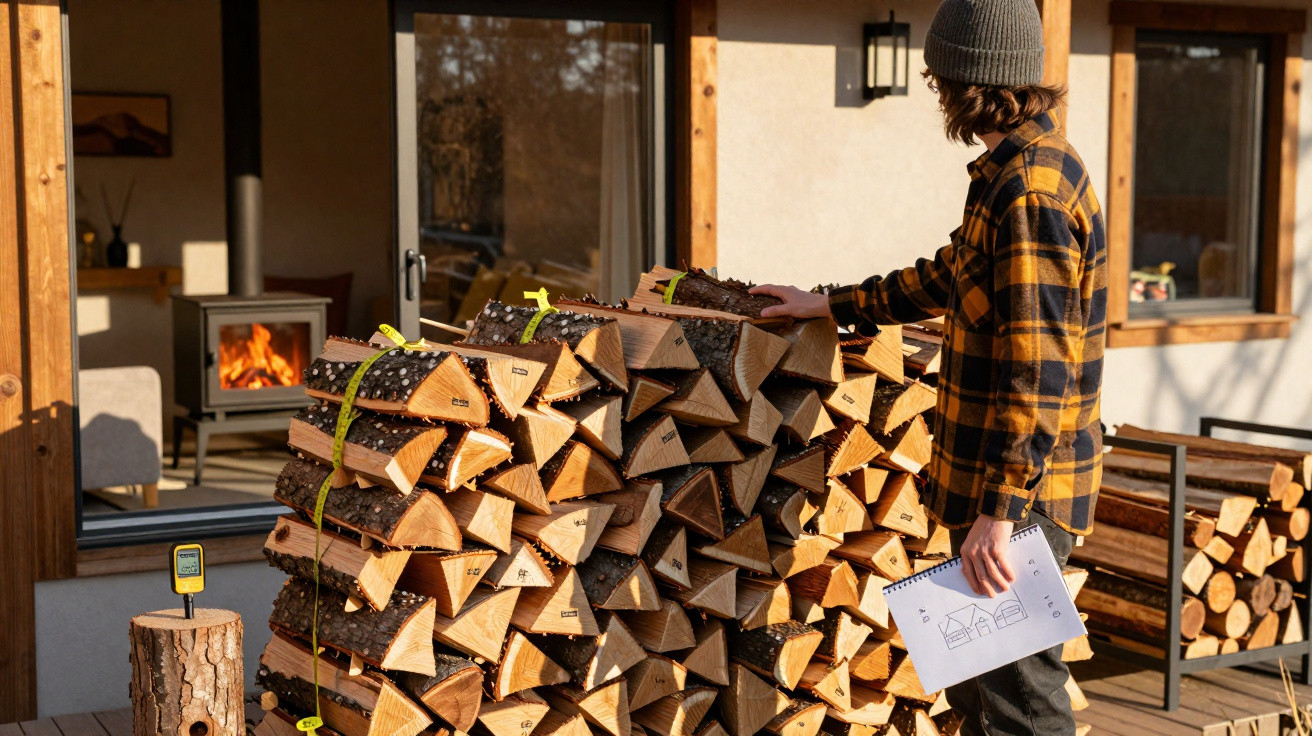
Anyone who relies on a wood‑burning stove or inset stove through the colder months faces the same question every year: will the amount of firewood you’ve ordered actually see you through, or will the log store be empty by mid‑February? The right answer depends on far more than your home’s floor area; it comes down to a whole set of factors that are easy to underestimate.
What a stacked cubic metre of firewood really means
Before getting into figures, it’s worth clarifying a common trade term. Firewood is often sold by the stacked cubic metre (in some places also called a stère). This means one cubic metre of logs stacked on a 1 m² footprint to a height of 1 metre.
In reality, there’s an important catch: a stacked cubic metre is traditionally based on 1‑metre lengths. If those same logs are cut to 50 cm, 33 cm or 25 cm, they can be stacked more tightly. The pile looks smaller, even though the amount of wood is essentially the same.
Ordering shorter log lengths at the same stacked‑cubic‑metre price usually means less “air” and more actual wood sitting in your store.
So when you compare quotes, it pays to check the log length and to ask whether the supplier charges by stacked cubic metres or loose cubic metres (tipped, unstacked logs). Loose measures contain noticeably more air gaps.
The most important factors affecting firewood consumption
How much wood a household burns in a heating season varies widely. These points have the biggest impact on overall use.
Floor area and internal volume
A compact 90 m² terraced house with standard ceiling heights will get through far less wood than a detached 160 m² older property with open gallery spaces. What matters isn’t only the floor area, but the total volume of air that needs warming.
Insulation quality
If you live in a well‑insulated new build with triple‑glazed windows, you’ll need substantially less energy to reach the same comfortable temperature than you would in a home with older, draughty windows. Modern efficiency standards often cut firewood demand by 30 to 50 percent compared with an unrefurbished building.
Appliance type and efficiency
A modern wood‑burning stove with clean combustion and secondary air makes far better use of fuel than an open fire. While current appliances can reach efficiencies above 80 percent, an open fireplace sends most of the heat straight up the chimney.
Wood species and overall quality
Hardwoods such as beech, oak or ash have a high density and deliver plenty of energy per log. They burn steadily and for longer. Softer conifers such as spruce or pine ignite quickly and give strong heat in a short burst, but they also burn through faster.
If you heat with wood regularly, properly seasoned hardwood is usually better value overall, even if the price per stacked cubic metre is higher.
Moisture content is at least as critical as species. Only seasoned wood with under 20 percent residual moisture burns cleanly and efficiently.
Climate and personal preferences
Naturally, consumption is higher in snowy regions with long, cold winters than in milder areas. Personal comfort plays a part too: some people are happy at 19 °C, while others only ease off the stove once it reaches 23 °C.
How many stacked cubic metres does a household need per winter?
Based on the experience of energy advisers and stove fitters, you can draw up some broad rules of thumb. They’re not a substitute for a bespoke calculation, but they do provide a reliable starting point.
Occasional use for atmosphere
If you mainly light the stove at weekends or on especially miserable evenings, you’ll usually stay in a fairly modest range.
- Occasional use: about 1 to 3 stacked cubic metres per heating season
That’s enough for plenty of cosy nights by the fire without putting too much strain on your budget.
Regular use as a heating top‑up
Many households use a stove to take pressure off gas or electric heating. In that setup, the stove often covers a large share of the living area, while other rooms continue to be heated in the usual way.
- Everyday heating top‑up: around 3 to 6 stacked cubic metres per winter
The exact figure depends heavily on insulation levels and how far you turn down the main heating elsewhere.
Wood as the main heating source
If the stove or inset stove is used to heat all (or nearly all) of the living space, the quantities rise noticeably.
- Wood as the primary heat source: roughly 5 to 12 stacked cubic metres per season
In a modern, well‑insulated detached house, 5 to 7 stacked cubic metres is often sufficient. In older buildings with little refurbishment, it can quickly become 10 or more.
Tips to reduce your firewood use noticeably
With a few basics in place, you’ll burn less fuel, do less work, and put less strain on the appliance.
- Use dry logs: Only wood with low residual moisture burns cleanly. Freshly felled timber should be stacked to season for at least two summers, depending on the species.
- Service the stove regularly: Remove ash, check door seals, clean the glass - a well‑maintained stove runs more efficiently.
- Have the chimney swept on schedule: The required sweep isn’t just a formality; it also improves draw and therefore combustion.
- Light the fire correctly: Top‑down lighting with dry kindling reduces smoke and makes better use of the wood.
- Upgrade insulation where possible: The top‑floor ceiling and loft space often offer particularly large savings.
Every extra centimetre of insulation saves firewood year after year - often more than many homeowners expect.
How to store your wood so it actually heats
Storage conditions can influence usable heat almost as much as species choice. If you stack logs on damp ground and wrap the entire pile tightly in plastic, you may get an unpleasant surprise when you try to light it.
The ideal storage spot
- airy, with good exposure to passing wind
- protected from direct rain and snow
- raised off the ground, for example on pallets, bricks or a batten frame
- with an open front or sides so air can circulate
A roof or cover above the stack is sensible. Fully sealing the pile with impermeable sheets is not: it traps moisture and slows drying.
Practical examples of winter firewood requirements
To get a feel for the scale, it helps to look at typical scenarios:
| House type | Stove use | Estimated requirement |
|---|---|---|
| Terraced house 100 m², well insulated | Heating top‑up in the living area | approx. 3–4 stacked cubic metres |
| Detached house 140 m², average insulation | Main heating with a central wood‑burning stove | approx. 6–8 stacked cubic metres |
| Older property 160 m², little refurbishment | Wood as the most important heat source | approx. 9–12 stacked cubic metres |
These figures can vary significantly - if you ventilate frequently for long periods, or routinely leave windows on the latch, you’ll burn noticeably more wood.
What many people overlook with firewood
Ordering early usually saves both money and hassle. Prices often jump in autumn, and delivery times can stretch. Buying in spring or summer frequently means better terms and enough time to let the wood season further.
It’s also wise to build in a small buffer. If you plan too tightly every year, the third cold snap can leave you with an empty store. Keeping half to a full stacked cubic metre in reserve makes planning far less stressful.
It’s also worth considering how a modern central heating system can work alongside a wood‑burning stove. Many people use the stove strategically during periods of high energy prices to reduce demand on the boiler. With the right approach, you can cut costs without losing comfort - for example, by heating the living area with wood while bedrooms remain moderately warmed by the main system.
If you’re new to all this, a simple method works well: in the first season, allow for one to two extra stacked cubic metres, track what you actually use, then adjust the next year. Over time you’ll build a realistic picture of your own firewood requirement - and keep the house warm without panic‑buying during frost and snowstorms.




Comments
No comments yet. Be the first to comment!
Leave a Comment