
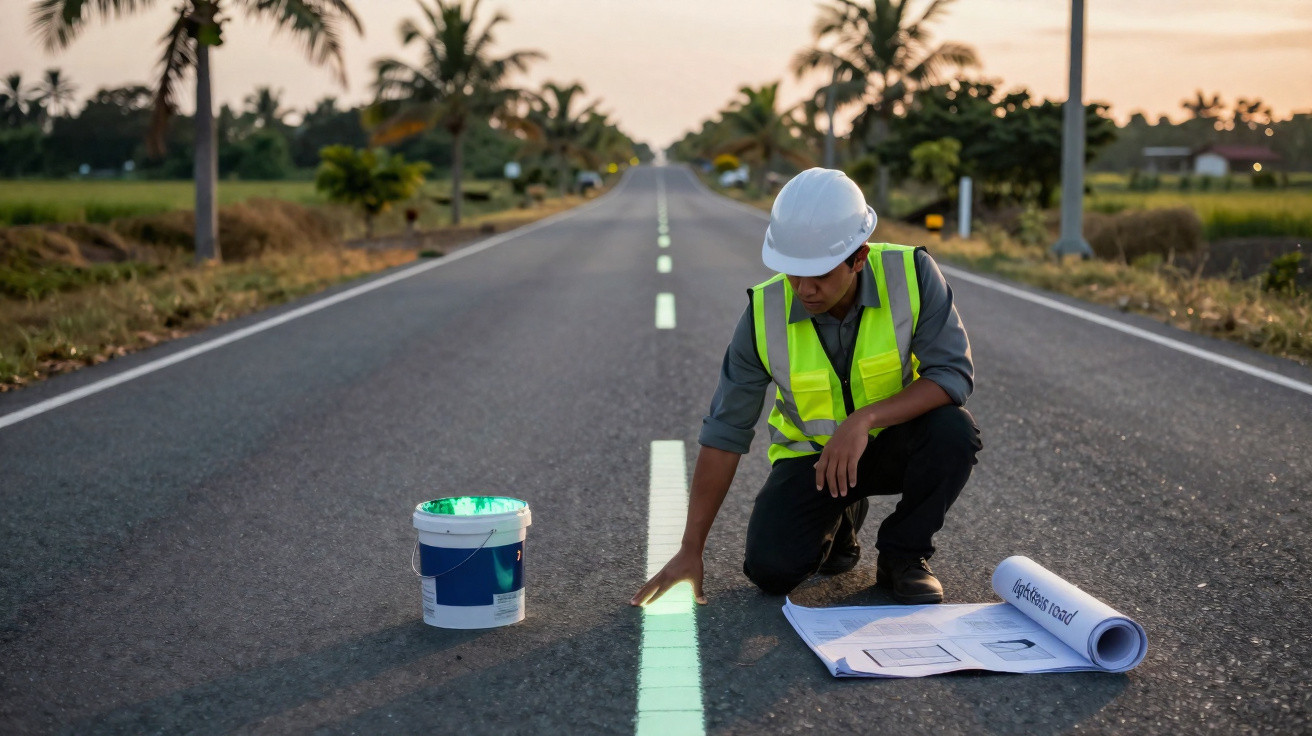
In Malaysia, the future of road lighting briefly looked as though it had arrived: instead of conventional street lamps, self-illuminating road markings were meant to make unlit rural routes safer. The trial made headlines well beyond the country’s borders - but just a year later the government pulled the plug. The decisive issue was less about the concept itself than about what it would cost.
How a slice of the future lit up in Semenyih
The test took place on a two-lane road near Semenyih in the state of Selangor. At the end of October 2023, the public works department fitted a 245 metre stretch with special lane markings designed to absorb sunlight during the day and glow after dark.
The thinking was straightforward. The area has no street lighting, the road bends frequently, and in wet weather visibility is poor. From the outset, officials stressed it was not a visual gimmick but a practical attempt to improve road safety and promote “innovation in road construction”.
"The road itself was meant to become the light source - without electricity, without lamp posts, built directly into the asphalt."
In daylight the markings looked almost ordinary. The change became apparent only after nightfall, when the lines gave off a greenish glow and offered drivers clearer guidance, including in rainy conditions. The responsible minister, Alexander Nanta Linggi, said the effect could remain visible for up to ten hours after sunset.
Why everyone suddenly started talking about glowing roads
The pilot scheme offered a simple promise that was easy to grasp: better visibility on dark roads without paying for electricity. That alone was enough to generate substantial attention, and not just within Malaysia.
Details from the test section underlined that the authorities were treating the issue seriously. Across the 245 metres, a total of 490 metres of glowing markings were applied, including through bends and at hazard points. The intention was for the system to partially replace traditional road studs (“cat’s eyes”).
The idea was not entirely unprecedented. In the Netherlands, designers and construction firms had already tried out so-called “Glowing Lines” that charge up during the day and shine for several hours at night. There, however, it remained a limited trial rather than a widespread roll-out.
In Malaysia, the framing felt more grounded: not an art installation or a showcase stunt, but an everyday road-safety test aimed at rural routes.
From pilot to vision: sudden expansion plans
As many drivers praised the glowing strip of asphalt, decision-makers began thinking much bigger within a few months. In February 2024, Selangor announced plans to test the technology at 15 additional locations across all nine districts.
The programme was set to cover around 15 kilometres of road, including sections in Sepang, Kuala Langat and Petaling. Estimated costs were put at about 900,000 Malaysian ringgit, making it look as though a one-off experiment might turn into a strategic infrastructure initiative.
At the same time, other states signalled interest. Johor identified 31 roads for similar trials, including a 300-metre section near Batu Pahat. Suddenly, glowing markings were being discussed as a potential standard tool for unlit rural roads nationwide.
The catch shows up in the numbers
As publicity grew, a familiar obstacle for infrastructure projects came into focus: price. The government shared a blunt comparison.
- Price per square metre of standard road paint: around 40 ringgit
- Price per square metre of photoluminescent specialist paint: around 749 ringgit
- Cost multiple: almost 20 times more expensive
And that figure covered only the initial installation, without long-term evidence on durability, weather resistance, or repair cycles. Those uncertainties are precisely where transport specialists usually become most cautious.
One sentence in Parliament bursts the dream
In November 2024 the U-turn arrived - and it was strikingly clear. Deputy Works Minister Ahmad Maslan told Parliament that the cost of the glowing markings was “too high”, meaning continuation of the illuminated lanes was “likely” off the table.
His second point was just as significant: internal tests had not convinced the ministry’s technical experts. In other words, it was not purely a budget issue; it also concerned technical assessment and compliance with standards.
"What looked to many drivers like a convincing safety benefit did not pass the experts’ tougher checks."
That shift turned an apparent success story into a familiar infrastructure reality. A technology can look impressive, help in practice, and still fail if it is too costly or too demanding to maintain. Ultimately, what matters is not social media photos but service life, maintenance intervals, standards - and a finite public budget.
Why the visibility question is not going away
Even without a major glowing-roads push, the original challenge remains: how can road markings be made reliably visible at night and in poor weather, especially in places with no lamp posts?
Road authorities around the world continue to work on exactly this problem. In Japan, for instance, the National Institute for Land and Infrastructure Management examines which metrics are suitable for maintaining and assuring the quality of motorway road markings. There, the condition of the markings is treated as a safety factor in its own right, not merely a minor detail.
From an engineering perspective, several elements interact:
| Aspect | Importance for safety |
|---|---|
| Reflectivity | Determines how effectively headlights make markings visible. |
| Contrast with the road surface | Crucial in rain, darkness and on dirty carriageways. |
| Durability | Dictates how quickly re-marking is needed. |
| Maintenance costs | Influences whether a solution remains affordable at scale. |
| Technical standards | Ensure consistency and minimum quality nationwide. |
What glowing roads have still taught us
Even though Semenyih remained a test site, the project still offers clear lessons. First, it shows how strongly road-building innovations can shape public perception: a 245 metre stretch was enough to spark a nationwide debate.
Second, it highlights how thin the line is between an “exciting pilot” and an “expensive mistake”. Trials like this typically have to clear several hurdles:
- a noticeable safety improvement in real traffic
- proven durability over multiple years
- clear maintenance plans for local authorities
- a cost envelope that can compete with established alternatives
The last point, in particular, became the stumbling block for the glowing markings. It is not enough for a technology to work in day-to-day conditions - it must also be affordable across thousands of kilometres of road network. Local councils often face a stark choice: one attention-grabbing flagship project or straightforward repairs across many problem spots.
Where photoluminescent markings could still make sense
Malaysia’s decision does not necessarily rule out such solutions entirely. Highly targeted use remains conceivable:
- short, hard-to-see danger points with no power connection
- tunnel sections where resilience against power cuts is needed
- test beds for combined systems using reflectors and LED technology
- specialist zones such as around industrial sites or ports
Hybrid approaches are also possible: standard high-reflectivity markings as the default, with limited glowing sections at particularly critical locations. That would allow benefits to be tested without coating long distances.
What drivers can take from the debate
For road users in Europe, the Malaysian story may feel distant at first. Yet it touches on questions that are just as relevant here: how safe are rural roads at night? Are markings and reflector posts enough? When does a new technology justify the premium?
A few broader points carry across:
- Clearly visible markings are not a luxury; they are part of active safety.
- Road-building innovation needs solid evidence, not just striking images.
- Cost per kilometre often matters more than technical feasibility.
- Pilot projects should produce data that enables an honest verdict - even when the result is negative.
For now, glowing roads remain a symbol of the tension between high-tech ambition and budget reality. Malaysia’s brief episode shows how quickly futuristic ideas can capture attention - and how demanding the conditions are for them to become a lasting part of everyday roads.

Comments
No comments yet. Be the first to comment!
Leave a Comment