
There’s a very specific pang of guilt that hits only when you spot a brand-new scratch on a wooden piece you genuinely adore.
It might be the dining table you saved for, or the coffee table that’s been with you since your first flatshare. One moment it’s simply part of the room, and the next your keys, a toy car, or someone’s belt buckle has gouged a pale, unmistakable line straight across the top. Your stomach drops. You find yourself quietly googling “refinishing”, “repair kits” and “is this ruined forever?”-all while mildly judging yourself for being this invested in a slab of timber.
Most of us have done the same little ritual: you rub at the mark with your thumb as if it’s just a smear, then step back and realise you’ve changed absolutely nothing. That’s usually when you start picturing sanding, staining, varnishing, and possibly weeping over a table under a tarp in the sitting room. Except there’s a much smaller, slightly bizarre step you can try first. It’s probably in your kitchen cupboard, often sitting in a bowl near the fruit. And it looks unhelpfully like something you’d eat.
The day a bowl of nuts saved my table
When I first heard the idea of rubbing a walnut over scratched wood, I laughed out loud. It sounded like one of those online “hacks” where people smear toothpaste on everything from phone screens to jewellery and then act amazed when it doesn’t transform their lives. But one Saturday morning, glaring at a long scratch across my oak coffee table-courtesy of a visiting nephew and a plastic dinosaur-I remembered the tip. Walnut. Rub. Somehow… fix?
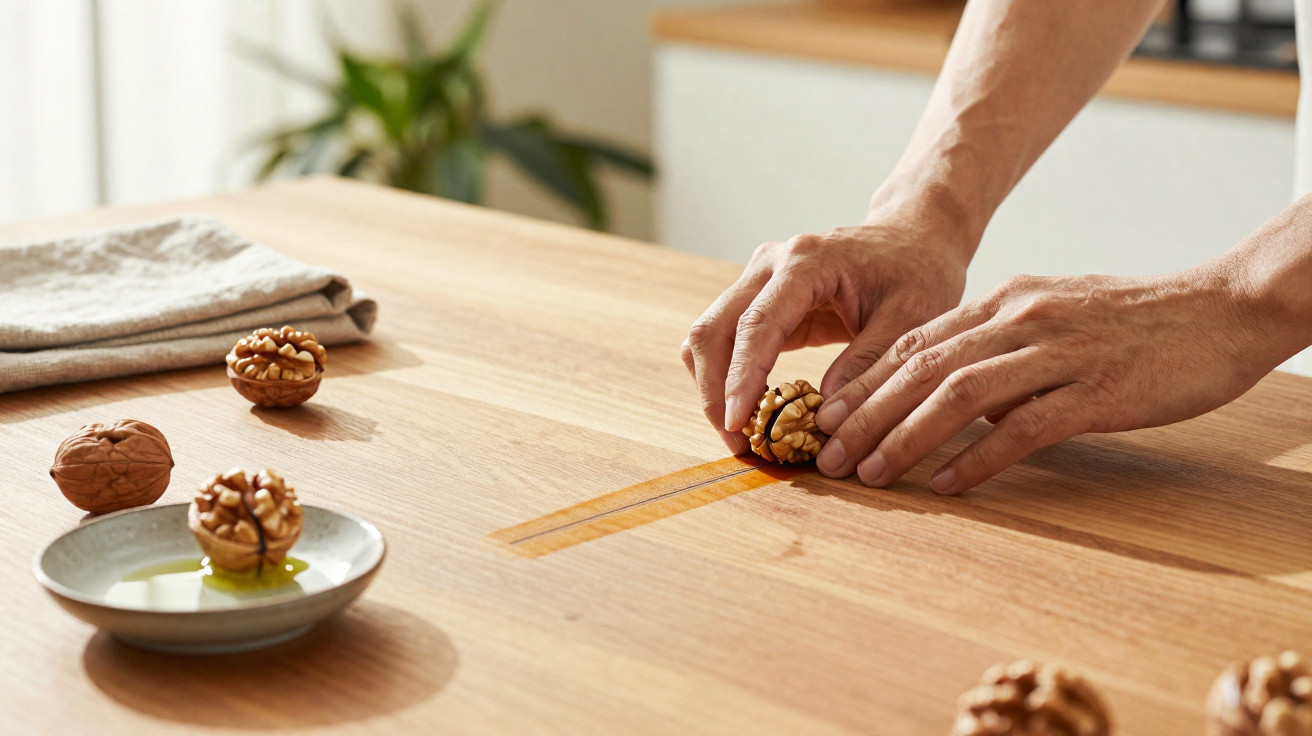
I went into the kitchen and hovered over the nut bowl, having a full internal debate. One side of me was sure I’d end up with a greasy, odd-looking tabletop. The other side was annoyed enough to try anything that didn’t involve power tools. So I cracked a walnut, felt faintly daft, and used the nut meat to rub along the pale line, following the grain, exactly as an internet stranger had once advised. The room went oddly solemn; the only noise was the soft, dry drag of walnut against wood.
At first, it seemed to do nothing at all. Then I gently wiped away the excess with my sleeve and the scratch just… dulled. The stark white line shifted to a warmer, browner shade and started blending into the surrounding finish. It wasn’t gone, not erased like a slick CGI edit, but it became hard to spot unless you crouched down and actively searched for it. I stepped back and felt that quietly ridiculous burst of satisfaction you get when something small-but weirdly important-finally goes your way.
That same table is still in my living room. And whenever I walk past it, I think about how a roughly 20p walnut did for that mark what a £30 repair kit promised to manage in three days. That’s when it clicked for me: some of the best home “fixes” are the ones that feel like a tiny refusal to buy yet another thing.
Why a walnut works on wood (and why it feels a bit like magic)
There’s real science tucked inside this bit of kitchen witchcraft. Walnuts contain plenty of natural oils, and those oils have a warm brown tone that’s close to many everyday furniture finishes. When you rub a walnut over a shallow scratch, the oil seeps into the newly exposed wood fibres, darkening the pale line and bringing it closer to the colour around it-like a miniature, edible stain pen.
And the rubbing itself matters. Friction slightly warms the oils, helping them spread and soak in more readily. With a bit of pressure, you also push tiny walnut particles into the scratch, filling microscopic gaps so the light doesn’t catch the damage as sharply. You’re not repairing the wood so much as disguising the injury. Think concealer, not surgery-and for surface marks, that’s more than enough.
Naturally, if a scratch is deep enough to catch your fingernail, or if wood is actually missing, a walnut won’t conjure a miracle. No nut on earth is going to replace timber or undo a gouge from shoving an entire wardrobe across the room in a panic. This trick is at its best in the “small but infuriating” zone: the kind of damage your eyes lock onto every time you pass, while your bank balance objects to the idea of professional refinishing.
There’s also something oddly comforting about using food to look after furniture. Your hands end up with a faintly nutty smell, the surface looks revived, and it’s a reminder that the things we live with don’t always need plastic bottles and complicated instructions to be cared for. Sometimes all they want is a touch of oil and a few minutes of focused attention.
How to actually do it, without feeling like a fool
The two-minute, no-fuss method
If you’re going to give it a go, keep it simple. First, make sure the surface is clean and dry-one quick pass with a soft cloth that’s barely damp is enough to pick up dust and crumbs. Crack open a walnut and take out the nut meat. You only need a decent piece you can hold without it instantly disintegrating. Avoid salted or flavoured nuts, unless you genuinely want your furniture to smell like barbecue seasoning.
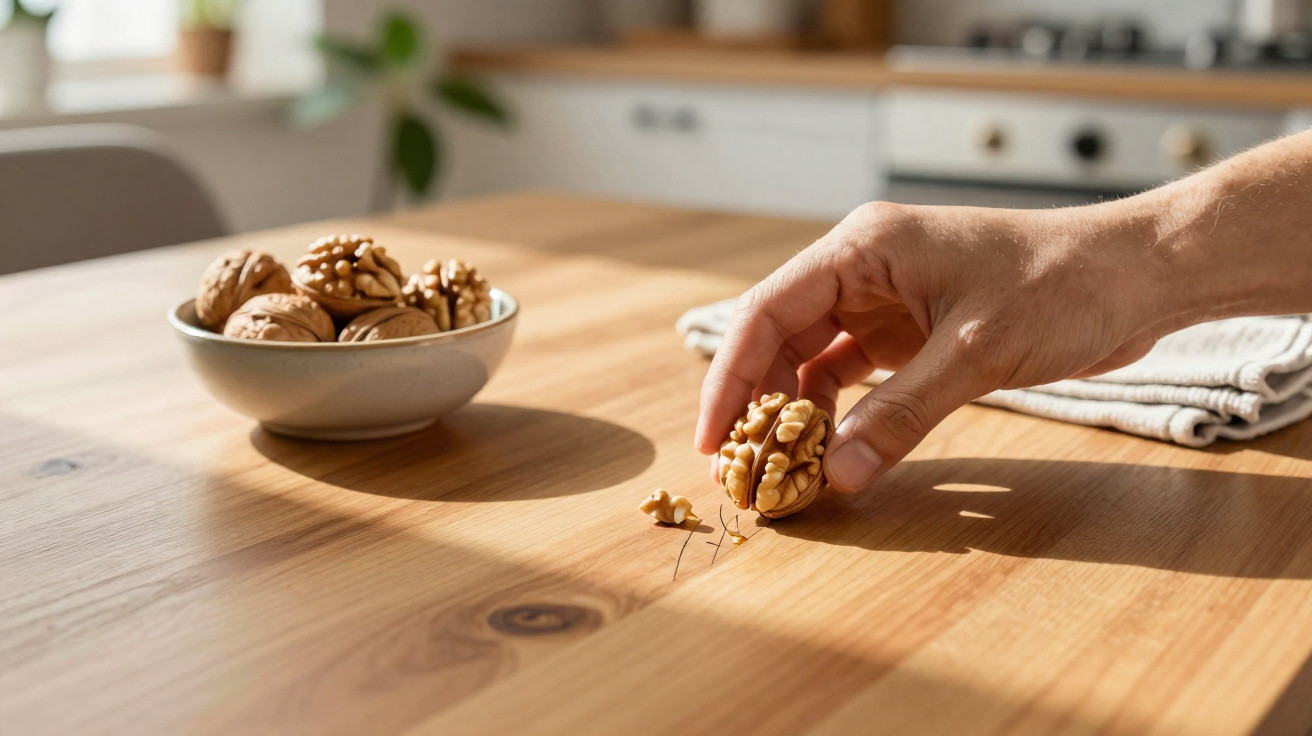
Rub the walnut over the scratch with gentle, steady pressure, always going in the direction of the grain. Go back and forth a few times, as if you’re colouring in the line with a very buttery pencil. You’ll notice a slight sheen of oil on the surface, which is exactly what you want. Leave it for a minute or two while you attempt to act relaxed and not stare at it every five seconds. Then use a soft cloth-or a clean section of your T-shirt-to lightly buff the area.
Step back and look. This is the moment of truth. Often the scratch will suddenly seem much quieter, as if someone has turned down its brightness. You may still be able to see it if you know precisely where it is, but it won’t grab the eye in the same way. And that’s usually the real goal: not flawless perfection, just relief from the constant visual nag.
When it doesn’t “work” straight away
Sometimes the first attempt barely shifts the mark, especially on lighter woods or pieces with a thick varnish layer. Before you decide the internet is lying to you, try another pass. Press a bit more firmly, give the oils an extra minute to absorb, then buff again. The improvement can be subtle-more of a gentle blur than a clean disappearance.
On very pale woods like pine or beech, the walnut can make the scratch look warmer without fully blending it in. That’s expected, because you’re effectively applying a brown-tinted oil to naturally light timber. Even so, it often looks better than a fresh, stark white cut. If it still bothers you, you can always move on to more involved repairs later. The walnut hasn’t harmed anything-it’s simply had a try.
And let’s be realistic: no one does this as a daily habit. You’re not going to wander round each evening lovingly nut-polishing every tiny scuff. This is an occasional, “ugh, I can’t unsee that” fix. For those moments, having an option that takes minutes and doesn’t require a shopping trip feels strangely empowering.
The emotional life of a scratch
The practical side of this trick is only half the story. The emotional side is something else entirely. A scratch in furniture is often less about the timber and more about what we project onto it. The first mark on a new table can feel like you’ve failed. You paid good money, you told yourself you’d be careful, and now-there it is: proof that you live a chaotic, very human life.
Often, the damage comes with people attached. There’s the ring left by the friend who never remembers coasters. The faint score where your child dragged a toy across the surface while narrating an epic battle in their head. The chipped corner from the night a party got a bit too enthusiastic. We flinch when it happens, and then years later we run a finger over the same marks and remember exactly who we were.
That’s why the walnut trick feels unexpectedly kind. You’re not scrubbing away the past. You’re just taking the edge off it. You’re saying: yes, that happened, but it doesn’t need to announce itself every time I walk into the room. It lets your furniture grow older alongside you, with fewer sharp lines and fewer cold flashes of regret.
There’s a quieter truth underneath all of this: we’re constantly told to replace things the moment they slip below perfect. A scratch becomes a reason to shop, not a reason to pause and see what can be repaired. Grabbing a walnut from the kitchen and using it to calm a mark on your table feels, in a small way, like choosing care over consumption. It won’t rewrite the world, but it may change how you see the things you already own.
When a walnut is enough - and when it isn’t
It’s easy to get overexcited and expect one small trick to solve every problem. A walnut can genuinely help with light, surface-level scratches, particularly on darker pieces and on wood that’s stained or oil-finished. It’s excellent for those thin, whitish lines that show up when something only skims the top layer. It can also perk up patches that look dry, adding a slight sheen that makes the surface seem less tired. For minor offences, it’s surprisingly effective.
But deep gouges, water damage, peeling varnish, or heat marks are in a different category. That’s when you’re into sanding, wood filler, stains, and new finishes. You may need to accept that a table has been well used and deserves a proper refresh-or at least a runner to hide the worst bits. Expecting a walnut to sort that out is like expecting a plaster to fix a broken bone: well-meaning, but nowhere near enough.
Finish matters too. Some ultra-glossy, heavily lacquered surfaces don’t absorb much of anything, including walnut oil. In those cases the scratch may be in the clear topcoat rather than the wood underneath. It’s still worth trying the walnut because you’ve got little to lose, but keep your expectations in check. Sometimes the biggest benefit of attempting a quick fix is learning what level of repair you truly need.
And if you decide you’d rather live with the scratch than commit to a weekend of refinishing, dust everywhere, and varnish smell clinging to the curtains-there’s no shame in that. Not every imperfection has to be “dealt with”. Some only need turning down from a shout to a whisper. A walnut is very good at doing exactly that.
A small ritual of care in a rushed house
There’s something almost old-fashioned about slowing down and tending to your furniture. Life feels relentlessly fast: meals eaten over laptops, emails answered on the sofa, washing dumped on the bed. Wooden pieces fade into the background-the table is just the surface under the takeaway, the sideboard is just where the post collects. When you stop, crack a walnut, and lean over a scratch, you’re choosing to say: this matters, at least for a minute.
You notice the grain again, the tiny shifts in colour, and the way the light slides across the surface at certain times of day. You remember why you picked that piece in the first place, why you carried it up a flight of stairs or waited six weeks for delivery. You think about the conversations, arguments, slow mornings and late nights it has quietly held. That’s a lot of life for a piece of wood to carry without acquiring a few scars.
Maybe that’s the real appeal of this strange little trick. It doesn’t only hide a flaw; it nudges you towards a gentler relationship with your home, where repair is normal and small efforts feel worthwhile. You’re not waiting for a miracle product or a professional to rescue the situation. You’re simply thinking: I can do something, right now, with what I already have.
Next time you spot a bright, taunting scratch across your favourite wooden surface, pause before you reach for your phone or your wallet. Go to the kitchen, find a walnut, and give it a go. At worst, you’ve sacrificed one snack. At best, in a few quiet minutes, you turn that little jolt of guilt into a private, satisfying win-and your table looks a bit more like it’s been loved, not merely used.



Comments
No comments yet. Be the first to comment!
Leave a Comment