
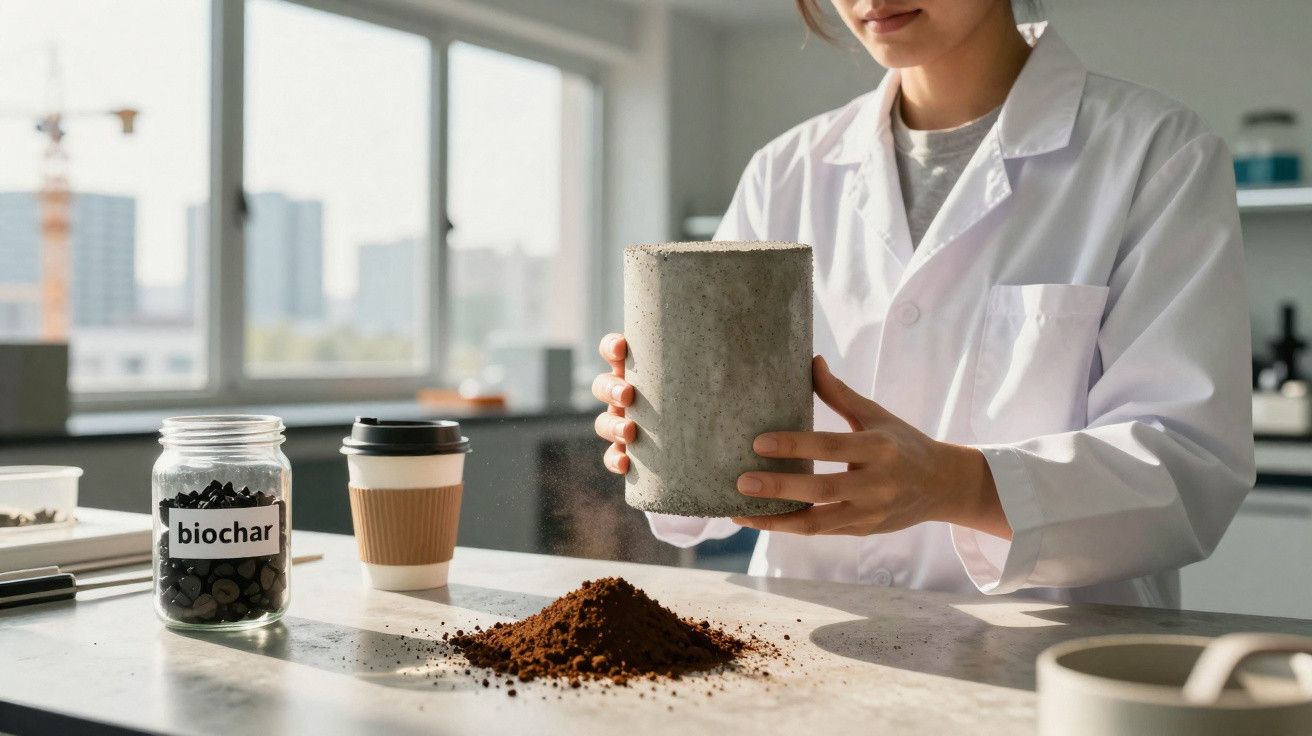
Charred coffee grounds may be able to make concrete up to 30 percent stronger, according to scientists in Australia.
The approach is a neat one because it has the potential to tackle more than one issue at the same time.
Coffee waste and its climate impact
Every year, roughly 10 billion kilograms of coffee waste are generated worldwide, and most of it is dumped in landfill sites.
"The disposal of organic waste poses an environmental challenge as it emits large amounts of greenhouse gases, including methane and carbon dioxide, which contribute to climate change," explained RMIT University engineer Rajeev Roychand when the research was published in 2023.
At the same time, the global construction sector continues to expand, driving rising demand for concrete - a material that is resource-intensive to produce and brings its own environmental pressures.
Watch the video below for an overview of the study.
Sand extraction and a circular-economy approach
"The ongoing extraction of natural sand around the world – typically taken from river beds and banks – to meet the rapidly growing demands of the construction industry has a big impact on the environment," said RMIT engineer Jie Li.
"There are critical and long-lasting challenges in maintaining a sustainable supply of sand due to the finite nature of resources and the environmental impacts of sand mining. With a circular-economy approach, we could keep organic waste out of landfill and also better preserve our natural resources like sand."
How coffee grounds are turned into biochar for concrete
Coffee grounds and other organic materials cannot simply be mixed straight into concrete, because they can leach chemicals that reduce the strength of the final building material.
To avoid this, the researchers used relatively low energy inputs to heat the coffee waste to above 350 °C, while keeping oxygen out.
This technique is known as pyrolysing. It breaks apart the organic compounds and produces a porous, carbon-rich charcoal called biochar, which can bond with - and therefore become part of - the cement matrix.
Roychand and his team also pyrolysed coffee grounds at 500 °C, although the biochar produced at that temperature yielded particles that were less strong.
The researchers stressed that the long-term durability of their cement product still needs to be evaluated.
They are now investigating how the coffee–cement blend holds up under freeze–thaw cycles, water absorption, abrasion, and a range of other stresses.
The group is also developing biochars made from additional organic waste streams, including wood, food, and agricultural waste.
"Our research is in the early stages, but these exciting findings offer an innovative way to greatly reduce the amount of organic waste that goes to landfill," said RMIT engineer Shannon Kilmartin-Lynch.
"Inspiration for my research, from an Indigenous perspective, involves Caring for Country, ensuring there's a sustainable life cycle for all materials and avoiding things going into landfill to minimize the impact on the environment."
Their findings were published in the Journal of Cleaner Production.
An earlier version of this article was published in September 2023.



Comments
No comments yet. Be the first to comment!
Leave a Comment