
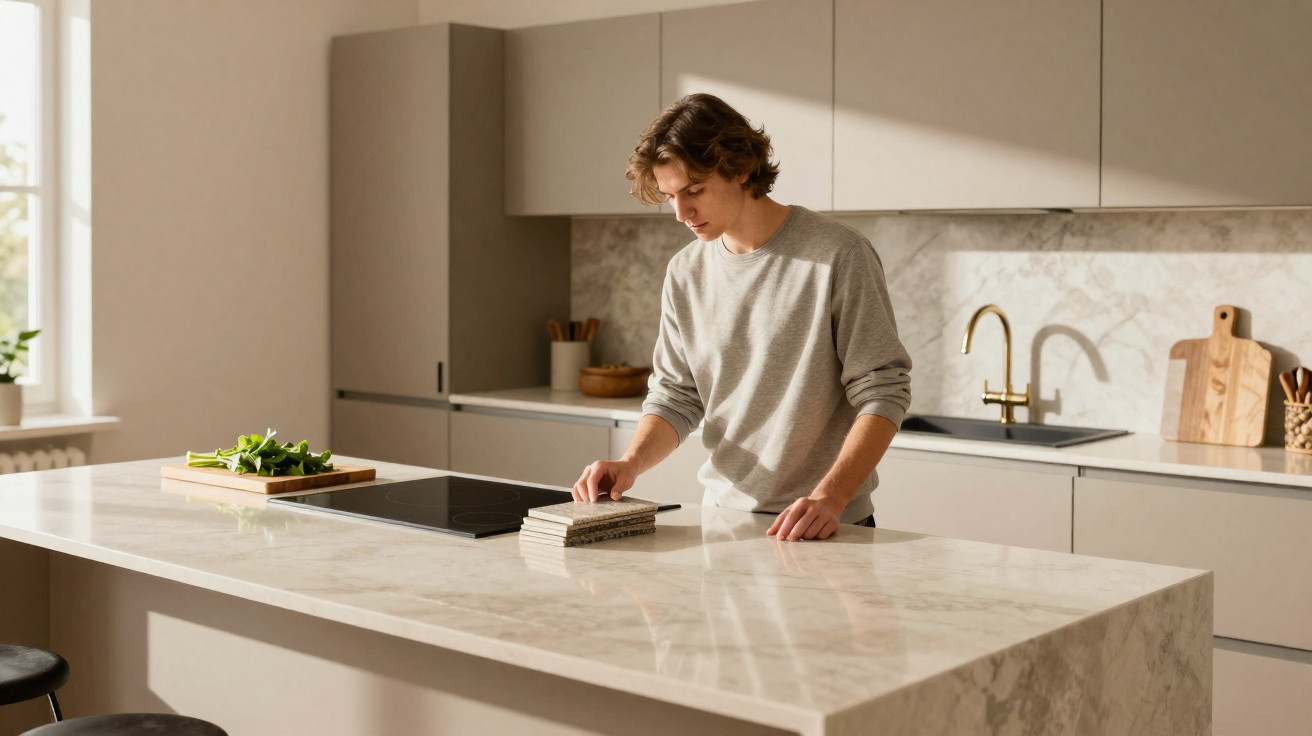
Granite still features in plenty of projects, but it has been losing ground on the kitchen worktop, where day-to-day practicality, straightforward upkeep and a seamless finish now carry more weight in the decision. In 2026, large-format porcelain slabs are gaining momentum because they can often be fitted over an existing base, stand up well to everyday use and cope better with staining without the mess and disruption of major demolition.
Why has granite lost momentum in today’s kitchens?
The visual appeal of natural stone is still there, but kitchen habits and expectations have shifted. When people renovate now, they tend to prioritise a surface that wipes clean easily, is less porous and offers larger, more continuous spans with fewer joints. Against that backdrop, granite is often criticised because it may need sealing in many situations and because it can vary noticeably from one slab to the next-something that does not always sit well with more precise cabinetry and tighter tolerances.
Market signals have changed too. Recent reports from suppliers and design publications point to growing demand for porcelain slabs and ultra-compact surfaces among 2026 specifications, largely due to their lighter look, thinner edges and a more “dry” installation approach. The 2026 trend does not make granite disappear, but it does shift preference towards materials with more predictable maintenance.
What does porcelain deliver on a kitchen worktop?
Worktop porcelain is not the standard floor tile. In this application it comes as large-format slabs with low absorption, a continuous pattern and thicknesses that allow you to create an upstand, a kitchen island and even a wall panel in the same finish. For anyone cooking daily, that matters because coffee, sauces and grease are typically easier to remove when the surface is less porous.
In practical terms, a porcelain-clad kitchen worktop tends to stand out for four reasons:
- lower risk of permanent marks from heavily pigmented liquids
- a more uniform finish, with less visual variation than natural stone
- the option to install over the existing base, depending on the structure
- competitive costs on projects that avoid demolition and waste disposal
No renovation at all-or does it depend on the existing base?
It depends, and getting this right prevents disappointment. If the kitchen worktop structure is solid, level and free from leaks or damp, many installers can apply porcelain directly over the old top. That can reduce rubble, speed up the job and avoid disturbing cabinetry, the sink and surrounding finishes. The idea of a cleaner build is realistic-but only after a technical inspection.
Before signing off on a quote, it is worth checking a few clear points:
- whether the base can handle the new cladding and the sink cut-out
- whether there are uneven corners or hollow/unsupported areas
- whether the worktop front edge can accommodate the new finish
- whether sockets, the upstand and the tap need millimetre-precise adjustments
How does the 2026 trend show up in kitchen design?
The 2026 trend is not only about the material. It also brings slimmer-looking worktops, an upstand in the same pattern, warmer tones and an overall lighter, less busy appearance. Porcelain fits this approach well because it can mimic stone, concrete or marble without relying on the strong visual “read” of a natural slab with very pronounced veining. The result is often a more continuous kitchen that is easier to blend with timber-effect cabinets, brushed metal and built-in appliances.
Versatility is another key advantage. The same slab can run up the wall, wrap the island and form the sink niche, which helps minimise visual breaks. In that sort of layout, granite can start to feel more traditional, while porcelain tends to suit compact schemes, new-build flats and fast-track refurbishments more naturally.
Is it worth switching now, or waiting for the next finishes cycle?
If your current kitchen worktop is worn, stains frequently or feels visually heavy compared with the rest of the room, switching now means you can take advantage of a market that is increasingly set up for overlay solutions. Granite remains a workable choice, but porcelain aligns more closely with what many homeowners want today: less maintenance, a continuous look and a controlled project from start to finish.
Over the coming months, the 2026 trend is likely to stay strong in residential projects because it combines a contemporary design language, rational installation and performance that matches real routines of cooking, cleaning and moving through the space. In small or open-plan kitchens, that combination tends to matter more than the tradition of natural stone-and it helps explain why so many specifications have moved towards large-format ceramic slabs.





Comments
No comments yet. Be the first to comment!
Leave a Comment