
The row began over a box of cereal. He was certain they had bought it two days earlier; she was equally certain there was nowhere left on the shelf to put it. They were both correct. The cupboard was crammed: partly opened packets, jars that had been overlooked, and mysterious tubs nobody was willing to investigate. Does that sound familiar? Open a cupboard door at home and there is always a risk that something will land in your face. It is not necessarily because you have “too much stuff”, but because the space has become stuck in the past.
One small alteration can bring it back to life.
And it is probably not the change you expect.
The small adjustment that quietly changes everything
Watch a person open an overfilled cupboard and there is usually a brief hesitation. Their gaze moves across the shelves, they let out a sigh, then push an item aside. That hesitation is the price of poorly planned storage. There is nothing wrong with the items themselves; the shelving is at fault. It is fixed, inflexible and stubbornly locked at a single height “because that’s how the builder installed them”.
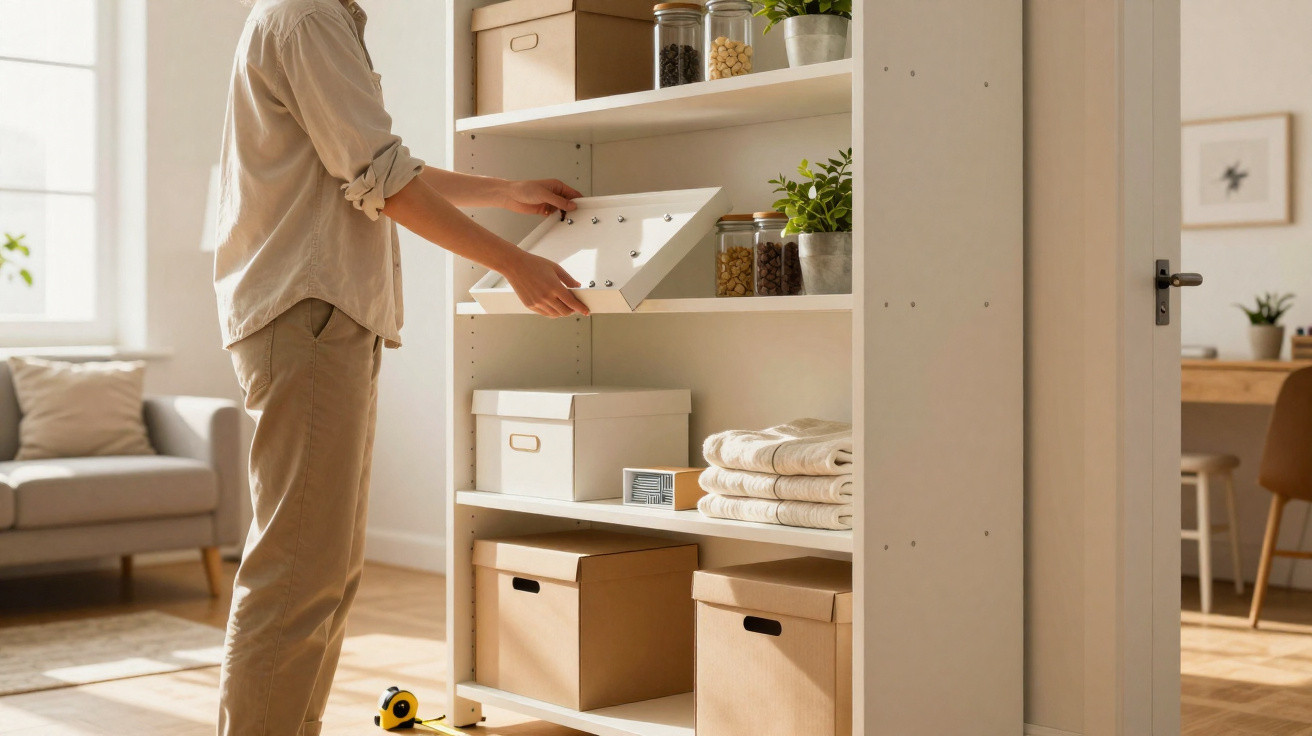
The modest change that makes storage adaptable is not a new storage box or smarter labelling. It is this: treat your shelves as temporary.
Shift them. Add more holes. Fit adjustable brackets. Consider every shelf level open to negotiation.
Picture a family kitchen evolving alongside the people who use it. In the beginning, the lower shelves hold plastic dishes and tubs of snacks. Two years on, the toddler has grown, so the snack shelf needs to move upwards. Next come phases of buying in bulk, baking, or making smoothies. Every fresh habit brings different items in different shapes. With adjustable shelves, the kitchen can be reconfigured in twenty minutes on a Sunday afternoon.
Without them, everything ends up piled in front of everything else.
That is when a cereal box turns into a household dispute.
There is a straightforward reason this single adjustment is so effective. Most storage arrangements are planned once and then left unchanged for a decade. Life is not like that. Interests shift, children grow, shopping is bought in bulk during offers, then stops after a split with Costco. Fixed shelves make you adapt your routines to the furniture. Adjustable shelves allow the furniture to adapt to your routines. That’s the whole game.
As soon as shelf height can be altered, unused vertical air becomes practical storage. Deep cupboards no longer consume everything inside them. And you stop “losing” possessions you genuinely have.
How to set up truly flexible storage at home
Begin with one cupboard only, rather than tackling the entire home. Open it, take a photograph on your phone, then remove every item and examine the empty framework. Ask yourself one simple question: “Where are the empty pockets of air?” Look above short jars, beneath hanging coats and behind lines of shoes.
Then make the small adjustment. Install or reposition a shelf so that no vertical gap is any taller than necessary. Where possible, fit rail systems with holes spaced every few centimetres. If that is not possible, place freestanding shelf risers inside the cupboard to divide up the height.
You are not organising anything at this stage. You are redesigning the setting.
This is the point at which many people stall. They begin with enthusiasm, purchase baskets and labels, and then stop because the arrangement feels overly rigid. Honestly, nobody manages this perfectly every day. Everyday life includes late nights, ill children and weeks of saying, “I’ll deal with it later”.
That is why systems designed to be too perfect fall apart. Flexible storage gives you room for error. When one category expands, move a shelf up by one position. When a seasonal pastime takes up less room, raise that shelf and reclaim valuable eye-level space.
We have all experienced the moment when you promise to “declutter for good”, only for life to laugh in your face.
“Once I stopped treating my cupboards like sacred architecture and started treating them like Lego,” says Anna, a 38-year-old nurse in Manchester, “I finally felt in control of my space. I move a shelf and suddenly I’ve ‘found’ half a cabinet I thought I’d lost.”
- Fit brackets, rails or pegboard systems that allow shelves to be moved easily.
- Keep one “floating” shelf in each room which can take on a different purpose every few months.
- Store lightweight, regularly used items between waist and eye height.
- Use the highest and lowest areas for bulky items or things used rarely.
- Review one storage area each season, changing only one shelf height.
A home that can change its mind as fast as you do
When you start to view storage as adjustable, your home becomes a little less demanding. The hall cupboard can serve as winter sports storage, then turn into a travel area during summer. A wardrobe in the spare room can hold craft boxes one year and baby clothes the next. Storage spaces cease to be “final decisions” and instead become living layouts that can be edited.
You also get rid of a subtle sense of guilt. Those heaps on the floor? They are often simply items left without a place because shelf spacing is wrong. Give them somewhere to land and they settle down. You do not suddenly become a minimalist; you just give your belongings a realistic place to live.
The plain truth is that most clutter problems are architecture problems dressed up as personality flaws.
| Key point | Detail | Value for the reader |
|---|---|---|
| Adjustable shelves | Add rails, extra holes, or risers to change shelf height | Turns wasted air into usable space without buying a bigger cabinet |
| One-zone-at-a-time approach | Work on a single cupboard or closet per session | Makes the process doable, avoids overwhelm, and delivers quick wins |
| Seasonal reshaping | Revisit shelf positions every few months | Keeps storage aligned with real life as habits, hobbies, and families change |
FAQ:
- Question 1 What is the cheapest way to make existing shelves adjustable? Often, the answer is simply to fit metal support rails with pre-drilled holes, move shelves onto new pegs, or use stackable shelf risers inside existing cupboards.
- Question 2 Do I need matching boxes and containers for this to work? No. Matching containers may look attractive, but the real change comes from adjusting shelf height and depth so the items you already own fit properly.
- Question 3 How often should I alter my storage areas? Think seasonally: every 3–4 months, or whenever a major life change occurs, such as a new job, a new baby or a new hobby.
- Question 4 What if I rent and cannot drill into walls or cupboards? Choose freestanding bookcases with adjustable shelves, over-door organisers, tension rods and stackable cubes that can be rearranged without tools.
- Question 5 Where should I begin if my entire home feels cramped? Choose the “pain point” you use every day: the entrance hall, the food cupboard or the wardrobe you open each morning, then adjust just one shelf there first.




Comments
No comments yet. Be the first to comment!
Leave a Comment