
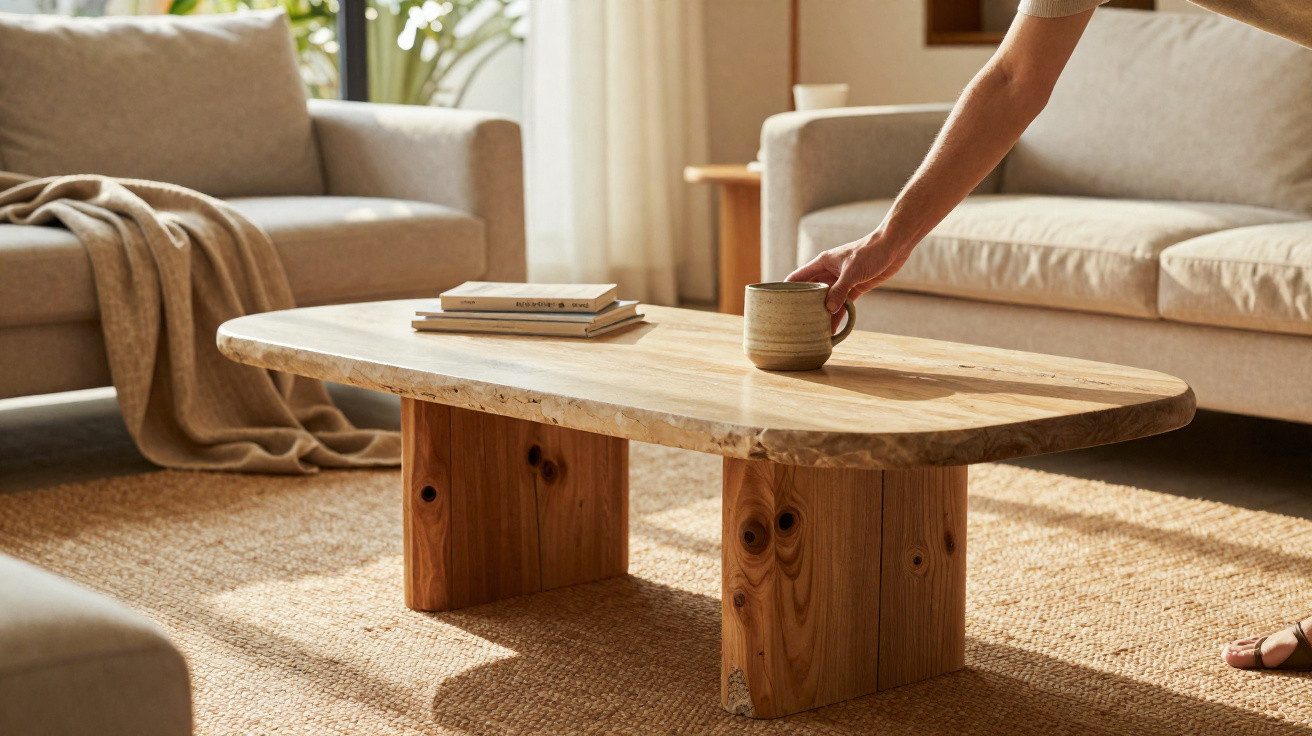
If you are looking to refresh your living room, you will soon encounter an endless range of coffee tables: glass, high-gloss finishes, marble and metal. Much of it appears sophisticated at first glance, yet can feel surprisingly impersonal in day-to-day life. This spring season, more and more interiors experts are shifting towards tables that feel authentic, are hard-wearing and create a visually calming focal point in the room.
Why the perfect coffee table is so difficult to find
The coffee table is the living room’s unofficial command centre. It ends up holding the remote control, a coffee cup, the children’s craft supplies and a laptop for working from home. Even so, it is often treated as an afterthought when buying furniture - until you realise that this one piece can completely alter the atmosphere of the room.
Because of uncertainty, many people choose familiar, sleek options: white lacquer, a glass top or a metal frame. They are practical, certainly. Over time, however, they can make a room feel more like a furniture showroom than a home.
“A good coffee table is not decoration but an anchor: it grounds the room, brings calm to the overall look and easily withstands everyday life.”
Smooth, glossy, cool: why marble and similar materials are losing their appeal
For years, the rule was simple: anyone wanting to look “stylish” bought marble, terrazzo or high-gloss surfaces. These materials look flawless in photographs. In real living rooms, though, the trend is now moving decisively away from them.
When perfection suddenly feels demanding
Highly polished finishes reflect a great deal of light; every fingerprint shows and every small knock becomes noticeable. Many people eventually find this coolness tiring. The living room should be somewhere to retreat to, not a showroom.
- Marble and terrazzo can often appear strict and formal.
- Smooth surfaces can quickly make small spaces feel “hard”.
- They require considerable care, while scratches and stains are highly visible.
As the desire for “slow living” grows, different values are taking centre stage: materials that forgive imperfections, tell stories and feel handcrafted rather than factory-made.
The desire for tactile materials
In a digitalised world, we spend all day looking at screens. At home, the wish for texture becomes stronger: you want to run your hand over expressive grain, feel slight irregularities and see edges that do not look laser-straight.
This is exactly where the new trend begins: surfaces are allowed to be imperfect. Small knots, fine cracks and rough stone edges suddenly feel valuable because they are not interchangeable.
“Character instead of perfection: the new generation of coffee tables shows its edges - in the best possible sense.”
The season’s favourite pairing: rustic wood meets a raw stone top
Interior designers and interiors influencers are rarely as united as they are on this trend: coffee tables made from solid wood combined with natural stone are replacing sterile glass and high-gloss alternatives.
Solid wood brings warmth to the room
Native timbers with visible texture are especially sought after, including:
- oiled oak with pronounced grain,
- dark walnut with a rich tone,
- elm or ash with lively figuring.
Instead of a thick lacquer coating, oil or wax is generally used. This allows the wood to breathe, gives it a warm feel and lets it age beautifully. Minor scratches become part of the patina rather than a cause for concern.
A solid wood table feels:
- visually warm and welcoming,
- exceptionally robust for everyday family life,
- timeless, as it is not tied to a short-lived trend.
Natural stone as a calm counterbalance
Stone is the second part of this successful formula - though not the mirror-smooth luxury version, but stone in its natural state. Current favourites include:
- travertine with open pores and small indentations,
- limestone with a broken edge,
- basalt or sandstone with a slightly rough texture.
These finishes make the table feel grounded and substantial. A weighty stone top conveys stability and calm without seeming ostentatious. It is also highly forgiving: water marks, a tipped-over wine glass or a child’s toy digger cause far less stress than they would on a delicate high-gloss top.
“This pairing works like a good couple: wood brings warmth, stone brings serenity - together they create a true living-room centrepiece.”
How to incorporate a new coffee table into your existing living room
Anyone setting out to buy a solid wood-and-stone table will soon face the next question: will it suit everything else? The good news is that, with a few simple approaches, this new focal point can work within an existing interior.
Balance the solidity with textiles
Wood and stone have presence. To prevent the room from feeling overly heavy, offset them with soft fabrics. Particularly effective choices include:
- a large wool or Berber rug directly beneath the table,
- linen, cotton velvet or coarse cotton cushions on the sofa and armchairs,
- a textured throw, such as knit or bouclé, casually draped over the sofa arm.
This combination makes the table feel integrated rather than hard. The eye finds contrasts: rough and soft, heavy and fluffy, cool and warm.
Choose the right size and shape
For the trend to work in everyday life, a few practical dimensions need to be right. Use the following as a rough guide:
| Criterion | Recommendation |
|---|---|
| Height | Approximately the sofa seat height, or no more than 5 cm lower |
| Distance from the sofa | Around 40–50 cm, allowing people to pass comfortably |
| Width in relation to the sofa | About two-thirds of the sofa’s length |
| Shape | Rectangular for large rooms; round or oval for smaller rooms |
For households with children, rounded corners or entirely round tops are often the better option. Many manufacturers now offer models where an organic, curved shape replaces the rigid lines of classic tables.
A piece of furniture made to last for years
A sturdy wood-and-stone table will usually cost more than a cheap chipboard bargain bought online. In return, it will generally last much longer, can be repaired, sanded and re-oiled, and will not need to be taken to the tip after three years.
Thinking long term saves money overall and conserves resources. The coffee table changes from a disposable product into a companion that records a small family history through its scratches, candle-wax residue and coffee stains.
“A good coffee table is not delicate but forgiving - and that is exactly what makes it so suitable for everyday life.”
How to adapt the trend to your style
The material combination of wood and stone can be interpreted with surprising flexibility. Three typical interior styles illustrate what this can look like:
- Simple Scandinavian: Light oak, a pale stone top and just a few accessories, such as a ceramic vase and a linen tray.
- Boho and cosy: More rustic wood, porous stone, colourful cushions, macramé and plants in terracotta pots.
- Clean modern: Dark wood, smoother stone in beige or greige, crisp lines and a small number of large decorative objects.
If you would first like to try out the look, there is no need to get rid of your old table immediately. A heavy stone bowl, a rustic wooden tray or a small side table made from natural materials can give you an initial sense of whether the style suits your home.
Care, risks and everyday practicality
Untreated or lightly oiled wood reacts to liquids. A few basic rules help to avoid frustration:
- Use coasters for glasses, particularly with red wine and dark drinks.
- Wipe up spills promptly with a lightly damp cloth.
- Re-oil the surface once or twice a year.
Small stains are difficult to prevent entirely on open-pored stone. Many owners deliberately take a relaxed approach here: the table is allowed to “live”. If that does not appeal to you, ask about pre-impregnated tops when buying, or apply a suitable stone-care product yourself.
In return, this type of furniture can cope with plenty: hot teapots placed on coasters, heavy art books, board games and putting your feet up during a series night. That is precisely what makes the trend so appealing to families and to people who genuinely use their living room - rather than styling it only for Instagram.
Comments
No comments yet. Be the first to comment!
Leave a Comment