
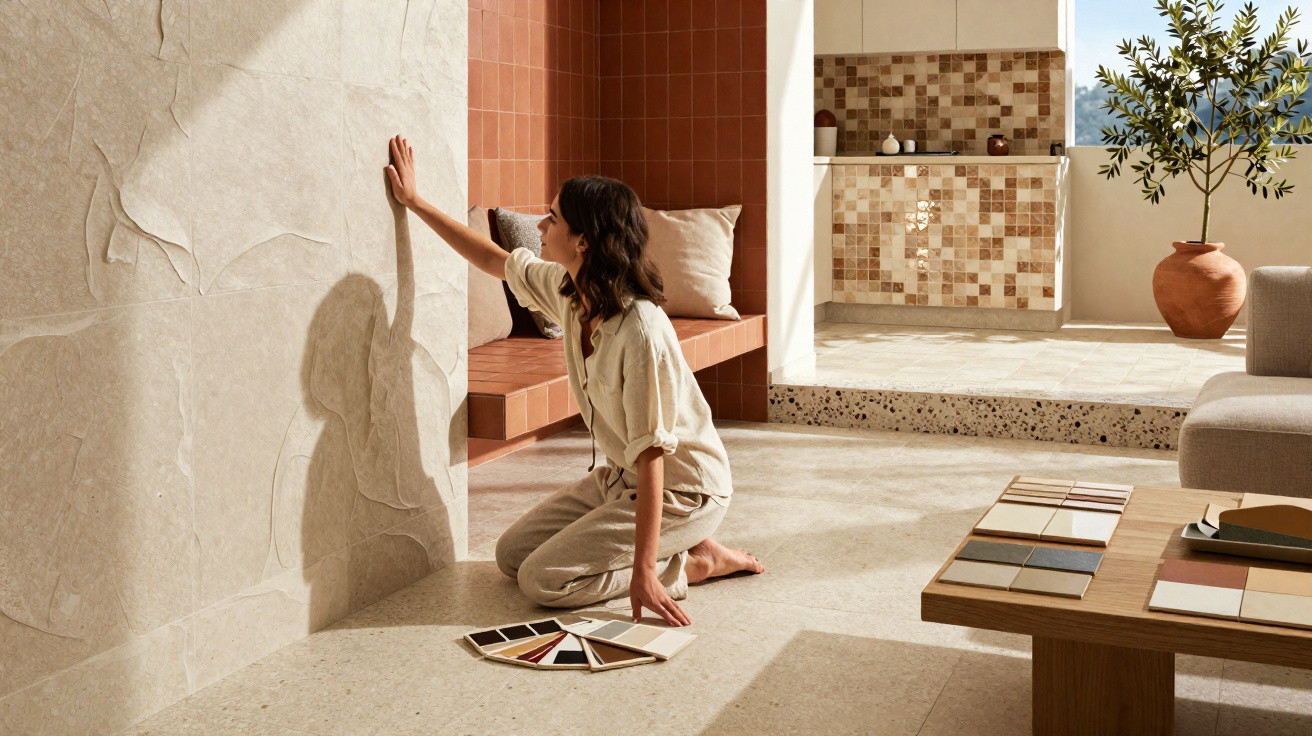
For a long time, wood-look tiles were treated as the “safe” option.
By 2026, that once-reliable look can come across as a bit flat, as interiors start to chase braver, more distinctive narratives.
Designers are increasingly stepping back from printed timber planks and leaning into surfaces with genuine depth, tactile variation and clearer cultural references. Whether it’s softened stone, reworked terracotta or glossy Moroccan tiles, the stand-out walls and floors of 2026 signal less “imitation” and more “assumed character”.
Why faux-wood tiles are losing ground
During the 2010s, wood-effect tiles surged in popularity: hard-wearing, water-resistant and highly convincing in photos. Come 2026, that polished consistency is beginning to read as slightly anonymous. Homeowners who can afford major updates are often looking for finishes that feel less like a showroom set and more like a home with a sense of history.
Homeowners are trading imitation grains for surfaces that accept their imperfections: colour variation, irregular textures, even visible repairs.
The industry has responded in step. European trade fairs this year featured noticeably fewer faux planks, replaced by more stone-effect slabs, hand-finished ceramics and richly textured ranges. The takeaway from manufacturers is unambiguous: choosing wood-look tiles now no longer signals the leading edge.
Natural stone reimagined: quiet luxury underfoot
Stone itself isn’t new, but its 2026 expression is different. Instead of relying on cold, glossy marble everywhere, specifiers are favouring gentler, almost chalky finishes that feel informal, comfortable and lived-in.
Travertine and stone-effect tiles
Travertine is central to the change. Its warm beige tones and naturally occurring voids conjure Mediterranean courtyards and timeworn Italian villas. In many schemes, genuine stone is still positioned as the premium choice, yet advances in manufacturing mean stone-effect porcelain can convince most people at a glance while staying easy to look after.
- Inside the home, it’s often laid continuously from the entrance through to the kitchen to create a calm, hotel-like atmosphere.
- Outside, it connects terraces and pools with sun-baked neutrals that weather attractively.
- In bathrooms, using one stone shade across floor and walls helps form a spa-like cocoon.
Soft travertine tones and stone-look porcelain deliver an understated, “quiet luxury” aesthetic that feels more timeless than imitation timber.
Terracotta makes a warm comeback
Once linked to rustic farmhouses and slightly dusty holiday properties, terracotta has returned with a cleaner, more intentional feel. Designers are now pairing it with slim black fittings, pared-back furniture and pale limewash walls, rather than leaning into the familiar clichés of chunky timber beams and dried floral décor.
Today’s terracotta also arrives in multiple shapes and scales: classic hexagonal tomettes, narrow bricks laid in herringbone, or large squares that can read almost like concrete from a distance. The palette runs from deep brick red through burnt orange to sandy pink.
Where terracotta shines in 2026 homes
Kitchens are one of the most popular places to use it, especially in open-plan layouts. Underfoot, terracotta brings warmth and reduces the starkness that can come with all-white cabinetry. Living spaces pick up personality from slightly uneven faces that catch the light. And on sheltered terraces, properly sealed terracotta offers a soft visual bridge between indoors and the garden.
Instead of pretending to be something else, terracotta owns its earthy tone, its slight imperfections and even its patina.
Terrazzo grows up, again
Terrazzo has cycled through several eras: from Venetian palazzi to 1970s office corridors, followed by a short, social-media-heavy comeback. In 2026, it is settling into a quieter, more refined chapter. The previously loud, multi-coloured blends are being replaced by simpler mixes with fewer, larger fragments.
Alongside traditional cement-based slabs, porcelain terrazzo-look tiles and poured resin alternatives are competing for attention. It remains popular on kitchen and bathroom floors and worktops, but designers are increasingly taking it up splashbacks and even across dining tables to create a single, monolithic surface.
Modern terrazzo walks a fine line between playful speckle and calm, graphic pattern, making it a strong alternative to faux wood in functional rooms.
Zellige: glossy tiles with real character
One of the clearest shifts is the rise of Moroccan-style zellige. Each small, hand-cut ceramic square varies slightly in thickness, glaze and shade. When installed together, the finish catches the light and appears to shimmer, as though the surface is subtly moving.
They’re showing up more often on kitchen splashbacks, shower walls and even around fireplaces. The result feels both handmade and high-end: the maker’s hand is visible, yet the gloss has an almost jewel-like richness.
| Material | Best use | Visual effect |
|---|---|---|
| Zellige tiles | Splashbacks, shower walls, feature niches | Shimmering, irregular, handcrafted |
| Stone / travertine | Floors, bathrooms, terraces | Soft, timeless, natural |
| Terracotta | Kitchens, living rooms, porches | Warm, rustic-modern, textured |
Supersized tiles for calm, continuous spaces
At the other extreme from tiny zellige squares, XXL tiles are surging. Large slabs of 100 x 100 cm or even 120 x 120 cm reduce grout lines and can mimic the look of a poured surface.
They’re especially effective in small flats, where keeping visual noise down matters. Bathrooms can appear broader when the floor reads as near-seamless. Hallways and entrances take on a gallery-like quality when finished in large-format stone or concrete-effect tiles.
Fewer joints mean fewer visual breaks, which naturally makes rooms feel larger and more refined.
Colour goes bold, but rooted in nature
The 2026 palette isn’t built around grey. Instead, the emphasis is on soft-but-assured shades drawn from clay, foliage and night skies.
Key palettes replacing faux-wood neutrals
- Softened reds with a hint of pink, used for feature floors or a single statement wall.
- Sunny yet slightly muted yellows in kitchens and utility areas to lift the mood.
- Deep navy and inky blues for dining rooms, shower rooms or bedrooms that want a more intimate feel.
- Pairings such as milk-chocolate brown with dusty rose, adding richness without looking harsh.
Rather than trying to coordinate with timber tones, many homeowners are choosing deliberate contrast: a dark blue wall against pale stone tiles, or terracotta flooring combined with cool white walls and black metal frames.
Texture and relief: walls that you want to touch
Perfectly flat, uniform finishes are starting to feel a touch clinical. Textured tiles-ribbed, 3D-printed, chiselled or hand-shaped-introduce shadow and a sense of touch. As daylight shifts, these surfaces change too, subtly altering the room throughout the day.
Manufacturers are offering ceramic wall panels with waves, flutes and geometric reliefs. When combined with understated lighting, they can turn a simple hallway or shower area into a feature zone without relying on loud colours or overly busy patterns.
Relief tiles bring character in a subtle way, especially in minimalist schemes that still want personality.
How to choose the right 2026-friendly surface at home
If you’re planning a renovation, the move away from wood-look tiles can feel a little disorientating. A useful way to decide is to begin with the atmosphere you want per room. Looking for calm? Choose large-format tiles in gentle stone shades. Want warmth and sociability? Terracotta or coloured ceramics are often a better fit. Prefer something sculptural and dramatic? Go for textured wall tiles alongside deep blues or greens.
Maintenance matters, too: real travertine needs sealing and careful cleaning, while porcelain versions cope better with spills and day-to-day family life. Zellige can take in a little moisture at the edges, which is why it tends to work best on walls rather than high-traffic floors. Terracotta can stain without treatment, although many people enjoy how scuffs and marks become part of the home’s ongoing story.
Practical scenarios and smart combinations
Picture a renovation in a compact city flat in the UK. Rather than laying grey wood-effect planks throughout, a designer might use light stone-look porcelain in an XXL format across the hallway, kitchen and living area, then keep a punch of colour for a small run of zellige on the kitchen splashback. In the bathroom, terrazzo tiles could take over on the floor, pulling key tones back into the main space.
In a larger family house, a different mix may suit: terracotta in the kitchen and boot room for warmth and durability, hard-wearing terrazzo in children’s bathrooms to disguise splashes, and calm travertine tones in the main bedroom suite. All of this still pairs well with genuine timber furniture-leaving that as the only “real wood” element in the scheme.
The advantage of layering materials like this is clear: less visual sameness, a closer match between finish and function in each room, and a more individual identity overall. Trends always carry risk, but these 2026 favourites-stone, terracotta, terrazzo, zellige, texture and bold but nature-led colour-are rooted in materials with long histories. That gives them a better chance of ageing well than yesterday’s faux forests printed onto porcelain planks.



Comments
No comments yet. Be the first to comment!
Leave a Comment