
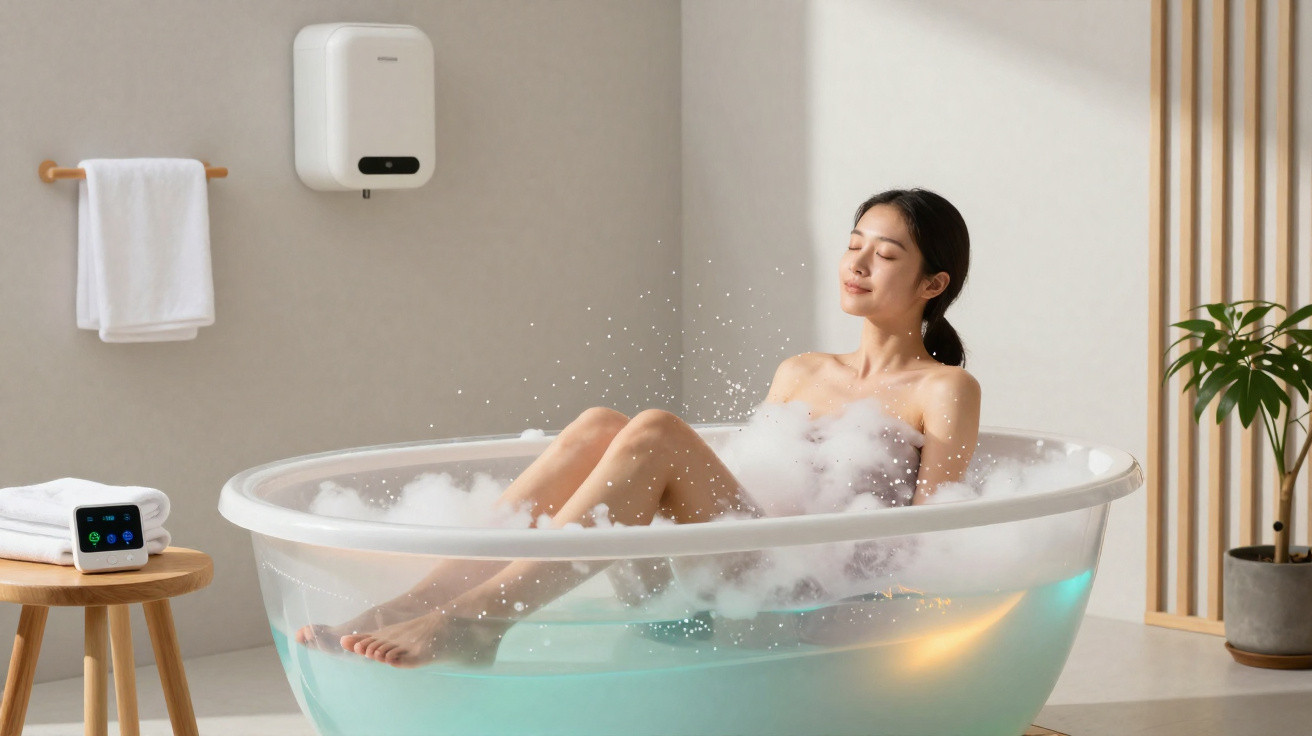
What sounds like a scene from a science-fiction film is already standing in Osaka as a working prototype: a fully automated body-washing capsule. Instead of a shower curtain and shampoo, a sealed cylinder takes over the entire wash, delivers a spa-like ambience, and keeps an eye on key health readings at the same time. Many experts see it as a potential turning point that could challenge the classic shower cubicle we have lived with for decades.
From shower cubicle to body capsule
At the centre of this development is a Japanese company based in Osaka. Its device is called “Mirai Ningen Sentakuki”, which roughly translates as “washing machine for the human of tomorrow”. The idea is simple: everyday personal hygiene should be as effortless and automated as a laundry cycle.
The capsule is spacious enough for one person to sit inside comfortably. Once the door closes, water runs in, sensors start the programme, and the machine handles everything else. No taps, no shower screen, and no tiles to scrub. In that sense, it could fundamentally reshape what we think a bathroom needs to be.
The vision: a bathroom without a traditional shower cubicle, where a smart washing capsule combines body care, relaxation and health monitoring.
How the “human washing machine” works
Microbubbles instead of a flannel
The cleaning process relies on so-called microbubbles-tiny air-and-water bubbles that are far smaller than the bubbles you would typically get in a conventional shower. The technology is already used in wellness facilities and in certain medical contexts.
- The capsule fills with water and microbubbles.
- The ultra-fine bubbles settle across the surface of the skin.
- Dirt particles and sebum loosen without harsh friction.
- The skin is cleaned gently, which may be particularly appealing for people with sensitive skin.
That means there is no need for vigorous scrubbing with a sponge or flannel. For people with skin conditions, older adults, or anyone with restricted mobility, this could be a genuine advantage.
AI adapts water, light and sound to the body
Multiple biometric sensors are built into the capsule. They measure, for example, pulse rate and other physical parameters. An AI analyses these readings in real time and adjusts the programme accordingly.
In practical terms, the machine can:
- vary the water temperature dynamically,
- regulate the pressure of water and air jets,
- shift the interior lighting from bright and energising to warm and calming,
- tailor background sounds or music to match the user’s mood.
The result is designed to feel more like a private spa pod than an ordinary shower. The goal is that someone who enters the bathroom stressed should leave it as relaxed as possible.
Clean, dry, unwind – all in 15 minutes
According to the manufacturer, the full cycle takes roughly a quarter of an hour. After the wash phase, the same capsule begins the drying step: warm air streams and directed airflow remove water from the skin, so a towel is not required.
| Phase | What happens? | Special feature |
|---|---|---|
| 1. Entry | The person sits in the capsule, the door closes | Sensors start |
| 2. Cleaning | Water and microbubbles rinse around the body | Gentle removal of dirt |
| 3. Wellness | Light, temperature and sounds are adjusted | Spa-like atmosphere |
| 4. Drying | Warm air dries the body completely | No towel needed |
With this approach, the company aims to merge three areas that are usually separate: cleansing the body, relaxation, and health checks. The capsule creates a closed environment where these elements happen one after another and, in part, in parallel.
A health monitor in the bathroom
One aspect that is particularly interesting for clinicians, care services and hospitals is that the system continuously collects data during the wash. Over time, that could make it possible to spot trends in a person’s health.
Possible examples include:
- indications of sustained stress through a consistently elevated heart rate,
- changes in circulatory stability in older people,
- programmes tailored for individuals with cardiovascular conditions.
The capsule combines hygiene, wellbeing and potential health monitoring-right in one of the most everyday places in life: the bathroom.
In the long term, such information could feed into digital patient records or be combined with wearables. That also puts questions of privacy and data security firmly in the spotlight.
Will the “washing machine for humans” come to Europe?
In Japan, enthusiasm for futuristic bathroom solutions has a long tradition. Back in the 1970s, the World Expo in Osaka showcased an early predecessor of an automated washing cabin. At the time it remained a concept. Today, modern sensors and AI make something approaching series production feel far more realistic.
Opportunities for everyday use
Across German-speaking markets, several use cases are conceivable:
- Care homes and hospitals: gentler personal care for people who cannot stand securely or grip safely.
- Luxury hotels and spas: a new wellness experience as a distinctive feature.
- Private households with a smart-home focus: tech-minded users who want to modernise their bathroom radically.
- Rehabilitation centres: a combination of hygiene and relaxation therapy.
In parallel, architects and bathroom planners could rethink the traditional bathroom layout. If the shower cubicle disappears, new open areas or alternative room concepts become possible-for instance, a bathroom where the capsule stands like a piece of furniture.
Open questions and risks
For now, it is still unclear what such a system will cost in the end, or how complex installation and maintenance will be. Just as sensitive is how the collected health data is handled.
Among the most critical issues are:
- Who stores the body data, and for how long?
- Would health insurers or employers be allowed to access it?
- How well protected are the systems against hacking?
Especially in Europe, with strict data-protection rules, this technology is likely to succeed only if manufacturers offer highly transparent solutions.
What the term “microbubbles” actually means
Microbubbles are gas bubbles in water with diameters in the micrometre range. Because they have a very large total surface area, they can bind dirt and oils particularly effectively. In rivers, for example, they can help with wastewater cleaning; in cosmetics, they are used in care baths.
For skin care, they offer several advantages:
- They can reach small skin indentations and pores.
- They work mechanically without relying on harsh chemicals.
- They usually irritate skin less than aggressive rubbing.
For children, older adults and people with sensitive skin, an approach like this may feel more pleasant than a hot shower combined with strong shower gel.
How our bathroom routine could change
The “human washing machine” fits into a broader trend: more and more parts of home life are being automated. Dishwashers, robot vacuum cleaners, smart heating-and now, potentially, fully automated body care too.
It is easy to imagine future scenarios like these: the capsule recognises the user, loads their preferred programme, links to a smartwatch, adjusts the wash to the person’s condition on the day, and-if desired-alerts their GP when readings look unusual. To some, that sounds enticing; to others, it immediately raises fears of surveillance and dependence on technology.
What is clear is this: if the concept catches on, the familiar picture of a bathroom with shower cubicle, fittings and tiled walls will come under pressure. In its place would be a central “furniture-like” unit that cleans, relaxes and monitors a person inside a sealed, protected space-part wellness pod, part medical laboratory.
Whether this development will truly reach the mass market in German-speaking regions remains uncertain. But the Japanese capsule shows just how radically even something as ordinary as showering can change when AI, sensors and design work together.




Comments
No comments yet. Be the first to comment!
Leave a Comment