
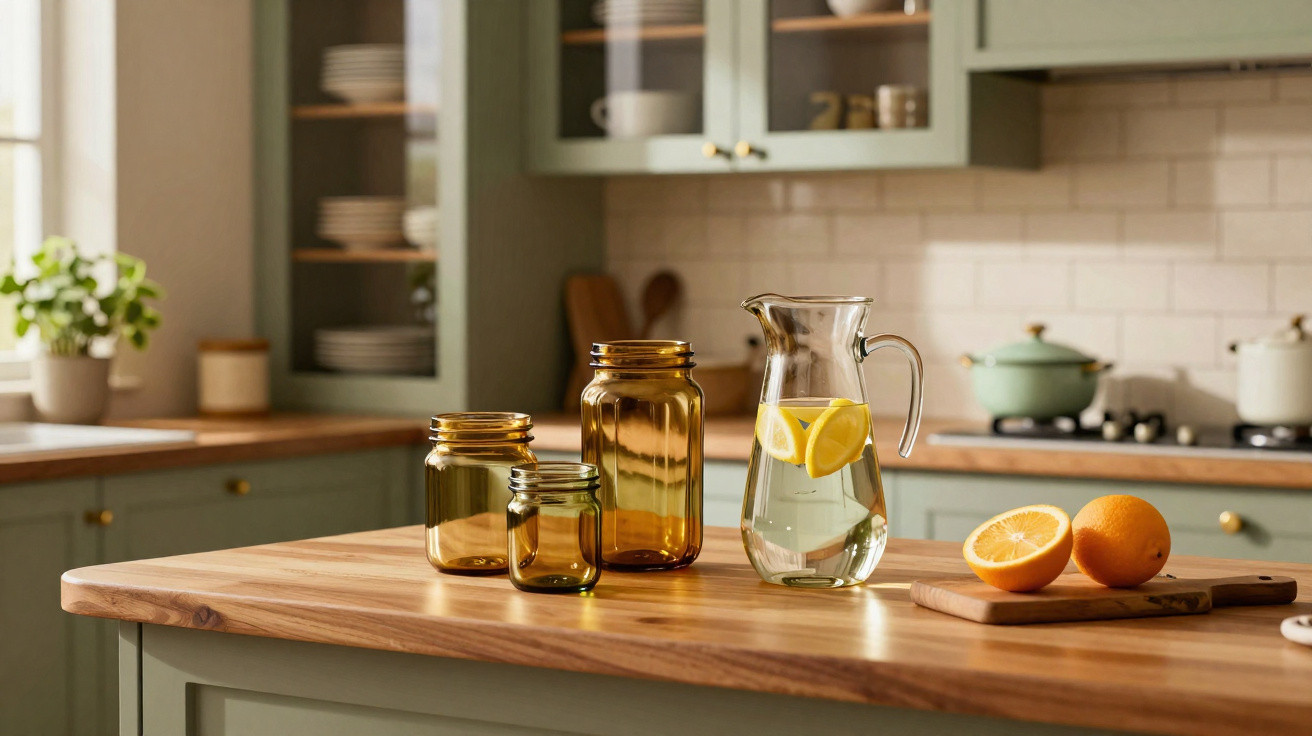
White Metro tiles, sterile stainless-steel surfaces, smooth walls with no personality: anyone renovating a kitchen has often had enough of that look. Designers and tradespeople have been reporting a clear shift as early as 2026: the splashback is meant to become the focal point - without a full refit and without a five-figure spend. And one comeback material from the 1970s is quietly rising to the top.
Smoked glass instead of Metro tiles: what’s driving the new trend
The new number one for kitchen walls is smoked glass, often also referred to as tinted glass. For decades it was seen as a leftover from dusty living rooms and dimly lit bars. In its current form, though, it looks far more refined: fresh ranges lean into understated shades, from light anthracite and warm bronze through to semi-transparent black.
The result is transformative. A kitchen with country-style fronts can suddenly feel more contemporary without losing its character. A completely white, pared-back kitchen gains depth and warmth rather than reading as clinical. That blend of timelessness with a hint of retro hits the spot for anyone who doesn’t want to chase a new craze every three years.
“Using smoked glass as a kitchen splashback strikes the balance: a touch of vintage, but with a crystal-clear contemporary look.”
Plenty of people are simply tired of plain white walls and large expanses of stainless steel. That’s why interior designers are increasingly treating the splashback like a picture: a coloured, subtly reflective surface that catches light without glaring. Compared with classic tiles, the look is quicker to change, and the space tends to feel more open.
How smoked glass changes the room visually
Smoked glass works like a soft filter between the light source and the wall. It reflects, but not as sharply as a mirror, and it absorbs some light without genuinely making the room feel darker. In narrow kitchens in particular, it can create a surprisingly strong sense of depth.
Anyone cooking in a typical fitted kitchen with a single run of units knows the feeling: you can seem to be standing right “up against the wall”. A continuous sheet of glass makes that wall appear to sit further back. Reflections from under-cabinet lighting or windows bring the surface to life, without becoming distracting.
- In small kitchens, the wall can seem to recede.
- In very bright kitchens, smoked glass softens harshness and glare.
- In darker kitchens, it creates an intimate, almost lounge-like mood.
This is especially useful for anyone who treats the kitchen as part of the living space, for example in open-plan layouts. In the evening, under indirect lighting, the splashback can look more like a stylish bar feature than a purely functional zone.
Real-life use: easy to clean, durable and surprisingly versatile
Looks alone don’t cut it in day-to-day cooking. Here, smoked glass scores in a very practical way: the surface is smooth, sealed and grout-free. Oil, tomato sauce or splashing water simply sit on the surface rather than soaking in.
For cleaning, you usually only need:
- a microfibre cloth,
- a little glass cleaner or mild washing-up liquid,
- a quick wipe over - done.
Fingerprints do show up on darker tones, but nowhere near as much as they do on high-gloss stainless steel. Limescale marks are also less noticeable than on clear glass, because the tint visually tones them down.
For safety, it matters that almost all suppliers use toughened safety glass (or equivalent single-pane safety glass). The material easily copes with heat behind a ceramic or induction hob and is far more impact-resistant than many people expect. With gas hobs, you should follow the manufacturer’s guidance, as a little more distance is often required.
“Smoked safety glass combines design ambition with everyday practicality - without specialist cleaning products and without worrying about heat.”
Another advantage is how much the colour range has expanded. Glaziers now offer, in some cases, hundreds of graded shades. That makes it possible to match the splashback precisely to fronts, worktops or flooring - from cool grey and warm taupe to near-black glass with a slight translucency.
How to integrate a glass splashback seamlessly into your kitchen
The key is contrast. The sleek, cool feel of glass needs partners with texture and tactility. These combinations tend to work particularly well:
- Rustic wood kitchen: smoked glass in light grey or bronze visually lightens the mass of timber and adds a modern note.
- Strictly white kitchen: a bronze-tinted glass splashback plus brass or gold handles brings warmth and a more homely feel.
- Dark, small kitchen: deep smoked glass can still work if the worktop and wall units stay light, and strong LED strips are fitted under the wall cupboards.
Practical rules of thumb for a balanced plan:
- Pair very dark glass shades only with powerful under-cabinet lighting.
- Include at least one larger light surface (worktop or fronts).
- Bring in wood or warmer finishes so the kitchen doesn’t feel too cold.
- Plan sockets in the glass area precisely in advance, as cut-outs are difficult to change later.
Mini renovation: big impact without a full refit
If you want to refresh the look of an existing kitchen, you don’t need to rip everything out. Smoked glass is ideal for targeted upgrades:
- just as a strip behind the hob,
- as a vertical panel next to a window,
- as a continuous run between wall and base units above the sink area.
Many manufacturers sell pre-prepared panels that can be screwed in place or mounted on rails. In rented homes, that means you can, in theory, return the kitchen to its original condition. If you’re not sure you’ll love the look long-term, it can be sensible to try lower-cost panels with a glass-like finish first, before ordering made-to-measure safety glass.
Costs, risks and what to watch during planning
Compared with large-format natural-stone cladding, glass often comes out cheaper - but it’s usually more expensive than basic tiles. The final price depends on thickness, glass type, special cut-outs and installation.
Typical cost drivers include:
| Factor | Impact on price |
|---|---|
| Glass thickness and safety glass | higher safety, slightly higher price per square metre |
| Shade and coating | special colours or metallic effects increase the cost |
| Cut-outs for sockets | each cut-out adds extra labour |
| Installation method | glued looks cleaner; screwed is usually cheaper and reversible |
There is a real risk if measurements are off: if a socket cut-out is even a few millimetres out, the fitting may no longer sit correctly. Ideally, installation should be done by a specialist - or at least measured jointly with a glazier.
Colour is another consideration. On small samples, shades often appear noticeably lighter. On a large surface under different lighting, the glass can quickly look darker. If you’re uncertain, it’s best to order several sample pieces and hold them up on the wall in your own kitchen.
Why this trend is likely to outlast other kitchen hypes
Many kitchen fashions of recent years - from loud coloured fronts to extreme concrete looks - have divided opinion. Smoked glass sits in a different space. It feels premium without shouting; it suits both country-style kitchens and minimalism; and if you ever want to change it, you can swap it out without touching the layout.
There’s also the push for longevity. Anyone investing several thousand pounds in a kitchen often wants choices that will still feel right in ten or fifteen years. A tinted glass surface tends to age far more slowly, visually, than a bold pattern or a highly specific trend colour on the doors.
The psychological effect is interesting too: the gentle reflection makes the kitchen feel more alive, because light, plants or decorative objects appear within the surface. At the same time, the room stays visually ordered, as the panel remains continuous and calm. That appeals to many people who have grown tired of open shelving and perpetually cluttered worktops.
Practical examples and combination ideas for 2026
If you’re considering updating your kitchen in 2026, these tried-and-tested scenarios can be useful reference points:
- City flat with period charm: white shaker-style doors, an oak worktop, bronze smoked glass, black tap - a mix of classic and modern.
- Loft with a concrete floor: matte-black base units, a light quartz worktop, a deep anthracite glass splashback, plus wooden shelves above to add warmth.
- Small fitted run in a new-build: handleless, very plain light-grey fronts, light taupe smoked glass, a strong LED strip - it reads larger and more premium than the footprint suggests.
Across all versions, the same principle applies: the glass splashback should never be the only special feature, but it also shouldn’t have to compete with too many other statements. One, at most two, strong elements are enough - for example glass plus distinctive handles, or glass plus striking pendant lights.
Anyone who enjoys planning details and takes lighting seriously will find that smoked glass in 2026 offers a way to elevate kitchens beyond the usual. Not loud, not brash, but clean and composed - exactly what many people want after years of extreme kitchen experiments.


Comments
No comments yet. Be the first to comment!
Leave a Comment