
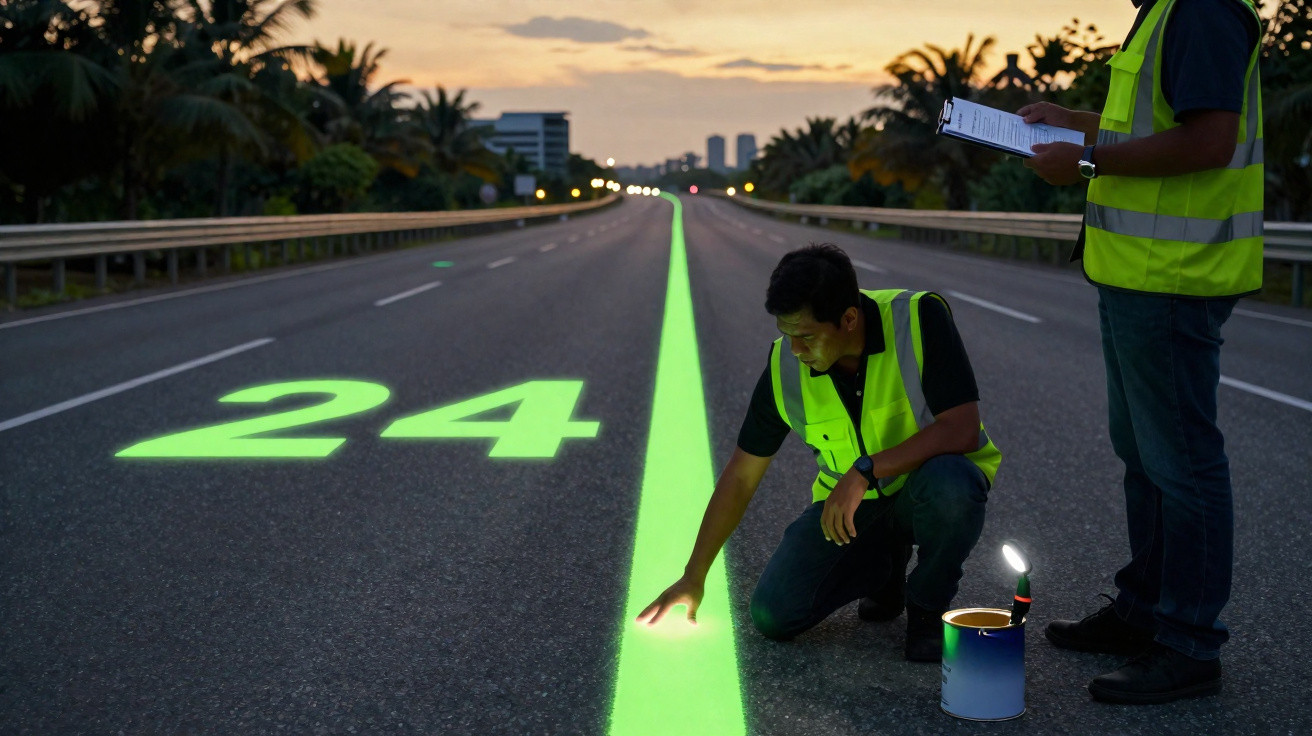
In a suburb of Kuala Lumpur, Malaysia turned an ordinary stretch of road into a high-tech showcase: lane markings that absorb sunlight in the daytime and glow on their own after dark. It looked tailor-made for social media as well as transport policy. A few months later came the sharp reality check - too expensive, too many unanswered questions, and the project suddenly in doubt.
A 245-metre glimpse of tomorrow’s roads
The trial took place on a rural road near Semenyih in the state of Selangor. Rather than relying on conventional street lighting, the highways authority tested a different approach: applying special photoluminescent paint to road markings. In daylight the carriageway appears largely normal, but once the sun sets the lines begin to emit light.
The pilot covered a 245-metre section at the junction of Jalan Sungai Lalang and Jalan Sungai Tekali. In total, around 490 metres of glowing markings were laid down - including on bends and at particularly difficult-to-see points.
The promise: improved safety on pitch-black routes, no electricity use, and fewer costly street lamps in remote areas.
Malaysia’s highways authority was careful to frame the work not as a gimmick, but as a genuine road-safety test. Minister Alexander Nanta Linggi said the markings could remain visible for up to ten hours - and that even in rain there was still a noticeable glow. The aim was a familiar problem for many countries: poorly lit rural roads where simple white lines offer barely any guidance at night.
Why the idea attracted global attention
Glowing lane markings are not a completely new idea, yet they have mostly appeared in pilots rather than widespread roll-outs. Years ago, the Netherlands drew headlines with the “Smart Highway” project by Studio Roosegaarde and Heijmans. There, so-called “Glowing Lines” charged in daylight and lit up at night for up to eight hours along a test section.
Malaysia adopted the same principle, but tied it more directly to an everyday challenge: poor visibility on unlit rural roads. In the first few weeks, many drivers reported favourable impressions. On social media, users praised how much easier it was to read the roadway - especially in places that had previously been completely dark.
- No poles, no lamps - just glowing lines
- Guidance even in rain, without any additional power
- A fast, highly visible effect for road users
- A strong signal: “The state is investing in modern infrastructure”
Politicians were quick to embrace the upbeat response. It soon became clear the plan was not meant to end with a single stretch of road.
Expansion plans: from a test stretch to a nationwide solution
As early as February 2024, Selangor announced it would distribute the glowing markings across 15 additional locations - spanning all nine districts. The programme envisaged roughly 15 kilometres of such markings, including in Sepang, Kuala Langat and Petaling. The budget envelope was around 900,000 Malaysian ringgit.
Other states followed suit. Johor identified 31 roads where the new material was to be trialled. In Batu Pahat, for example, a 300 metre section on Jalan Paloh J16 was planned. What had started as a niche idea was beginning to look like a genuine infrastructure trend.
At the same time, engineers and finance teams were sharpening their pencils behind the scenes. Even then, one thing was becoming obvious: the effect was real, but the technology was anything but cheap.
The cost brake: 20 times more expensive than normal paint
Photoluminescent paint is a high-tech product. It contains pigments that store light and release it gradually. That is precisely what makes it useful - and costly. The Malaysian government published figures: the specialist paint costs around 749 ringgit per square metre. By comparison, standard road-marking paint is about 40 ringgit per square metre.
That put the glowing markings at almost twenty times the price of the standard option - before durability and maintenance had even been settled.
A friendly vision of the future quickly became a classic infrastructure calculation: Will the material last long enough? How often will it need repainting? What damage will tropical rain, heat and heavy goods traffic cause? And can it be deployed across thousands of kilometres of rural roads without overwhelming public budgets?
In late autumn 2024, the political response arrived - and it was sobering.
The statement that changed everything
In November 2024, Deputy Minister of Works Ahmad Maslan told Parliament with unexpected bluntness that the costs were too high, and that continuing the glowing markings was therefore “probably” off the table. Even more sensitive was his second point: internal tests had not satisfied the ministry’s experts.
Those remarks flipped the storyline. The “road of the future” became, once again, a straightforward pilot that had lost out on the metrics that matter in practice: value for money, performance and scalability. Positive feedback from motorists was not enough to persuade technical decision-makers.
As with many new transport technologies, the pattern is familiar: an idea can be compelling, generate media attention and work in the short term - and still fail when maintenance, standards and long-term budgets do not align.
What the experiment still achieved
Even if a major roll-out does not happen, the underlying problem remains: road authorities worldwide are looking for ways to make markings more visible at night and in poor weather. On motorways and in areas without continuous lighting, it can come down to split seconds in which drivers must pick out lane boundaries.
In Japan, for instance, the National Institute for Land and Infrastructure Management examines in detail how the quality of road markings can be measured and maintained. Brightness, reflectivity and wear - all of these help determine how safe a road is.
The Malaysian trial makes two points particularly clear:
- Technical innovation in road building can generate huge public attention.
- Without robust evidence on cost-effectiveness and durability, it stays stuck at the pilot stage.
What sits behind the glowing paint
Photoluminescent paints typically use inorganic pigments that absorb energy from sunlight or artificial light, then release it later as a faint glow. The brightness decreases over time, which is why the initial effect after sunset often looks much stronger than the remaining glow in the early morning hours.
For road traffic, what matters is not the “wow factor” but dependable, high visibility over many hours - in rain, fog and contamination from tyre wear. That is where the technology becomes demanding: the paint layer must be tough, must not wear away too quickly, and has to retain its glow for years.
There is also a standards problem. Even if the markings do glow, clear benchmarks are needed to define when they count as “visible enough”. Without minimum requirements for brightness and service life, it remains difficult to justify budget decisions.
Where glowing stripes could still have a chance
The concept is not completely abandoned worldwide. Niche uses where the higher cost may be acceptable remain plausible, such as:
- short, high-collision bends on rural roads
- cycle paths where column lighting is not desired
- footpaths in parks or nature reserves with light-protection rules
- temporary sections at night-time roadworks
In these settings, limited lengths can curb costs while the safety or comfort benefit remains tangible for users. At the same time, they allow better durability and maintenance data to be gathered than a one-off trial can deliver.
For countries such as Germany, Austria or Switzerland, there is an additional question of how such solutions could be fitted into existing rulebooks. Standards for marking widths, reflectivity values and winter maintenance matter greatly where gritters and snowploughs operate. A glowing paint that gets scraped off after the first winter would stand little chance.
The Malaysian case therefore offers a valuable reality check: future-facing ideas in road construction must do more than look impressive. They have to work day-to-day - affordably, maintainably and in line with standards - or they remain a brief glow in the dark.





Comments
No comments yet. Be the first to comment!
Leave a Comment