
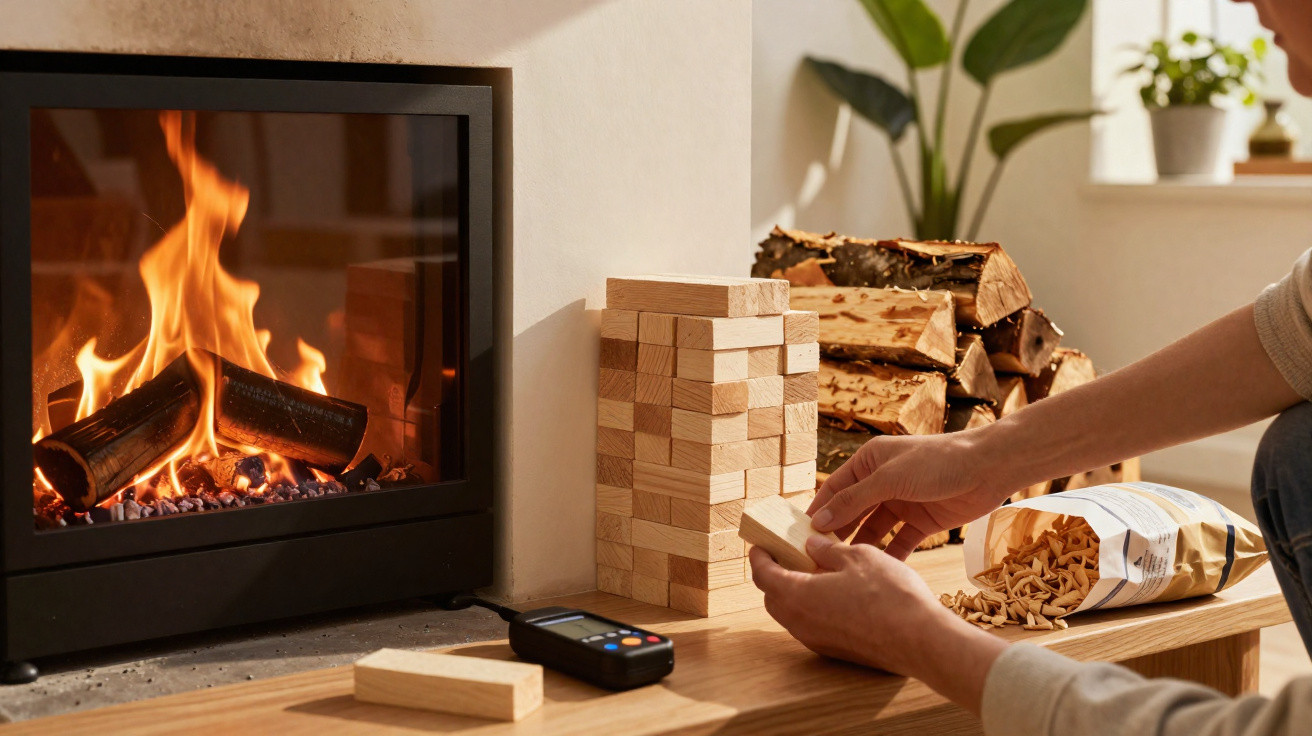
DIY stores and online retailers are currently buzzing about a particular fuel: heavily compressed wood briquettes that are said to deliver several times the heating output of traditional logs. What’s the technology behind them, how do they perform day to day – and who really benefits from switching?
What’s behind the new high-performance wood briquettes
These products aren’t standard split logs. They are highly compacted wood briquettes made from sawdust and wood shavings. Such by-products are produced anyway in sawmills and joinery workshops, then pressed under high pressure into sturdy, uniform “fuel sticks” – without any chemical additives.
Under very high pressure, extremely dense briquettes are formed with little residual moisture and a high energy content per piece.
At their core, they differ from conventional firewood in three ways: far lower water content, much greater density, and a very consistent composition. That combination is what leads to the noticeably stronger heat output in a stove or fireplace.
Why these briquettes can produce up to four times more heat
Moisture: the decisive difference
Standard firewood is usually considered “dry” when its moisture content is around 20 percent. Freshly cut wood can easily reach 40 to 50 percent and then tends to smoke rather than heat. These newer briquettes are typically below 10 percent moisture.
- Freshly cut wood: up to 50 % water
- Well-seasoned firewood: about 20–30 % water
- Wood briquettes: usually under 10 % water
Less water means the stove doesn’t have to spend energy evaporating moisture first; instead, more of the combustion energy can go straight into the room. The flame also burns hotter and more evenly.
High density, long burn time
During pressing, most of the air is driven out and the material is compacted heavily. That means that, volume for volume, a briquette contains far more wood mass than a similarly sized log.
As a result, a single briquette can provide as much energy as three to four classic logs. In everyday use, that shows up as longer burn times and a noticeably warmer room, without the need to keep topping up the fire.
Steady heat with fewer fluctuations
Because each briquette is made to the same recipe, it tends to deliver very consistent warmth. A mixed stack of woodland logs can vary widely in calorific value: sometimes dense trunk wood, sometimes softer branches, sometimes still too damp. That can cause temperature swings and requires more frequent adjustment of the stove.
Many users report that two to three briquettes are enough to maintain a stable, comfortable temperature for an entire evening.
Everyday benefits: cleaner, more space-efficient, more convenient
Less mess, less work
One advantage that many people only notice after switching is how much cleaner briquettes are. There’s hardly any bark dropping off, no insects, no musty pieces, and significantly less dust when stacking.
- Less ash, so the ash pan needs emptying less often
- Fewer soot deposits in the flue
- Lower risk of chimney fires caused by glazed soot
If you don’t want to saw, split, and stack multiple cubic metres of logs every year, briquettes offer a convenient alternative. They arrive ready for the stove, don’t need a year of drying time, and are easier to store even in smaller flats.
Environmental aspects: made from waste wood instead of new felling
Because briquettes are produced from sawdust and offcuts, no additional trees need to be felled specifically for them. They make use of what the timber industry produces anyway, easing pressure on forests and reducing waste.
Their low moisture content also means they burn hotter and more completely. Compared with damp or low-quality firewood, this can reduce emissions of fine particulates and unburnt gases. In densely built-up residential areas, that can noticeably improve local air quality.
Less storage space, more energy
Another point that appeals to many city dwellers is the much higher energy density per cubic metre compared with logs. One cubic metre of briquettes replaces roughly four cubic metres of conventional firewood.
If you only have a small cellar or garage, briquettes can quickly free up several square metres of storage space.
How to use the new briquettes correctly
Lighting them properly: step by step
In practice, getting started is similar to a familiar wood fire, with a few useful tweaks:
- Place two to three eco firelighters or wood wool lighters in the stove.
- Put a little kindling or a smaller briquette on top.
- Open the primary air fully and light the firelighters.
- Wait until you have a stable flame.
- Only then add one to two large briquettes – don’t cram the firebox full straight away.
Important: briquettes expand slightly as they burn and produce very intense embers. It’s best to begin with smaller quantities until you know how they behave in your particular stove.
Check safety and compatibility
Not every stove can handle every heat output. The documentation for your fireplace or wood-burning stove usually states whether wood briquettes are an approved fuel. If you’re unsure, speak to your chimney sweep – they’ll know local rules and the limits of your appliance.
Overheating can occur if too many briquettes are loaded at once while all air vents are left wide open. In that case, stove and flue-gas temperatures can rise very quickly. Checking the built-in thermometer, or fitting a stove thermometer, helps you stay within the safe range.
Comparison with classic firewood
| Feature | Wood briquettes | Logs |
|---|---|---|
| Energy content per volume | very high | medium |
| Storage space | very low | high |
| Moisture | under 10 % | 20–50 % depending on drying |
| Cleanliness | hardly any mess, no pests | bark, insects, sometimes mould |
| Preparation | ready for the stove | often sawing, splitting, long drying |
In terms of price, briquettes per tonne are often slightly more expensive than loose logs bought locally from a farmer or sourced yourself. However, the much higher yield per kilogram frequently balances that out. People who compare total use across a full heating season often find they actually spend less.
Typical mistakes and how to avoid them
People new to briquettes often run into the same issues. Three points come up repeatedly:
- Too much at once: the stove is overloaded, the system overheats, and the chimney sweep isn’t impressed.
- Incorrect air control: the primary air is reduced too early, so the briquettes smoulder instead of burning strongly.
- Poor storage: cardboard and wrapping removed, briquettes left in a damp corner of the cellar – they absorb water and lose performance.
If you store briquettes dry and well ventilated, provide enough air during the lighting phase, and follow the manufacturer’s guidance, you’ll get substantially more out of the fuel.
Who benefits most from switching?
Households that use their stove to genuinely heat the home – not just for ambience – stand to gain the most. Anyone with a small to medium-sized flat, limited storage space, and no desire to chop logs is clearly in the target group.
Briquettes can also be appealing for older people: they weigh less than large logs, stack more neatly, and involve less physical effort. In many areas, commuters use them to bring the house up to temperature quickly after work, without needing to keep feeding the fire late into the night.
What to look for when buying
There are now plenty of suppliers on the market. A quick look at the product label helps you choose:
- Information on residual moisture (ideally under 10 percent)
- 100 percent natural hardwood or mixed-wood residues
- Certifications for sustainable forestry are a plus
- No additives or binders listed
If you start by testing a small quantity, you can see how the briquettes behave in your stove and estimate realistic consumption. Many retailers offer trial packs or half pallets before you commit to stocking up for an entire winter season.


Comments
No comments yet. Be the first to comment!
Leave a Comment