
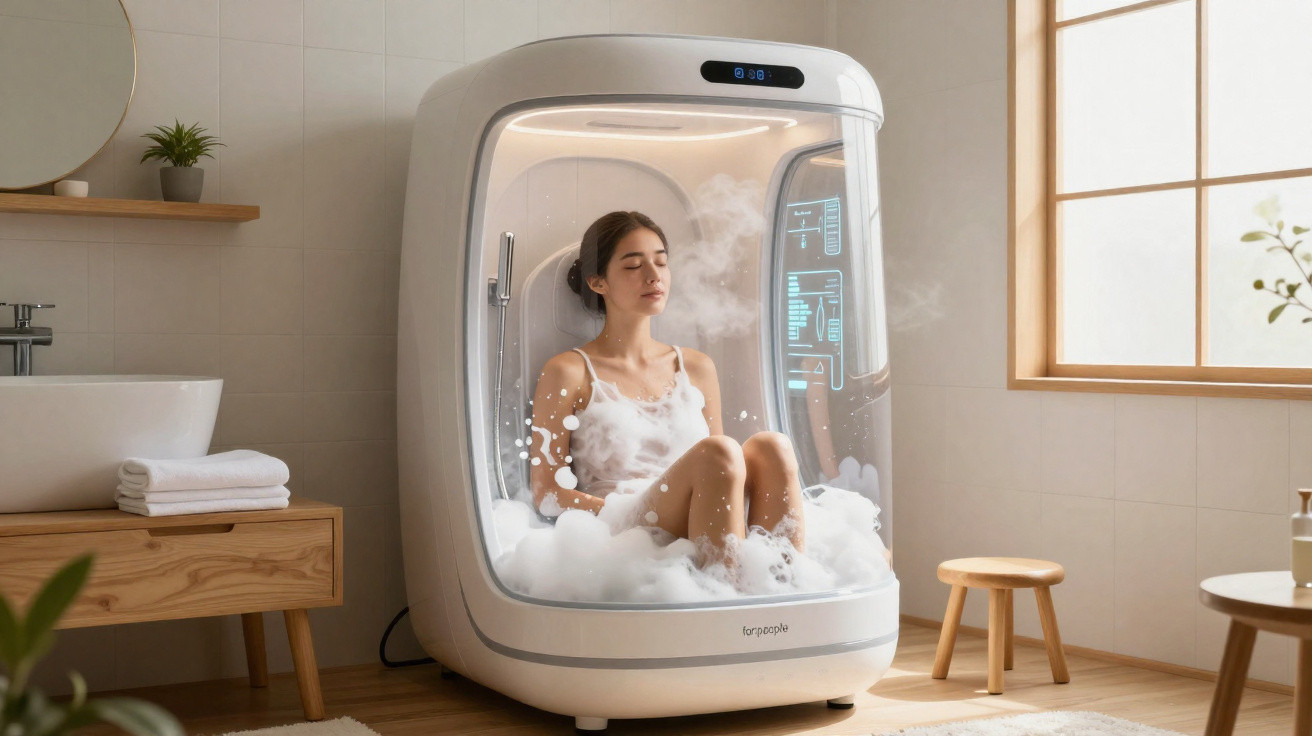
A Japanese company wants to make the daily shower as effortless as running a wash cycle. Instead of a shower head, shampoo and a towel, a fully automated capsule is designed to wash and dry the whole body and even read health data - in around 15 minutes.
What’s behind the idea of the “human washing machine”
In Osaka, the firm Science Co. is developing a device that feels like part spa pod, part high-tech gadget and part miniature wellness suite. The project is called “Mirai Ningen Sentakuki”, which roughly translates as “washing machine for the human of the future”.
At its heart is the plan to move the entire washing routine into a sealed capsule. You sit down inside, recline, and the system does the rest. No bending down, no lathering up, no towelling off.
"The capsule is intended to automate the entire process from stepping in to leaving with a clean, dry body - all in a single run."
The concept itself isn’t completely unprecedented. Back at the 1970 World Expo in Osaka, an early prototype of an automated human washing station was shown. At the time it remained more idea than reality. Today, advances in sensors, microbubble technology and artificial intelligence make the product far more plausible.
How the futuristic shower capsule works
Step in, sit down, start the machine
The “human washing machine” is built as a closed capsule in which the user sits comfortably. Once the lid is shut, an automated sequence begins:
- The water supply starts and is regulated
- Microbubbles are injected into the water
- Special nozzles take over cleansing the body
- Sensors continuously track vital data
- A built-in drying phase runs at the end
According to the developers, the full cycle is meant to take about 15 minutes. The idea is that you step out already dry - making a towel, at least in theory, unnecessary.
Cleaning with microbubbles instead of scrubbing with a flannel
The central component is a method based on extremely fine air bubbles. These microbubbles are much smaller than normal bubbles in water and are intended to penetrate tiny creases and contours of the skin.
They are meant to lift dirt particles and sebum away gently. That reduces the need for vigorous rubbing, which can irritate the skin. Variations of this approach already appear in some wellness treatments and premium whirlpools, but here it is applied consistently to everyday body care.
"Microbubbles are supposed to cleanse the skin without the person needing to do much themselves - the body is treated, in a sense, like a delicate textile."
Shower, spa and health check in one device
Sensors track how the body is doing
The team isn’t focusing on cleanliness alone. Inside the capsule are biometric sensors that measure heart rate, among other physical parameters. Throughout the washing phase, the system collects data.
Those readings feed into an AI that continuously adjusts the session. The goal is to create an experience that feels as comfortable and personalised as possible.
Water, light and sound - everything adjusts automatically
Depending on the user’s condition, the capsule is designed to control several elements:
- Water temperature: Warmer or cooler depending on stress level or personal preference.
- Water-jet pressure: Softer when the user is more sensitive, stronger when a massage-like effect is desired.
- Interior lighting: Calming colours or brighter light, aligned with the current mood.
- Soundscape: From gentle ambient noise to relaxing music, triggered by analysed data.
In this way, the wash becomes a tailored mini spa appointment. You get clean, and at the same time the system aims to reduce signs of stress and help the body settle.
"The capsule attempts to ‘read’ a person’s condition and adjust the interior environment like a digital wellness coach."
A new take on daily personal care
From a quick shower to a guided ritual
The developers’ aim is straightforward: make the everyday bathroom routine quicker, easier and more pleasant - without sacrificing hygiene. Instead of a five-minute shower followed by hurried drying, everything runs as one unified programme.
The twist is that, while you relax, the system gathers health data in parallel. In future, such information could, for example, indicate whether someone is persistently tense, recovering poorly, or whether certain vital signs are shifting over time.
That means the capsule merges three areas that have typically been separate:
- Cleansing the body
- Relaxation and wellbeing
- Monitoring key physical indicators
What the technology could mean in day-to-day life
Whether these capsules will ever become common in typical homes remains entirely unclear. More likely early settings include hotels, wellness centres, premium care homes or hospitals - places where comfort, hygiene and health oversight matter at the same time.
Later on, accessible bathrooms could benefit in particular: people with limited mobility would not need to turn in the shower, bend down or balance on slippery tiles. The capsule would take over many of the physically demanding steps.
Opportunities, limits and open questions
Benefits for comfort, hygiene and health
From today’s perspective, several potential advantages stand out:
- Comfort: Minimal physical effort, with an automated process.
- Time: Washing and drying in one enclosed, fixed sequence.
- Skin friendliness: Gentle microbubbles instead of harsh scrubbing.
- Monitoring: Early clues to changes in vital signs.
- Wellness factor: Individually controlled lighting and sound for greater relaxation.
At the same time, major questions remain: How expensive will the unit be to buy? How much energy and water does the technology actually consume? Who is responsible for managing sensitive health data? And psychologically, how does it feel to place that level of trust in a machine?
Why the classic shower won’t disappear overnight
Even if headlines talk about the shower cubicle “vanishing”, a standard shower is unlikely to leave our bathrooms any time soon. It is inexpensive, durable, familiar and requires comparatively little technology.
The “human washing machine” is aimed more at a premium segment and specialist use cases. It points to where bathrooms, wellness and digital health monitoring could be heading as sensors and AI become more embedded in everyday life.
What users should know about the new technology
Anyone looking into concepts like this quickly runs into terms that need unpacking. Microbubbles, for instance, are tiny gas bubbles formed in water; because they have a very large surface area, they can bind dirt particles effectively. They are generally considered relatively kind to the skin, but they are not suitable for every medical context - for example, certain skin conditions where a dermatologist provides strict guidance on cleansing.
Capturing vital data may sound convenient, but it comes with responsibility. If measurements are stored long-term, operators must meet stringent data-protection standards. For users, it can be sensible to treat such devices as a complement to medical check-ups rather than a replacement.
Another interesting point is how the capsule could be combined with other technologies. Links to smartwatches or fitness trackers, for example, could help bring workload, sleep and recovery together into a broader picture. In that scenario, morning washing would become one component of a wider approach to health management - almost incidentally, while the system gets you clean.




Comments
No comments yet. Be the first to comment!
Leave a Comment